

96P/Machholz has been observed by SOHO’s LASCO experiment several times.
This particular comet does not get as close to the Sun as the Kreutz group and this
probably saves it from complete disintegration. Probably the most famous Kreutz
comet was C/1965 S1 (Ikeya-Seki) which passed close to the Sun in September 1965
and broke into three pieces shortly before perihelion.
Jutzi et al. (2017) have computed the critical specific impact energies (in [J kg
À1 ])
needed to produce a complete disruption of a cometary nucleus by high velocity
impact. The specific impact energy of a collision is defined as
Q col ¼
1
2
μ r v
2
col
M N þ m p
À
Á
ð7:1Þ
where
μ r ¼
M N m p
M N þ m p
À
Á
ð7:2Þ
and M N is the mass of the nucleus, m p is the mass of the projectile and v col is the
collision velocity. The critical specific impact energy for disruption is dependent
upon the impact velocity which in the asteroid belt can be 10–15 km s
À1 . Using
scaling relations from Jutzi et al. (2017) and Holsapple (1993) and extrapolating the
impact rate from Teanby, we get a lifetime against complete disruption by impact in
the Earth-Jupiter region of 10
5
–10
6 orbits for a 2 km sized nucleus. This is considerably longer than the disruption rate calculated by Belton (2015) from observations
of fragmentation events.
To summarize, the timescales for comet loss arising from proposed mechanisms
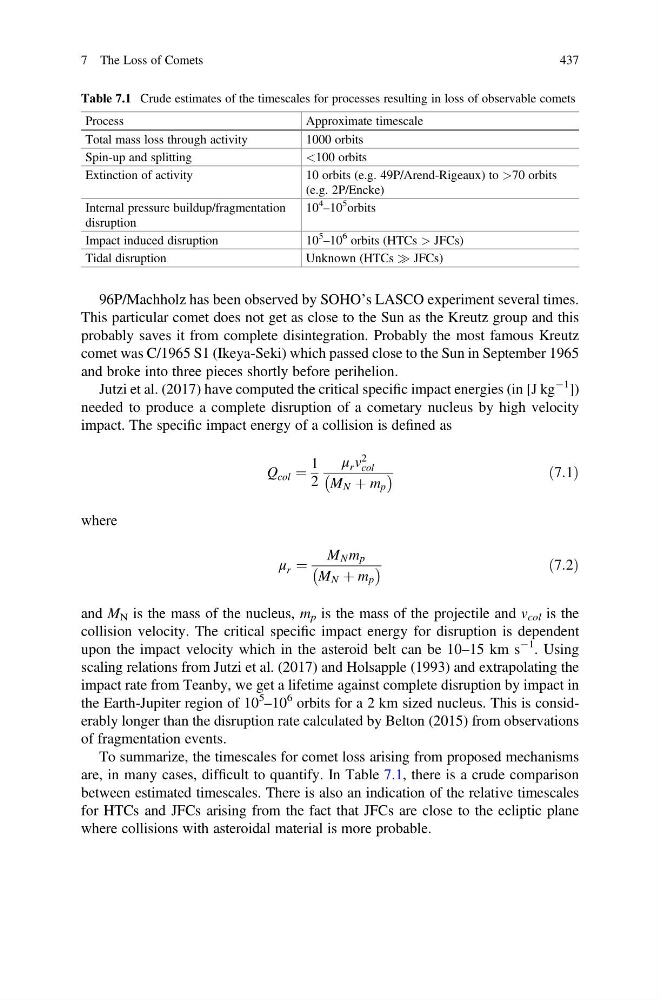
are, in many cases, difficult to quantify. In Table 7.1, there is a crude comparison
between estimated timescales. There is also an indication of the relative timescales
for HTCs and JFCs arising from the fact that JFCs are close to the ecliptic plane
where collisions with asteroidal material is more probable.
Table 7.1 Crude estimates of the timescales for processes resulting in loss of observable comets
Process
Approximate timescale
Total mass loss through activity
1000 orbits
Spin-up and splitting
<100 orbits
Extinction of activity
10 orbits (e.g. 49P/Arend-Rigeaux) to >70 orbits
(e.g. 2P/Encke)
Internal pressure buildup/fragmentation
disruption
10
4
–10
5
orbits
Impact induced disruption
10
5
–10
6 orbits (HTCs > JFCs)
Tidal disruption
Unknown (HTCs ) JFCs)
7 The Loss of Comets
437
This particular comet does not get as close to the Sun as the Kreutz group and this
probably saves it from complete disintegration. Probably the most famous Kreutz
comet was C/1965 S1 (Ikeya-Seki) which passed close to the Sun in September 1965
and broke into three pieces shortly before perihelion.
Jutzi et al. (2017) have computed the critical specific impact energies (in [J kg
À1 ])
needed to produce a complete disruption of a cometary nucleus by high velocity
impact. The specific impact energy of a collision is defined as
Q col ¼
1
2
μ r v
2
col
M N þ m p
À
Á
ð7:1Þ
where
μ r ¼
M N m p
M N þ m p
À
Á
ð7:2Þ
and M N is the mass of the nucleus, m p is the mass of the projectile and v col is the
collision velocity. The critical specific impact energy for disruption is dependent
upon the impact velocity which in the asteroid belt can be 10–15 km s
À1 . Using
scaling relations from Jutzi et al. (2017) and Holsapple (1993) and extrapolating the
impact rate from Teanby, we get a lifetime against complete disruption by impact in
the Earth-Jupiter region of 10
5
–10
6 orbits for a 2 km sized nucleus. This is considerably longer than the disruption rate calculated by Belton (2015) from observations
of fragmentation events.
To summarize, the timescales for comet loss arising from proposed mechanisms
are, in many cases, difficult to quantify. In Table 7.1, there is a crude comparison
between estimated timescales. There is also an indication of the relative timescales
for HTCs and JFCs arising from the fact that JFCs are close to the ecliptic plane
where collisions with asteroidal material is more probable.
Table 7.1 Crude estimates of the timescales for processes resulting in loss of observable comets
Process
Approximate timescale
Total mass loss through activity
1000 orbits
Spin-up and splitting
<100 orbits
Extinction of activity
10 orbits (e.g. 49P/Arend-Rigeaux) to >70 orbits
(e.g. 2P/Encke)
Internal pressure buildup/fragmentation
disruption
10
4
–10
5
orbits
Impact induced disruption
10
5
–10
6 orbits (HTCs > JFCs)
Tidal disruption
Unknown (HTCs ) JFCs)
7 The Loss of Comets
437