

of comets known to have split is kept by the International Comet Quarterly.
1 A
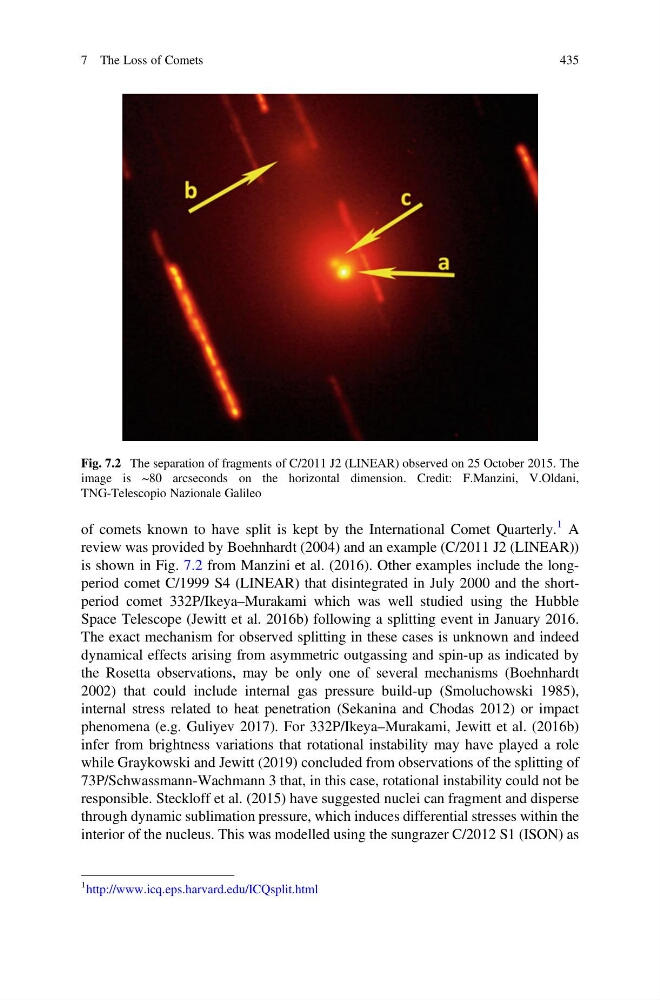
review was provided by Boehnhardt (2004) and an example (C/2011 J2 (LINEAR))
is shown in Fig. 7.2 from Manzini et al. (2016). Other examples include the longperiod comet C/1999 S4 (LINEAR) that disintegrated in July 2000 and the shortperiod comet 332P/Ikeya–Murakami which was well studied using the Hubble
Space Telescope (Jewitt et al. 2016b) following a splitting event in January 2016.
The exact mechanism for observed splitting in these cases is unknown and indeed
dynamical effects arising from asymmetric outgassing and spin-up as indicated by
the Rosetta observations, may be only one of several mechanisms (Boehnhardt
2002) that could include internal gas pressure build-up (Smoluchowski 1985),
internal stress related to heat penetration (Sekanina and Chodas 2012) or impact
phenomena (e.g. Guliyev 2017). For 332P/Ikeya–Murakami, Jewitt et al. (2016b)
infer from brightness variations that rotational instability may have played a role
while Graykowski and Jewitt (2019) concluded from observations of the splitting of
73P/Schwassmann-Wachmann 3 that, in this case, rotational instability could not be
responsible. Steckloff et al. (2015) have suggested nuclei can fragment and disperse
through dynamic sublimation pressure, which induces differential stresses within the
interior of the nucleus. This was modelled using the sungrazer C/2012 S1 (ISON) as
Fig. 7.2 The separation of fragments of C/2011 J2 (LINEAR) observed on 25 October 2015. The
image is ~80 arcseconds on the horizontal dimension. Credit: F.Manzini, V.Oldani,
TNG-Telescopio Nazionale Galileo
1 http://www.icq.eps.harvard.edu/ICQsplit.html
7 The Loss of Comets
435
1 A
review was provided by Boehnhardt (2004) and an example (C/2011 J2 (LINEAR))
is shown in Fig. 7.2 from Manzini et al. (2016). Other examples include the longperiod comet C/1999 S4 (LINEAR) that disintegrated in July 2000 and the shortperiod comet 332P/Ikeya–Murakami which was well studied using the Hubble
Space Telescope (Jewitt et al. 2016b) following a splitting event in January 2016.
The exact mechanism for observed splitting in these cases is unknown and indeed
dynamical effects arising from asymmetric outgassing and spin-up as indicated by
the Rosetta observations, may be only one of several mechanisms (Boehnhardt
2002) that could include internal gas pressure build-up (Smoluchowski 1985),
internal stress related to heat penetration (Sekanina and Chodas 2012) or impact
phenomena (e.g. Guliyev 2017). For 332P/Ikeya–Murakami, Jewitt et al. (2016b)
infer from brightness variations that rotational instability may have played a role
while Graykowski and Jewitt (2019) concluded from observations of the splitting of
73P/Schwassmann-Wachmann 3 that, in this case, rotational instability could not be
responsible. Steckloff et al. (2015) have suggested nuclei can fragment and disperse
through dynamic sublimation pressure, which induces differential stresses within the
interior of the nucleus. This was modelled using the sungrazer C/2012 S1 (ISON) as
Fig. 7.2 The separation of fragments of C/2011 J2 (LINEAR) observed on 25 October 2015. The
image is ~80 arcseconds on the horizontal dimension. Credit: F.Manzini, V.Oldani,
TNG-Telescopio Nazionale Galileo
1 http://www.icq.eps.harvard.edu/ICQsplit.html
7 The Loss of Comets
435