

Damocloids are objects with orbits similar to those of Halley-family (Figs. 6.1
and 1.17) and long-period comets but they do not display visible signs of outgassing.
The prototype for these objects is (5335) Damocles. Their high eccentricities and
inclinations suggest that the Damocloids are the dead or dormant nuclei of longperiod comets (Asher et al. 1994; Jewitt 2005).
There are two definitions of Damocloids with one stating that a Damocloid is any
point-source object having T J
2. The other definition requires the object to be
retrograde or it should be a combination of having a perihelion distance <5.2 AU, a
semi-major axis >8.0 AU, and an eccentricity >0.75. The two definitions are
roughly, but not precisely, equivalent. There are now over 150 objects that meet
these criteria and many are plotted in Fig. 6.1. (5335) Damocles is marked. Note how
the Damocloids and longer period comets appear to occupy a similar region in this
diagram.
The hypothesis that Damocloids and Halley-type comets are related is strengthened by the detection of outgassing from some Damocloids after their initial
detection as inert objects leading to them being re-classified as comets. C/2001
OG108 (LONEOS) is an example (Abell et al. 2003). For this object, with an orbital
period of 48.51 years and a radius similar to that of 1P/Halley, we can, by analogy,
estimate that its lifetime against complete erosional loss should have been less than a
million years. Lightcurves and sizes can be determined to provide further statistics,
as with asteroid 2006 BZ8 (Hergenrother 2018), that may place constraints on, for
example, tensile strength.
There seems now to be little doubt that short-period and Halley-type comets can
become inert and dormant providing one means by which comets are “lost”. Further
evidence for decrease in activity with time comes from observations of 49P/ArendRigaux for which the active area has been inferred to have reduced from ~3% to
~0.2% over six apparitions (Chu et al. 2019).
The measured spin-up of 67P over its perihelion passage has shown that the
timescale for this process can be appreciably shorter than the timescale for total
erosional loss and that this may lead to splitting of nuclei well before their activity
diminishes. There is considerable ground-based evidence for comets splitting. A list
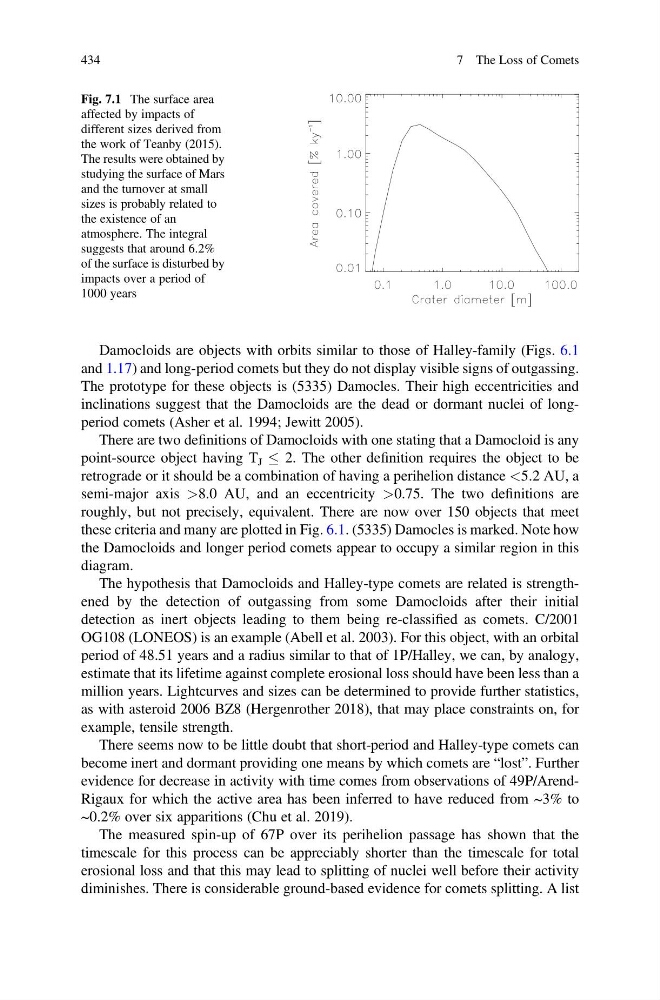
Fig. 7.1 The surface area
affected by impacts of
different sizes derived from
the work of Teanby (2015).
The results were obtained by
studying the surface of Mars
and the turnover at small
sizes is probably related to
the existence of an
atmosphere. The integral
suggests that around 6.2%
of the surface is disturbed by
impacts over a period of
1000 years
434
7 The Loss of Comets
and 1.17) and long-period comets but they do not display visible signs of outgassing.
The prototype for these objects is (5335) Damocles. Their high eccentricities and
inclinations suggest that the Damocloids are the dead or dormant nuclei of longperiod comets (Asher et al. 1994; Jewitt 2005).
There are two definitions of Damocloids with one stating that a Damocloid is any
point-source object having T J
2. The other definition requires the object to be
retrograde or it should be a combination of having a perihelion distance <5.2 AU, a
semi-major axis >8.0 AU, and an eccentricity >0.75. The two definitions are
roughly, but not precisely, equivalent. There are now over 150 objects that meet
these criteria and many are plotted in Fig. 6.1. (5335) Damocles is marked. Note how
the Damocloids and longer period comets appear to occupy a similar region in this
diagram.
The hypothesis that Damocloids and Halley-type comets are related is strengthened by the detection of outgassing from some Damocloids after their initial
detection as inert objects leading to them being re-classified as comets. C/2001
OG108 (LONEOS) is an example (Abell et al. 2003). For this object, with an orbital
period of 48.51 years and a radius similar to that of 1P/Halley, we can, by analogy,
estimate that its lifetime against complete erosional loss should have been less than a
million years. Lightcurves and sizes can be determined to provide further statistics,
as with asteroid 2006 BZ8 (Hergenrother 2018), that may place constraints on, for
example, tensile strength.
There seems now to be little doubt that short-period and Halley-type comets can
become inert and dormant providing one means by which comets are “lost”. Further
evidence for decrease in activity with time comes from observations of 49P/ArendRigaux for which the active area has been inferred to have reduced from ~3% to
~0.2% over six apparitions (Chu et al. 2019).
The measured spin-up of 67P over its perihelion passage has shown that the
timescale for this process can be appreciably shorter than the timescale for total
erosional loss and that this may lead to splitting of nuclei well before their activity
diminishes. There is considerable ground-based evidence for comets splitting. A list
Fig. 7.1 The surface area
affected by impacts of
different sizes derived from
the work of Teanby (2015).
The results were obtained by
studying the surface of Mars
and the turnover at small
sizes is probably related to
the existence of an
atmosphere. The integral
suggests that around 6.2%
of the surface is disturbed by
impacts over a period of
1000 years
434
7 The Loss of Comets