

the cometary neutrals. Consequently, the ion and electron temperatures drop rapidly
because the energy given to new plasma by the pickup process is now far lower.
Finally, one crosses a boundary into a field-free region. This boundary is sometimes
called the contact surface and the field-free region is called the diamagnetic cavity.
A diamagnetic cavity arises when solar wind ions are unable to penetrate the inner
coma because of collisions with outflowing neutrals (Haerendel 1987). The solar
wind ions carry the magnetic field and this absence of penetration also excludes the
field from this region. Consequently, within this cavity, newly created ions do not
“see” any magnetic field and are instead coupled to the outflowing neutrals and flow
away from the nucleus through ion-neutral drag (friction).
This description of the interaction is evident in Rubin et al. (2014c) who modelled
the flow using a multifluid magnetohydrodynamics (MHD) model tuned to fit the
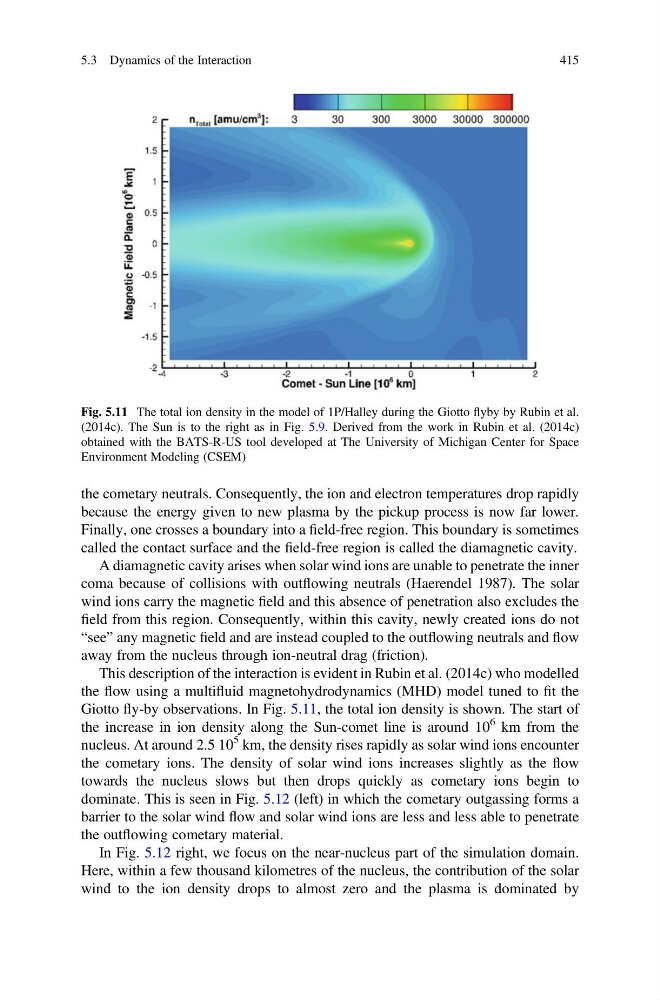
Giotto fly-by observations. In Fig. 5.11, the total ion density is shown. The start of
the increase in ion density along the Sun-comet line is around 10
6 km from the
nucleus. At around 2.5 10
5 km, the density rises rapidly as solar wind ions encounter
the cometary ions. The density of solar wind ions increases slightly as the flow
towards the nucleus slows but then drops quickly as cometary ions begin to
dominate. This is seen in Fig. 5.12 (left) in which the cometary outgassing forms a
barrier to the solar wind flow and solar wind ions are less and less able to penetrate
the outflowing cometary material.
In Fig. 5.12 right, we focus on the near-nucleus part of the simulation domain.
Here, within a few thousand kilometres of the nucleus, the contribution of the solar
wind to the ion density drops to almost zero and the plasma is dominated by
Fig. 5.11 The total ion density in the model of 1P/Halley during the Giotto flyby by Rubin et al.
(2014c). The Sun is to the right as in Fig. 5.9. Derived from the work in Rubin et al. (2014c)
obtained with the BATS-R-US tool developed at The University of Michigan Center for Space
Environment Modeling (CSEM)
5.3 Dynamics of the Interaction
415
because the energy given to new plasma by the pickup process is now far lower.
Finally, one crosses a boundary into a field-free region. This boundary is sometimes
called the contact surface and the field-free region is called the diamagnetic cavity.
A diamagnetic cavity arises when solar wind ions are unable to penetrate the inner
coma because of collisions with outflowing neutrals (Haerendel 1987). The solar
wind ions carry the magnetic field and this absence of penetration also excludes the
field from this region. Consequently, within this cavity, newly created ions do not
“see” any magnetic field and are instead coupled to the outflowing neutrals and flow
away from the nucleus through ion-neutral drag (friction).
This description of the interaction is evident in Rubin et al. (2014c) who modelled
the flow using a multifluid magnetohydrodynamics (MHD) model tuned to fit the
Giotto fly-by observations. In Fig. 5.11, the total ion density is shown. The start of
the increase in ion density along the Sun-comet line is around 10
6 km from the
nucleus. At around 2.5 10
5 km, the density rises rapidly as solar wind ions encounter
the cometary ions. The density of solar wind ions increases slightly as the flow
towards the nucleus slows but then drops quickly as cometary ions begin to
dominate. This is seen in Fig. 5.12 (left) in which the cometary outgassing forms a
barrier to the solar wind flow and solar wind ions are less and less able to penetrate
the outflowing cometary material.
In Fig. 5.12 right, we focus on the near-nucleus part of the simulation domain.
Here, within a few thousand kilometres of the nucleus, the contribution of the solar
wind to the ion density drops to almost zero and the plasma is dominated by
Fig. 5.11 The total ion density in the model of 1P/Halley during the Giotto flyby by Rubin et al.
(2014c). The Sun is to the right as in Fig. 5.9. Derived from the work in Rubin et al. (2014c)
obtained with the BATS-R-US tool developed at The University of Michigan Center for Space
Environment Modeling (CSEM)
5.3 Dynamics of the Interaction
415