

u p r
ð Þ
u 1
¼
1
1 þ
r ml
r
ð5:27Þ
where
r ml ¼
1
3
m i R i Q g
πv g ρ 1 u 1
ð5:28Þ
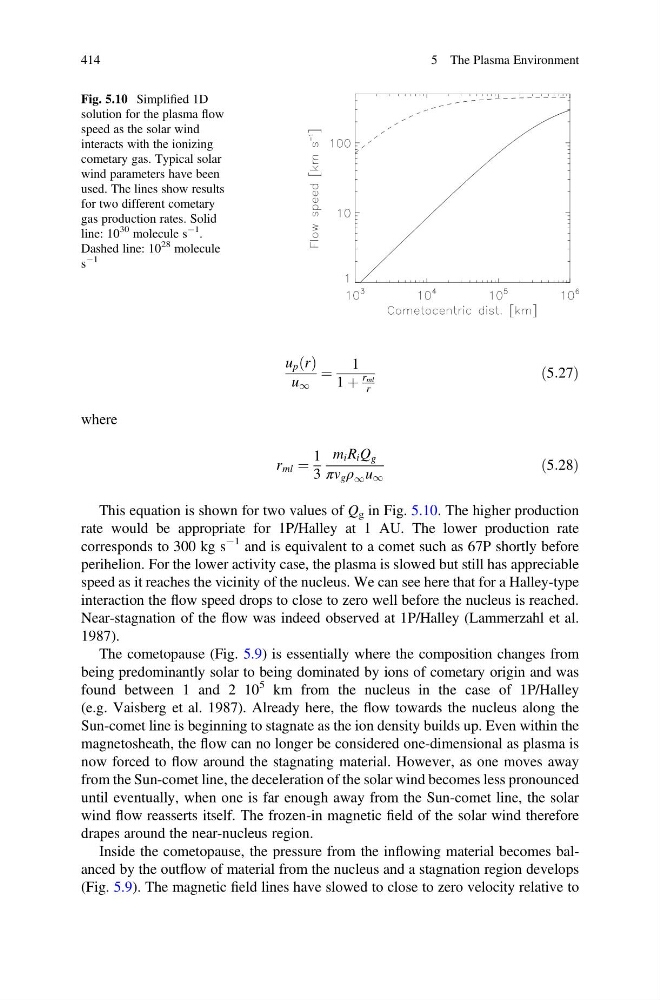
This equation is shown for two values of Q g in Fig. 5.10. The higher production
rate would be appropriate for 1P/Halley at 1 AU. The lower production rate
corresponds to 300 kg s
À1 and is equivalent to a comet such as 67P shortly before
perihelion. For the lower activity case, the plasma is slowed but still has appreciable
speed as it reaches the vicinity of the nucleus. We can see here that for a Halley-type
interaction the flow speed drops to close to zero well before the nucleus is reached.
Near-stagnation of the flow was indeed observed at 1P/Halley (Lammerzahl et al.
1987).
The cometopause (Fig. 5.9) is essentially where the composition changes from
being predominantly solar to being dominated by ions of cometary origin and was
found between 1 and 2 10
5 km from the nucleus in the case of 1P/Halley
(e.g. Vaisberg et al. 1987). Already here, the flow towards the nucleus along the
Sun-comet line is beginning to stagnate as the ion density builds up. Even within the
magnetosheath, the flow can no longer be considered one-dimensional as plasma is
now forced to flow around the stagnating material. However, as one moves away
from the Sun-comet line, the deceleration of the solar wind becomes less pronounced
until eventually, when one is far enough away from the Sun-comet line, the solar
wind flow reasserts itself. The frozen-in magnetic field of the solar wind therefore
drapes around the near-nucleus region.
Inside the cometopause, the pressure from the inflowing material becomes balanced by the outflow of material from the nucleus and a stagnation region develops
(Fig. 5.9). The magnetic field lines have slowed to close to zero velocity relative to
Fig. 5.10 Simplified 1D
solution for the plasma flow
speed as the solar wind
interacts with the ionizing
cometary gas. Typical solar
wind parameters have been
used. The lines show results
for two different cometary
gas production rates. Solid
line: 10
30 molecule s
À1
.
Dashed line: 10
28 molecule
s
À1
414
5 The Plasma Environment
ð Þ
u 1
¼
1
1 þ
r ml
r
ð5:27Þ
where
r ml ¼
1
3
m i R i Q g
πv g ρ 1 u 1
ð5:28Þ
This equation is shown for two values of Q g in Fig. 5.10. The higher production
rate would be appropriate for 1P/Halley at 1 AU. The lower production rate
corresponds to 300 kg s
À1 and is equivalent to a comet such as 67P shortly before
perihelion. For the lower activity case, the plasma is slowed but still has appreciable
speed as it reaches the vicinity of the nucleus. We can see here that for a Halley-type
interaction the flow speed drops to close to zero well before the nucleus is reached.
Near-stagnation of the flow was indeed observed at 1P/Halley (Lammerzahl et al.
1987).
The cometopause (Fig. 5.9) is essentially where the composition changes from
being predominantly solar to being dominated by ions of cometary origin and was
found between 1 and 2 10
5 km from the nucleus in the case of 1P/Halley
(e.g. Vaisberg et al. 1987). Already here, the flow towards the nucleus along the
Sun-comet line is beginning to stagnate as the ion density builds up. Even within the
magnetosheath, the flow can no longer be considered one-dimensional as plasma is
now forced to flow around the stagnating material. However, as one moves away
from the Sun-comet line, the deceleration of the solar wind becomes less pronounced
until eventually, when one is far enough away from the Sun-comet line, the solar
wind flow reasserts itself. The frozen-in magnetic field of the solar wind therefore
drapes around the near-nucleus region.
Inside the cometopause, the pressure from the inflowing material becomes balanced by the outflow of material from the nucleus and a stagnation region develops
(Fig. 5.9). The magnetic field lines have slowed to close to zero velocity relative to
Fig. 5.10 Simplified 1D
solution for the plasma flow
speed as the solar wind
interacts with the ionizing
cometary gas. Typical solar
wind parameters have been
used. The lines show results
for two different cometary
gas production rates. Solid
line: 10
30 molecule s
À1
.
Dashed line: 10
28 molecule
s
À1
414
5 The Plasma Environment