

the bow shock. 1P/Halley was emitting gas at >20 tonne s
À1 (Krankowsky et al.
1986) at the time of the Halley Armada resulting in a bow shock position roughly
3 10
5 km from the nucleus in the direction towards the Sun. The presence of
cometary pick-up ions was detected by Giotto more than 20 times this distance
from the nucleus (at 8 10
6 km; Neugebauer et al. 1987).
The plasma at this point is still collisionless and so flow continues until charge
exchange collisions with cometary neutrals become important. This next region
inside the bow shock is called the magnetosheath (Fig. 5.9) and is typically characterized by plasma turbulence (Verigin et al. 1987). The flow speed within the
magnetosheath continues to drop as the distance to the nucleus reduces until it
approaches zero in the case of an active comet.
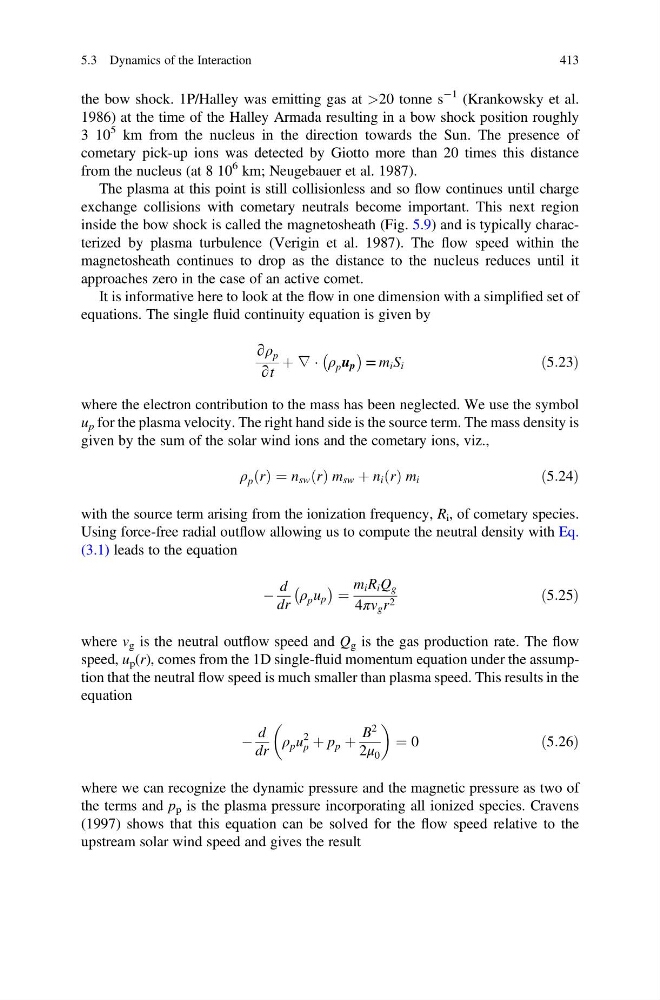
It is informative here to look at the flow in one dimension with a simplified set of
equations. The single fluid continuity equation is given by
∂ρ p
∂t
þ ∇ Á ρ p u p
À
Á = m i S i
ð5:23Þ
where the electron contribution to the mass has been neglected. We use the symbol
u p for the plasma velocity. The right hand side is the source term. The mass density is
given by the sum of the solar wind ions and the cometary ions, viz.,
ρ p r
ð Þ ¼ n sw r
ð Þ m sw þ n i r
ð Þ m i
ð5:24Þ
with the source term arising from the ionization frequency, R i , of cometary species.
Using force-free radial outflow allowing us to compute the neutral density with Eq.
(3.1) leads to the equation
À
d
dr
ρ p u p
À
Á ¼
m i R i Q g
4πv g r 2
ð5:25Þ
where v g is the neutral outflow speed and Q g is the gas production rate. The flow
speed, u p (r), comes from the 1D single-fluid momentum equation under the assumption that the neutral flow speed is much smaller than plasma speed. This results in the
equation
À
d
dr
ρ p u
2
p þ p p þ
B
2
2μ 0
¼ 0
ð5:26Þ
where we can recognize the dynamic pressure and the magnetic pressure as two of
the terms and p p is the plasma pressure incorporating all ionized species. Cravens
(1997) shows that this equation can be solved for the flow speed relative to the
upstream solar wind speed and gives the result
5.3 Dynamics of the Interaction
413
À1 (Krankowsky et al.
1986) at the time of the Halley Armada resulting in a bow shock position roughly
3 10
5 km from the nucleus in the direction towards the Sun. The presence of
cometary pick-up ions was detected by Giotto more than 20 times this distance
from the nucleus (at 8 10
6 km; Neugebauer et al. 1987).
The plasma at this point is still collisionless and so flow continues until charge
exchange collisions with cometary neutrals become important. This next region
inside the bow shock is called the magnetosheath (Fig. 5.9) and is typically characterized by plasma turbulence (Verigin et al. 1987). The flow speed within the
magnetosheath continues to drop as the distance to the nucleus reduces until it
approaches zero in the case of an active comet.
It is informative here to look at the flow in one dimension with a simplified set of
equations. The single fluid continuity equation is given by
∂ρ p
∂t
þ ∇ Á ρ p u p
À
Á = m i S i
ð5:23Þ
where the electron contribution to the mass has been neglected. We use the symbol
u p for the plasma velocity. The right hand side is the source term. The mass density is
given by the sum of the solar wind ions and the cometary ions, viz.,
ρ p r
ð Þ ¼ n sw r
ð Þ m sw þ n i r
ð Þ m i
ð5:24Þ
with the source term arising from the ionization frequency, R i , of cometary species.
Using force-free radial outflow allowing us to compute the neutral density with Eq.
(3.1) leads to the equation
À
d
dr
ρ p u p
À
Á ¼
m i R i Q g
4πv g r 2
ð5:25Þ
where v g is the neutral outflow speed and Q g is the gas production rate. The flow
speed, u p (r), comes from the 1D single-fluid momentum equation under the assumption that the neutral flow speed is much smaller than plasma speed. This results in the
equation
À
d
dr
ρ p u
2
p þ p p þ
B
2
2μ 0
¼ 0
ð5:26Þ
where we can recognize the dynamic pressure and the magnetic pressure as two of
the terms and p p is the plasma pressure incorporating all ionized species. Cravens
(1997) shows that this equation can be solved for the flow speed relative to the
upstream solar wind speed and gives the result
5.3 Dynamics of the Interaction
413