

The criterion defining a shock wave is that the bulk velocity of the plasma drops
from “supersonic” to “subsonic”, where the speed of sound c s is defined by
c s ¼
ffiffiffiffiffiffi ffi
γp p
ρ p
r
ð5:20Þ
where γ is the ratio of specific heats, p p is the plasma pressure, and ρ p is its density. In
a plasma, the pressure term must include the partial pressures from both electrons
and ions leading to the didactically clearer equation
c s ¼
ffiffiffiffiffiffiffiffiffiffiffiffiffiffiffiffiffiffiffiffiffiffiffi
γk T e þ T i
ð
Þ
m i
r
ð5:21Þ
where T e and T i define the electron and ion temperatures. The ideal gas law is here an
assumption. The gyrovelocity of the ions around field lines can also be used to assign
a thermal velocity to the plasma which is comparable to the sound speed.
The sonic Mach number, Ma s , is then given by
Ma s ¼
u sw
c s
ð5:22Þ
and using the values given in Table 5.1 we see that, in the undisturbed solar wind,
Ma s % 10. In other words, it is highly supersonic. But the mass loading remote from
the nucleus already slows the solar wind and, even more importantly, is a significant
heat source. The picked-up protons have an initial temperature around 60 times
higher than the solar wind species. This leads to a rise in the thermal pressure of the
plasma and a reduction of the Mach number to approximately two at the position of
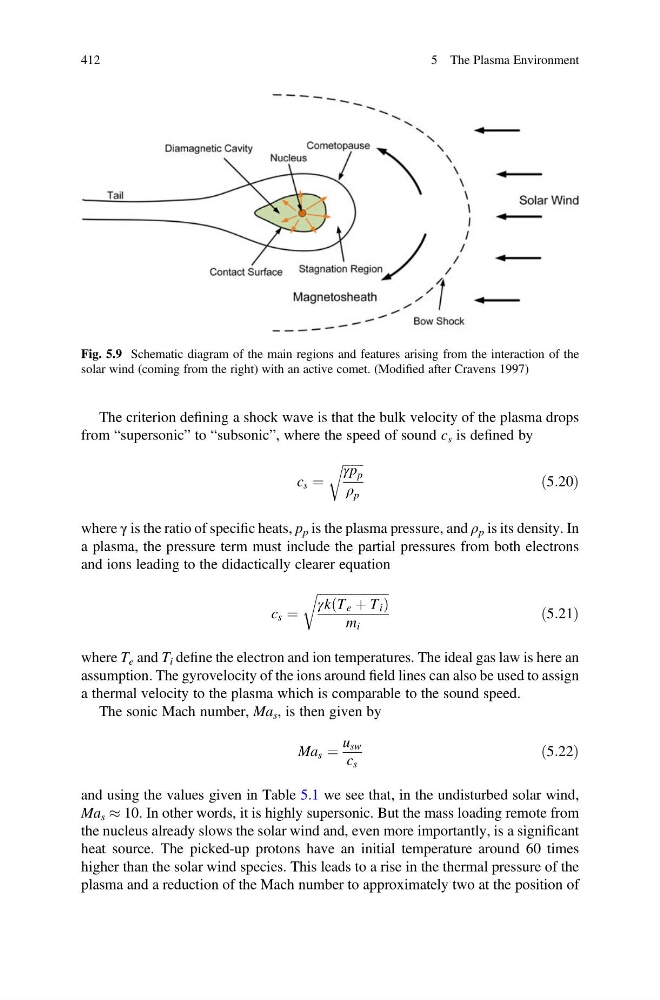
Fig. 5.9 Schematic diagram of the main regions and features arising from the interaction of the
solar wind (coming from the right) with an active comet. (Modified after Cravens 1997)
412
5 The Plasma Environment
from “supersonic” to “subsonic”, where the speed of sound c s is defined by
c s ¼
ffiffiffiffiffiffi ffi
γp p
ρ p
r
ð5:20Þ
where γ is the ratio of specific heats, p p is the plasma pressure, and ρ p is its density. In
a plasma, the pressure term must include the partial pressures from both electrons
and ions leading to the didactically clearer equation
c s ¼
ffiffiffiffiffiffiffiffiffiffiffiffiffiffiffiffiffiffiffiffiffiffiffi
γk T e þ T i
ð
Þ
m i
r
ð5:21Þ
where T e and T i define the electron and ion temperatures. The ideal gas law is here an
assumption. The gyrovelocity of the ions around field lines can also be used to assign
a thermal velocity to the plasma which is comparable to the sound speed.
The sonic Mach number, Ma s , is then given by
Ma s ¼
u sw
c s
ð5:22Þ
and using the values given in Table 5.1 we see that, in the undisturbed solar wind,
Ma s % 10. In other words, it is highly supersonic. But the mass loading remote from
the nucleus already slows the solar wind and, even more importantly, is a significant
heat source. The picked-up protons have an initial temperature around 60 times
higher than the solar wind species. This leads to a rise in the thermal pressure of the
plasma and a reduction of the Mach number to approximately two at the position of
Fig. 5.9 Schematic diagram of the main regions and features arising from the interaction of the
solar wind (coming from the right) with an active comet. (Modified after Cravens 1997)
412
5 The Plasma Environment