

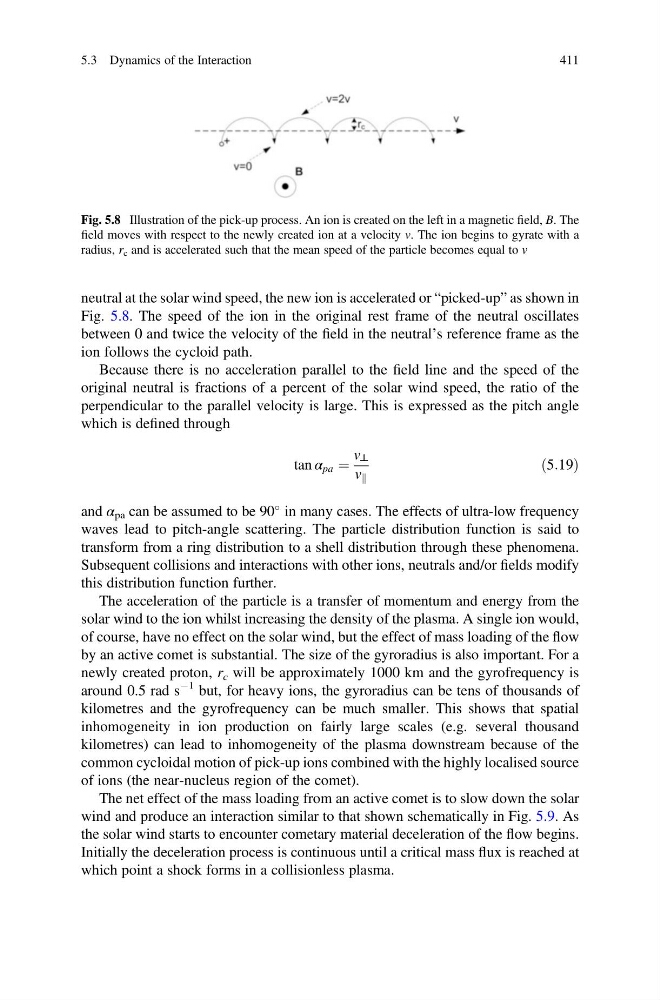
neutral at the solar wind speed, the new ion is accelerated or “picked-up” as shown in
Fig. 5.8. The speed of the ion in the original rest frame of the neutral oscillates
between 0 and twice the velocity of the field in the neutral’s reference frame as the
ion follows the cycloid path.
Because there is no acceleration parallel to the field line and the speed of the
original neutral is fractions of a percent of the solar wind speed, the ratio of the
perpendicular to the parallel velocity is large. This is expressed as the pitch angle
which is defined through
tan α pa ¼
v ┴
v k
ð5:19Þ
and α pa can be assumed to be 90
in many cases. The effects of ultra-low frequency
waves lead to pitch-angle scattering. The particle distribution function is said to
transform from a ring distribution to a shell distribution through these phenomena.
Subsequent collisions and interactions with other ions, neutrals and/or fields modify
this distribution function further.
The acceleration of the particle is a transfer of momentum and energy from the
solar wind to the ion whilst increasing the density of the plasma. A single ion would,
of course, have no effect on the solar wind, but the effect of mass loading of the flow
by an active comet is substantial. The size of the gyroradius is also important. For a
newly created proton, r c will be approximately 1000 km and the gyrofrequency is
around 0.5 rad s
À1 but, for heavy ions, the gyroradius can be tens of thousands of
kilometres and the gyrofrequency can be much smaller. This shows that spatial
inhomogeneity in ion production on fairly large scales (e.g. several thousand
kilometres) can lead to inhomogeneity of the plasma downstream because of the
common cycloidal motion of pick-up ions combined with the highly localised source
of ions (the near-nucleus region of the comet).
The net effect of the mass loading from an active comet is to slow down the solar
wind and produce an interaction similar to that shown schematically in Fig. 5.9. As
the solar wind starts to encounter cometary material deceleration of the flow begins.
Initially the deceleration process is continuous until a critical mass flux is reached at
which point a shock forms in a collisionless plasma.
Fig. 5.8 Illustration of the pick-up process. An ion is created on the left in a magnetic field, B. The
field moves with respect to the newly created ion at a velocity v. The ion begins to gyrate with a
radius, r c and is accelerated such that the mean speed of the particle becomes equal to v
5.3 Dynamics of the Interaction
411
Fig. 5.8. The speed of the ion in the original rest frame of the neutral oscillates
between 0 and twice the velocity of the field in the neutral’s reference frame as the
ion follows the cycloid path.
Because there is no acceleration parallel to the field line and the speed of the
original neutral is fractions of a percent of the solar wind speed, the ratio of the
perpendicular to the parallel velocity is large. This is expressed as the pitch angle
which is defined through
tan α pa ¼
v ┴
v k
ð5:19Þ
and α pa can be assumed to be 90
in many cases. The effects of ultra-low frequency
waves lead to pitch-angle scattering. The particle distribution function is said to
transform from a ring distribution to a shell distribution through these phenomena.
Subsequent collisions and interactions with other ions, neutrals and/or fields modify
this distribution function further.
The acceleration of the particle is a transfer of momentum and energy from the
solar wind to the ion whilst increasing the density of the plasma. A single ion would,
of course, have no effect on the solar wind, but the effect of mass loading of the flow
by an active comet is substantial. The size of the gyroradius is also important. For a
newly created proton, r c will be approximately 1000 km and the gyrofrequency is
around 0.5 rad s
À1 but, for heavy ions, the gyroradius can be tens of thousands of
kilometres and the gyrofrequency can be much smaller. This shows that spatial
inhomogeneity in ion production on fairly large scales (e.g. several thousand
kilometres) can lead to inhomogeneity of the plasma downstream because of the
common cycloidal motion of pick-up ions combined with the highly localised source
of ions (the near-nucleus region of the comet).
The net effect of the mass loading from an active comet is to slow down the solar
wind and produce an interaction similar to that shown schematically in Fig. 5.9. As
the solar wind starts to encounter cometary material deceleration of the flow begins.
Initially the deceleration process is continuous until a critical mass flux is reached at
which point a shock forms in a collisionless plasma.
Fig. 5.8 Illustration of the pick-up process. An ion is created on the left in a magnetic field, B. The
field moves with respect to the newly created ion at a velocity v. The ion begins to gyrate with a
radius, r c and is accelerated such that the mean speed of the particle becomes equal to v
5.3 Dynamics of the Interaction
411