

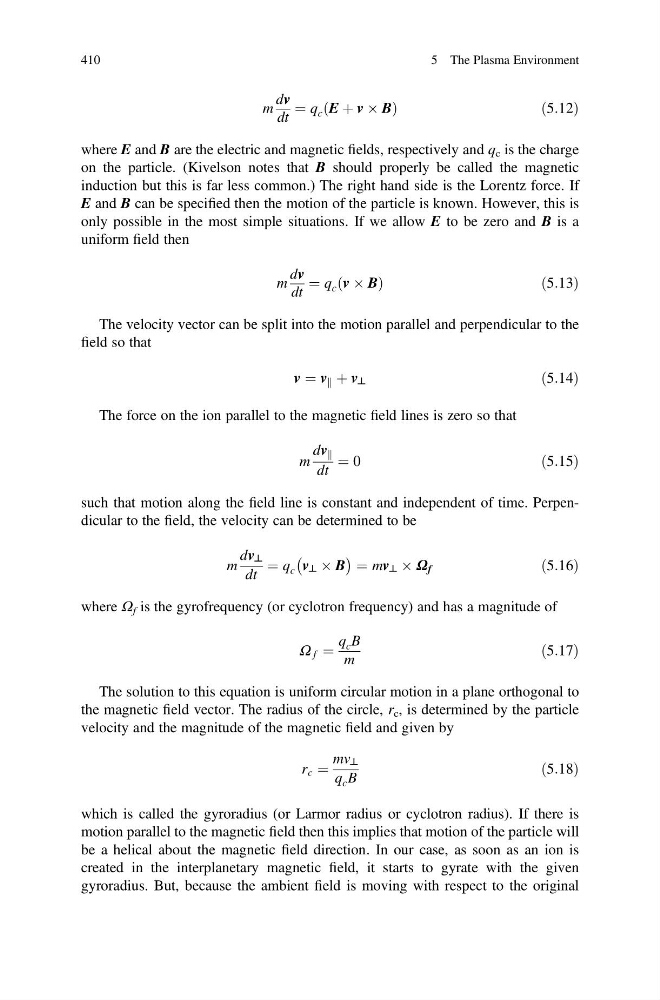
m
dv
dt
¼ q c E þ v  B
ð
Þ
ð 5:12Þ
where E and B are the electric and magnetic fields, respectively and q c is the charge
on the particle. (Kivelson notes that B should properly be called the magnetic
induction but this is far less common.) The right hand side is the Lorentz force. If
E and B can be specified then the motion of the particle is known. However, this is
only possible in the most simple situations. If we allow E to be zero and B is a
uniform field then
m
dv
dt
¼ q c v  B
ð
Þ
ð5:13Þ
The velocity vector can be split into the motion parallel and perpendicular to the
field so that
v ¼ v k þ v ┴
ð5:14Þ
The force on the ion parallel to the magnetic field lines is zero so that
m
dv k
dt
¼ 0
ð5:15Þ
such that motion along the field line is constant and independent of time. Perpendicular to the field, the velocity can be determined to be
m
dv ┴
dt
¼ q c v ┴ Â B
À
Á ¼ mv ┴ Â Ω f
ð5:16Þ
where Ω f is the gyrofrequency (or cyclotron frequency) and has a magnitude of
Ω f ¼
q c B
m
ð5:17Þ
The solution to this equation is uniform circular motion in a plane orthogonal to
the magnetic field vector. The radius of the circle, r c , is determined by the particle
velocity and the magnitude of the magnetic field and given by
r c ¼
mv ┴
q c B
ð5:18Þ
which is called the gyroradius (or Larmor radius or cyclotron radius). If there is
motion parallel to the magnetic field then this implies that motion of the particle will
be a helical about the magnetic field direction. In our case, as soon as an ion is
created in the interplanetary magnetic field, it starts to gyrate with the given
gyroradius. But, because the ambient field is moving with respect to the original
410
5 The Plasma Environment
dv
dt
¼ q c E þ v  B
ð
Þ
ð 5:12Þ
where E and B are the electric and magnetic fields, respectively and q c is the charge
on the particle. (Kivelson notes that B should properly be called the magnetic
induction but this is far less common.) The right hand side is the Lorentz force. If
E and B can be specified then the motion of the particle is known. However, this is
only possible in the most simple situations. If we allow E to be zero and B is a
uniform field then
m
dv
dt
¼ q c v  B
ð
Þ
ð5:13Þ
The velocity vector can be split into the motion parallel and perpendicular to the
field so that
v ¼ v k þ v ┴
ð5:14Þ
The force on the ion parallel to the magnetic field lines is zero so that
m
dv k
dt
¼ 0
ð5:15Þ
such that motion along the field line is constant and independent of time. Perpendicular to the field, the velocity can be determined to be
m
dv ┴
dt
¼ q c v ┴ Â B
À
Á ¼ mv ┴ Â Ω f
ð5:16Þ
where Ω f is the gyrofrequency (or cyclotron frequency) and has a magnitude of
Ω f ¼
q c B
m
ð5:17Þ
The solution to this equation is uniform circular motion in a plane orthogonal to
the magnetic field vector. The radius of the circle, r c , is determined by the particle
velocity and the magnitude of the magnetic field and given by
r c ¼
mv ┴
q c B
ð5:18Þ
which is called the gyroradius (or Larmor radius or cyclotron radius). If there is
motion parallel to the magnetic field then this implies that motion of the particle will
be a helical about the magnetic field direction. In our case, as soon as an ion is
created in the interplanetary magnetic field, it starts to gyrate with the given
gyroradius. But, because the ambient field is moving with respect to the original
410
5 The Plasma Environment