

who compared photoionization rates with electron impact ionization in various
regions of the plasma environment). The process can be represented by
e þ M⟶M
þ
þ e þ e
ð5:10Þ
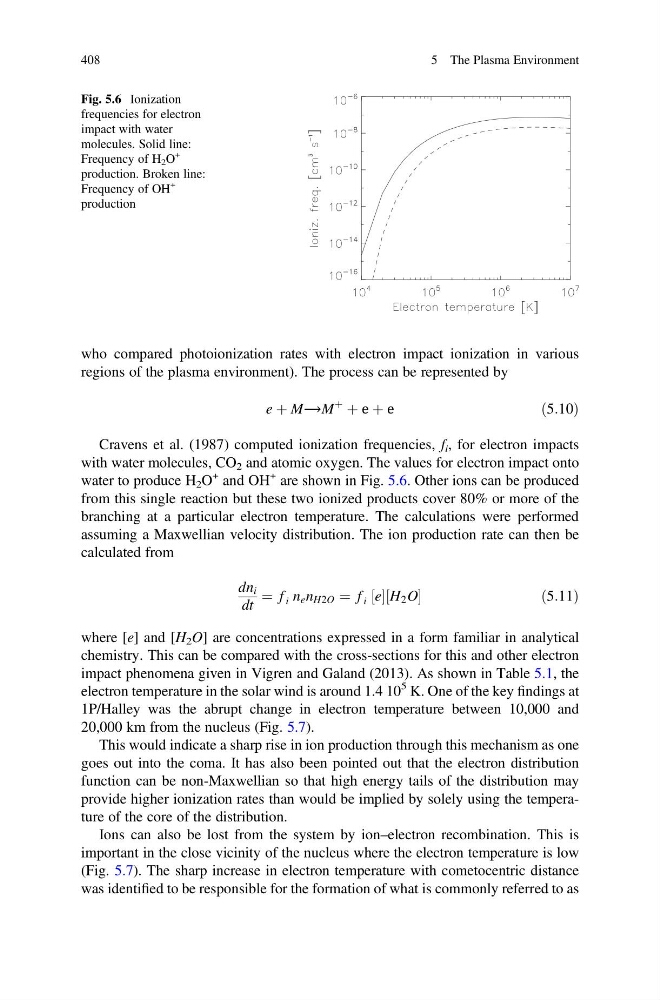
Cravens et al. (1987) computed ionization frequencies, f i , for electron impacts
with water molecules, CO 2 and atomic oxygen. The values for electron impact onto
water to produce H 2 O
+ and OH
+ are shown in Fig. 5.6. Other ions can be produced
from this single reaction but these two ionized products cover 80% or more of the
branching at a particular electron temperature. The calculations were performed
assuming a Maxwellian velocity distribution. The ion production rate can then be
calculated from
dn i
dt
¼ f i n e n H2O ¼ f i e
½ H 2 O
½
ð5:11Þ
where [e] and [H 2 O] are concentrations expressed in a form familiar in analytical
chemistry. This can be compared with the cross-sections for this and other electron
impact phenomena given in Vigren and Galand (2013). As shown in Table 5.1, the
electron temperature in the solar wind is around 1.4 10
5 K. One of the key findings at
1P/Halley was the abrupt change in electron temperature between 10,000 and
20,000 km from the nucleus (Fig. 5.7).
This would indicate a sharp rise in ion production through this mechanism as one
goes out into the coma. It has also been pointed out that the electron distribution
function can be non-Maxwellian so that high energy tails of the distribution may
provide higher ionization rates than would be implied by solely using the temperature of the core of the distribution.
Ions can also be lost from the system by ion–electron recombination. This is
important in the close vicinity of the nucleus where the electron temperature is low
(Fig. 5.7). The sharp increase in electron temperature with cometocentric distance
was identified to be responsible for the formation of what is commonly referred to as
Fig. 5.6 Ionization
frequencies for electron
impact with water
molecules. Solid line:
Frequency of H 2 O
+
production. Broken line:
Frequency of OH
+
production
408
5 The Plasma Environment
regions of the plasma environment). The process can be represented by
e þ M⟶M
þ
þ e þ e
ð5:10Þ
Cravens et al. (1987) computed ionization frequencies, f i , for electron impacts
with water molecules, CO 2 and atomic oxygen. The values for electron impact onto
water to produce H 2 O
+ and OH
+ are shown in Fig. 5.6. Other ions can be produced
from this single reaction but these two ionized products cover 80% or more of the
branching at a particular electron temperature. The calculations were performed
assuming a Maxwellian velocity distribution. The ion production rate can then be
calculated from
dn i
dt
¼ f i n e n H2O ¼ f i e
½ H 2 O
½
ð5:11Þ
where [e] and [H 2 O] are concentrations expressed in a form familiar in analytical
chemistry. This can be compared with the cross-sections for this and other electron
impact phenomena given in Vigren and Galand (2013). As shown in Table 5.1, the
electron temperature in the solar wind is around 1.4 10
5 K. One of the key findings at
1P/Halley was the abrupt change in electron temperature between 10,000 and
20,000 km from the nucleus (Fig. 5.7).
This would indicate a sharp rise in ion production through this mechanism as one
goes out into the coma. It has also been pointed out that the electron distribution
function can be non-Maxwellian so that high energy tails of the distribution may
provide higher ionization rates than would be implied by solely using the temperature of the core of the distribution.
Ions can also be lost from the system by ion–electron recombination. This is
important in the close vicinity of the nucleus where the electron temperature is low
(Fig. 5.7). The sharp increase in electron temperature with cometocentric distance
was identified to be responsible for the formation of what is commonly referred to as
Fig. 5.6 Ionization
frequencies for electron
impact with water
molecules. Solid line:
Frequency of H 2 O
+
production. Broken line:
Frequency of OH
+
production
408
5 The Plasma Environment