

et al. 2013, from C/2012 S1 (ISON) and C/2011 L4 (PanSTARRS) by Snios et al.
2016,; see also Fig. 5.5).
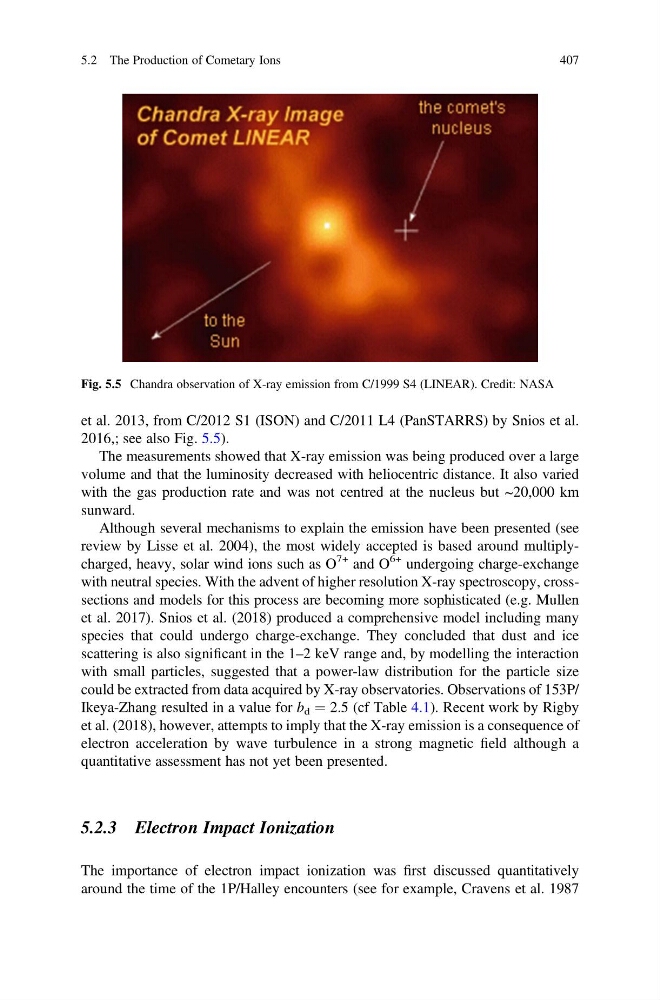
The measurements showed that X-ray emission was being produced over a large
volume and that the luminosity decreased with heliocentric distance. It also varied
with the gas production rate and was not centred at the nucleus but ~20,000 km
sunward.
Although several mechanisms to explain the emission have been presented (see
review by Lisse et al. 2004), the most widely accepted is based around multiplycharged, heavy, solar wind ions such as O
7+ and O
6+ undergoing charge-exchange
with neutral species. With the advent of higher resolution X-ray spectroscopy, crosssections and models for this process are becoming more sophisticated (e.g. Mullen
et al. 2017). Snios et al. (2018) produced a comprehensive model including many
species that could undergo charge-exchange. They concluded that dust and ice
scattering is also significant in the 1–2 keV range and, by modelling the interaction
with small particles, suggested that a power-law distribution for the particle size
could be extracted from data acquired by X-ray observatories. Observations of 153P/
Ikeya-Zhang resulted in a value for b d ¼ 2.5 (cf Table 4.1). Recent work by Rigby
et al. (2018), however, attempts to imply that the X-ray emission is a consequence of
electron acceleration by wave turbulence in a strong magnetic field although a
quantitative assessment has not yet been presented.
5.2.3 Electron Impact Ionization
The importance of electron impact ionization was first discussed quantitatively
around the time of the 1P/Halley encounters (see for example, Cravens et al. 1987
Fig. 5.5 Chandra observation of X-ray emission from C/1999 S4 (LINEAR). Credit: NASA
5.2 The Production of Cometary Ions
407
2016,; see also Fig. 5.5).
The measurements showed that X-ray emission was being produced over a large
volume and that the luminosity decreased with heliocentric distance. It also varied
with the gas production rate and was not centred at the nucleus but ~20,000 km
sunward.
Although several mechanisms to explain the emission have been presented (see
review by Lisse et al. 2004), the most widely accepted is based around multiplycharged, heavy, solar wind ions such as O
7+ and O
6+ undergoing charge-exchange
with neutral species. With the advent of higher resolution X-ray spectroscopy, crosssections and models for this process are becoming more sophisticated (e.g. Mullen
et al. 2017). Snios et al. (2018) produced a comprehensive model including many
species that could undergo charge-exchange. They concluded that dust and ice
scattering is also significant in the 1–2 keV range and, by modelling the interaction
with small particles, suggested that a power-law distribution for the particle size
could be extracted from data acquired by X-ray observatories. Observations of 153P/
Ikeya-Zhang resulted in a value for b d ¼ 2.5 (cf Table 4.1). Recent work by Rigby
et al. (2018), however, attempts to imply that the X-ray emission is a consequence of
electron acceleration by wave turbulence in a strong magnetic field although a
quantitative assessment has not yet been presented.
5.2.3 Electron Impact Ionization
The importance of electron impact ionization was first discussed quantitatively
around the time of the 1P/Halley encounters (see for example, Cravens et al. 1987
Fig. 5.5 Chandra observation of X-ray emission from C/1999 S4 (LINEAR). Credit: NASA
5.2 The Production of Cometary Ions
407