

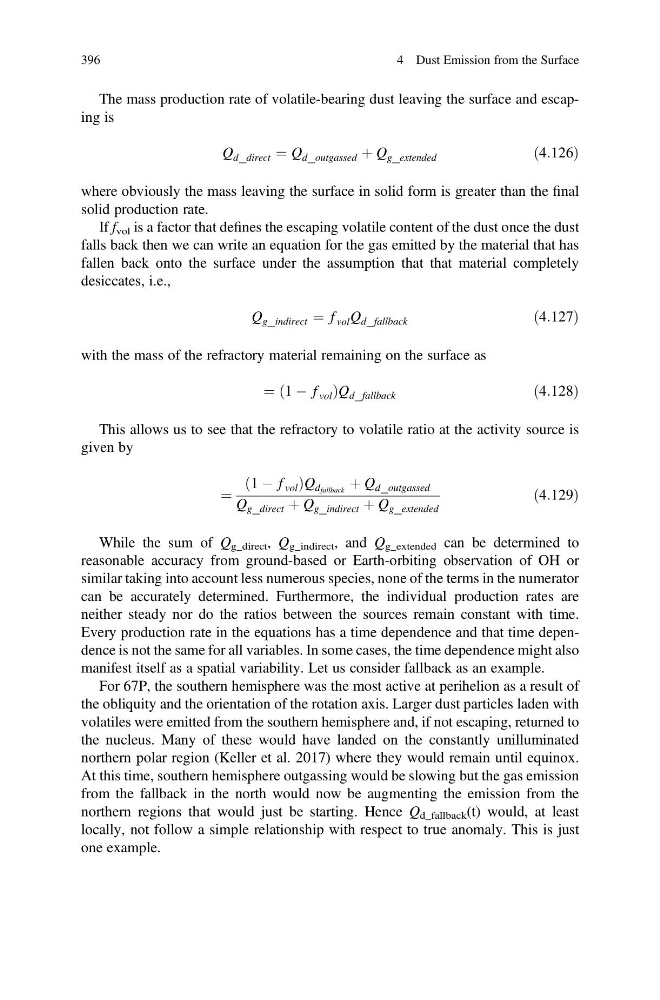
The mass production rate of volatile-bearing dust leaving the surface and escaping is
Q d direct ¼ Q d outgassed þ Q g extended
ð4:126Þ
where obviously the mass leaving the surface in solid form is greater than the final
solid production rate.
If f vol is a factor that defines the escaping volatile content of the dust once the dust
falls back then we can write an equation for the gas emitted by the material that has
fallen back onto the surface under the assumption that that material completely
desiccates, i.e.,
Q g indirect ¼ f vol Q d fallback
ð4:127Þ
with the mass of the refractory material remaining on the surface as
¼ 1 À f vol
ð
Þ Q d fallback
ð4:128Þ
This allows us to see that the refractory to volatile ratio at the activity source is
given by
¼
1 À f vol
ð
Þ Q d fallback þ Q d outgassed
Q g direct þ Q g indirect þ Q g extended
ð4:129Þ
While the sum of Q g_direct , Q g_indirect , and Q g_extended can be determined to
reasonable accuracy from ground-based or Earth-orbiting observation of OH or
similar taking into account less numerous species, none of the terms in the numerator
can be accurately determined. Furthermore, the individual production rates are
neither steady nor do the ratios between the sources remain constant with time.
Every production rate in the equations has a time dependence and that time dependence is not the same for all variables. In some cases, the time dependence might also
manifest itself as a spatial variability. Let us consider fallback as an example.
For 67P, the southern hemisphere was the most active at perihelion as a result of
the obliquity and the orientation of the rotation axis. Larger dust particles laden with
volatiles were emitted from the southern hemisphere and, if not escaping, returned to
the nucleus. Many of these would have landed on the constantly unilluminated
northern polar region (Keller et al. 2017) where they would remain until equinox.
At this time, southern hemisphere outgassing would be slowing but the gas emission
from the fallback in the north would now be augmenting the emission from the
northern regions that would just be starting. Hence Q d_fallback (t) would, at least
locally, not follow a simple relationship with respect to true anomaly. This is just
one example.
396
4 Dust Emission from the Surface
Q d direct ¼ Q d outgassed þ Q g extended
ð4:126Þ
where obviously the mass leaving the surface in solid form is greater than the final
solid production rate.
If f vol is a factor that defines the escaping volatile content of the dust once the dust
falls back then we can write an equation for the gas emitted by the material that has
fallen back onto the surface under the assumption that that material completely
desiccates, i.e.,
Q g indirect ¼ f vol Q d fallback
ð4:127Þ
with the mass of the refractory material remaining on the surface as
¼ 1 À f vol
ð
Þ Q d fallback
ð4:128Þ
This allows us to see that the refractory to volatile ratio at the activity source is
given by
¼
1 À f vol
ð
Þ Q d fallback þ Q d outgassed
Q g direct þ Q g indirect þ Q g extended
ð4:129Þ
While the sum of Q g_direct , Q g_indirect , and Q g_extended can be determined to
reasonable accuracy from ground-based or Earth-orbiting observation of OH or
similar taking into account less numerous species, none of the terms in the numerator
can be accurately determined. Furthermore, the individual production rates are
neither steady nor do the ratios between the sources remain constant with time.
Every production rate in the equations has a time dependence and that time dependence is not the same for all variables. In some cases, the time dependence might also
manifest itself as a spatial variability. Let us consider fallback as an example.
For 67P, the southern hemisphere was the most active at perihelion as a result of
the obliquity and the orientation of the rotation axis. Larger dust particles laden with
volatiles were emitted from the southern hemisphere and, if not escaping, returned to
the nucleus. Many of these would have landed on the constantly unilluminated
northern polar region (Keller et al. 2017) where they would remain until equinox.
At this time, southern hemisphere outgassing would be slowing but the gas emission
from the fallback in the north would now be augmenting the emission from the
northern regions that would just be starting. Hence Q d_fallback (t) would, at least
locally, not follow a simple relationship with respect to true anomaly. This is just
one example.
396
4 Dust Emission from the Surface