

and this has a marked effect on the computation of Q d /Q g . However, it is not obvious
that large dust particles are devoid of volatile material that might be subsequently
released. The indisputable evidence that some large particles fail to reach escape
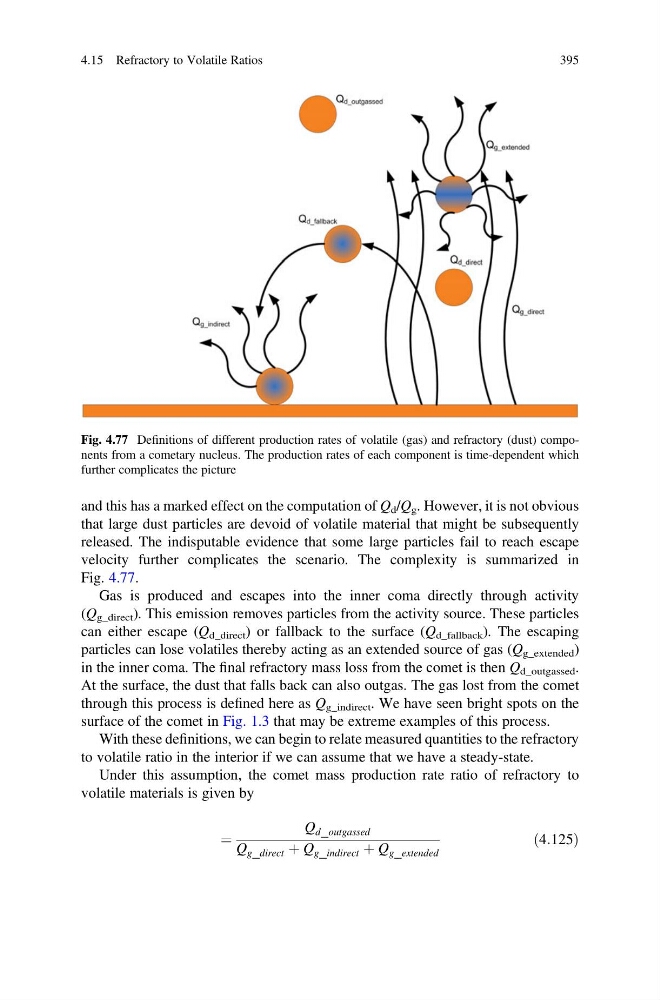
velocity further complicates the scenario. The complexity is summarized in
Fig. 4.77.
Gas is produced and escapes into the inner coma directly through activity
(Q g_direct ). This emission removes particles from the activity source. These particles
can either escape (Q d_direct ) or fallback to the surface (Q d_fallback ). The escaping
particles can lose volatiles thereby acting as an extended source of gas (Q g_extended )
in the inner coma. The final refractory mass loss from the comet is then Q d_outgassed .
At the surface, the dust that falls back can also outgas. The gas lost from the comet
through this process is defined here as Q g_indirect . We have seen bright spots on the
surface of the comet in Fig. 1.3 that may be extreme examples of this process.
With these definitions, we can begin to relate measured quantities to the refractory
to volatile ratio in the interior if we can assume that we have a steady-state.
Under this assumption, the comet mass production rate ratio of refractory to
volatile materials is given by
¼
Q d outgassed
Q g direct þ Q g indirect þ Q g extended
ð4:125Þ
Fig. 4.77 Definitions of different production rates of volatile (gas) and refractory (dust) components from a cometary nucleus. The production rates of each component is time-dependent which
further complicates the picture
4.15 Refractory to Volatile Ratios
395
that large dust particles are devoid of volatile material that might be subsequently
released. The indisputable evidence that some large particles fail to reach escape
velocity further complicates the scenario. The complexity is summarized in
Fig. 4.77.
Gas is produced and escapes into the inner coma directly through activity
(Q g_direct ). This emission removes particles from the activity source. These particles
can either escape (Q d_direct ) or fallback to the surface (Q d_fallback ). The escaping
particles can lose volatiles thereby acting as an extended source of gas (Q g_extended )
in the inner coma. The final refractory mass loss from the comet is then Q d_outgassed .
At the surface, the dust that falls back can also outgas. The gas lost from the comet
through this process is defined here as Q g_indirect . We have seen bright spots on the
surface of the comet in Fig. 1.3 that may be extreme examples of this process.
With these definitions, we can begin to relate measured quantities to the refractory
to volatile ratio in the interior if we can assume that we have a steady-state.
Under this assumption, the comet mass production rate ratio of refractory to
volatile materials is given by
¼
Q d outgassed
Q g direct þ Q g indirect þ Q g extended
ð4:125Þ
Fig. 4.77 Definitions of different production rates of volatile (gas) and refractory (dust) components from a cometary nucleus. The production rates of each component is time-dependent which
further complicates the picture
4.15 Refractory to Volatile Ratios
395