

experiment led to an organic to silicate ratio of the non-volative component of at
least 75:25 (Hérique et al. 2016). Comparisons are, however, difficult. The mass
spectrometers actually derive a C/Si ratio and must assume how the carbon is bound
to other elements while the radiowave sounding experiment deduces the ratio
through comparison of the permittivity with standards through calibration using
density constraints (Hérique et al. 2019).
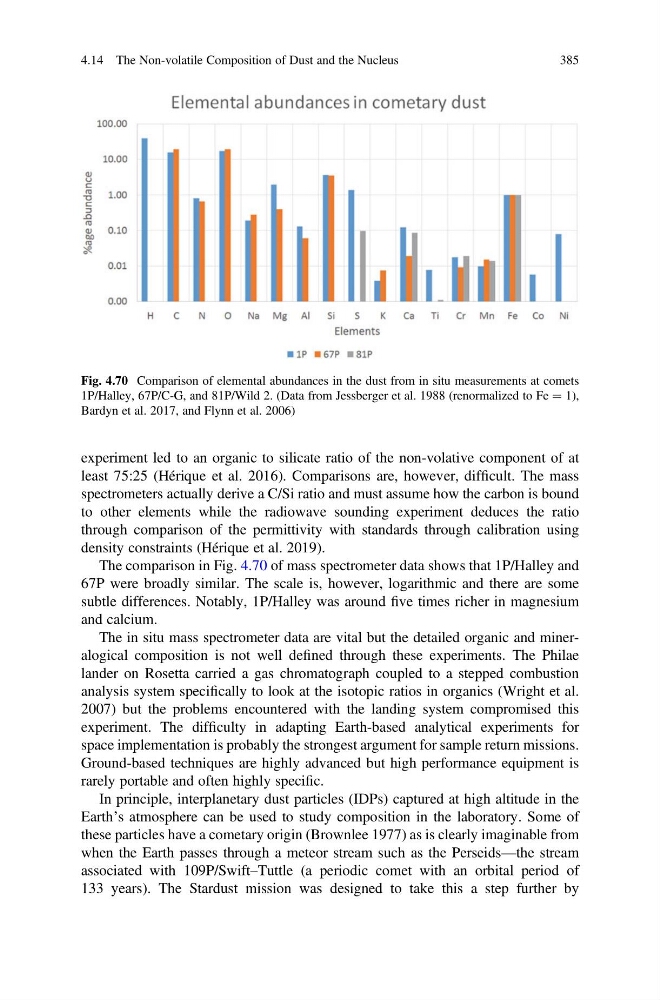
The comparison in Fig. 4.70 of mass spectrometer data shows that 1P/Halley and
67P were broadly similar. The scale is, however, logarithmic and there are some
subtle differences. Notably, 1P/Halley was around five times richer in magnesium
and calcium.
The in situ mass spectrometer data are vital but the detailed organic and mineralogical composition is not well defined through these experiments. The Philae
lander on Rosetta carried a gas chromatograph coupled to a stepped combustion
analysis system specifically to look at the isotopic ratios in organics (Wright et al.
2007) but the problems encountered with the landing system compromised this
experiment. The difficulty in adapting Earth-based analytical experiments for
space implementation is probably the strongest argument for sample return missions.
Ground-based techniques are highly advanced but high performance equipment is
rarely portable and often highly specific.
In principle, interplanetary dust particles (IDPs) captured at high altitude in the
Earth’s atmosphere can be used to study composition in the laboratory. Some of
these particles have a cometary origin (Brownlee 1977) as is clearly imaginable from
when the Earth passes through a meteor stream such as the Perseids—the stream
associated with 109P/Swift–Tuttle (a periodic comet with an orbital period of
133 years). The Stardust mission was designed to take this a step further by
Fig. 4.70 Comparison of elemental abundances in the dust from in situ measurements at comets
1P/Halley, 67P/C-G, and 81P/Wild 2. (Data from Jessberger et al. 1988 (renormalized to Fe ¼ 1),
Bardyn et al. 2017, and Flynn et al. 2006)
4.14 The Non-volatile Composition of Dust and the Nucleus
385
least 75:25 (Hérique et al. 2016). Comparisons are, however, difficult. The mass
spectrometers actually derive a C/Si ratio and must assume how the carbon is bound
to other elements while the radiowave sounding experiment deduces the ratio
through comparison of the permittivity with standards through calibration using
density constraints (Hérique et al. 2019).
The comparison in Fig. 4.70 of mass spectrometer data shows that 1P/Halley and
67P were broadly similar. The scale is, however, logarithmic and there are some
subtle differences. Notably, 1P/Halley was around five times richer in magnesium
and calcium.
The in situ mass spectrometer data are vital but the detailed organic and mineralogical composition is not well defined through these experiments. The Philae
lander on Rosetta carried a gas chromatograph coupled to a stepped combustion
analysis system specifically to look at the isotopic ratios in organics (Wright et al.
2007) but the problems encountered with the landing system compromised this
experiment. The difficulty in adapting Earth-based analytical experiments for
space implementation is probably the strongest argument for sample return missions.
Ground-based techniques are highly advanced but high performance equipment is
rarely portable and often highly specific.
In principle, interplanetary dust particles (IDPs) captured at high altitude in the
Earth’s atmosphere can be used to study composition in the laboratory. Some of
these particles have a cometary origin (Brownlee 1977) as is clearly imaginable from
when the Earth passes through a meteor stream such as the Perseids—the stream
associated with 109P/Swift–Tuttle (a periodic comet with an orbital period of
133 years). The Stardust mission was designed to take this a step further by
Fig. 4.70 Comparison of elemental abundances in the dust from in situ measurements at comets
1P/Halley, 67P/C-G, and 81P/Wild 2. (Data from Jessberger et al. 1988 (renormalized to Fe ¼ 1),
Bardyn et al. 2017, and Flynn et al. 2006)
4.14 The Non-volatile Composition of Dust and the Nucleus
385