

4.14 The Non-volatile Composition of Dust and the Nucleus
It is perhaps surprising that, while we have discussed ices and volatiles coming from
the nucleus extensively, we have appeared to ignore the surface non-volatile composition. This arises because, up to this point in time, direct measurements are
limited. Remote-sensing observations have limitations and consequently direct
measurements in the inner coma of the dust emitted by the nucleus play a very
large role in trying to deduce the surface composition.
Jessberger et al. (1988) described the abundance of elements in dust particles
analysed by the PUMA experiment at 1P/Halley during the Vega fly-bys while
Bardyn et al. (2017) has provided the average composition of 67P’s dust particles as
deduced from COSIMA measurements on Rosetta. The 1P/Halley data showed the
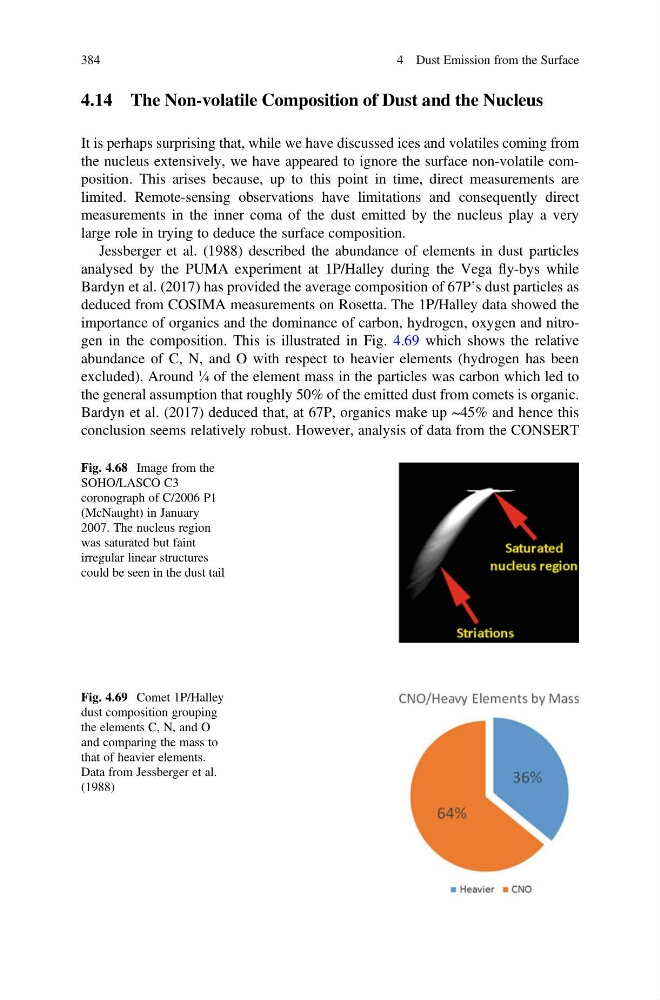
importance of organics and the dominance of carbon, hydrogen, oxygen and nitrogen in the composition. This is illustrated in Fig. 4.69 which shows the relative
abundance of C, N, and O with respect to heavier elements (hydrogen has been
excluded). Around ¼ of the element mass in the particles was carbon which led to
the general assumption that roughly 50% of the emitted dust from comets is organic.
Bardyn et al. (2017) deduced that, at 67P, organics make up ~45% and hence this
conclusion seems relatively robust. However, analysis of data from the CONSERT
Fig. 4.69 Comet 1P/Halley
dust composition grouping
the elements C, N, and O
and comparing the mass to
that of heavier elements.
Data from Jessberger et al.
(1988)
Fig. 4.68 Image from the
SOHO/LASCO C3
coronograph of C/2006 P1
(McNaught) in January
2007. The nucleus region
was saturated but faint
irregular linear structures
could be seen in the dust tail
384
4 Dust Emission from the Surface
It is perhaps surprising that, while we have discussed ices and volatiles coming from
the nucleus extensively, we have appeared to ignore the surface non-volatile composition. This arises because, up to this point in time, direct measurements are
limited. Remote-sensing observations have limitations and consequently direct
measurements in the inner coma of the dust emitted by the nucleus play a very
large role in trying to deduce the surface composition.
Jessberger et al. (1988) described the abundance of elements in dust particles
analysed by the PUMA experiment at 1P/Halley during the Vega fly-bys while
Bardyn et al. (2017) has provided the average composition of 67P’s dust particles as
deduced from COSIMA measurements on Rosetta. The 1P/Halley data showed the
importance of organics and the dominance of carbon, hydrogen, oxygen and nitrogen in the composition. This is illustrated in Fig. 4.69 which shows the relative
abundance of C, N, and O with respect to heavier elements (hydrogen has been
excluded). Around ¼ of the element mass in the particles was carbon which led to
the general assumption that roughly 50% of the emitted dust from comets is organic.
Bardyn et al. (2017) deduced that, at 67P, organics make up ~45% and hence this
conclusion seems relatively robust. However, analysis of data from the CONSERT
Fig. 4.69 Comet 1P/Halley
dust composition grouping
the elements C, N, and O
and comparing the mass to
that of heavier elements.
Data from Jessberger et al.
(1988)
Fig. 4.68 Image from the
SOHO/LASCO C3
coronograph of C/2006 P1
(McNaught) in January
2007. The nucleus region
was saturated but faint
irregular linear structures
could be seen in the dust tail
384
4 Dust Emission from the Surface