

their data with the 1.3 μm radius dust aggregates composed of 1000 spherical
monomers of 0.1 μm and refractive indices of m ref ¼ (1.65, i0.05) although the
number of measurements obtained was small and exclusively at low phase angle.
The similarity to values suggested as fitting the 67P phase function and the infrared
spectra of 67P is somewhat remarkable.
4.13 Equation of Motion of Charged Dust
Once the dust particles have de-coupled from the gas and particles are outside the
Hill sphere (typically at distances >300 km), the gas drag and gravity terms
disappear from the equation of motion and the major influence on particle motion
results from radiation pressure resulting in the “fountain-like” appearance of the dust
coma. However, there are other, more subtle, forces at work. In particular, dust
particle charging combined with the inter-planetary magnetic field can influence dust
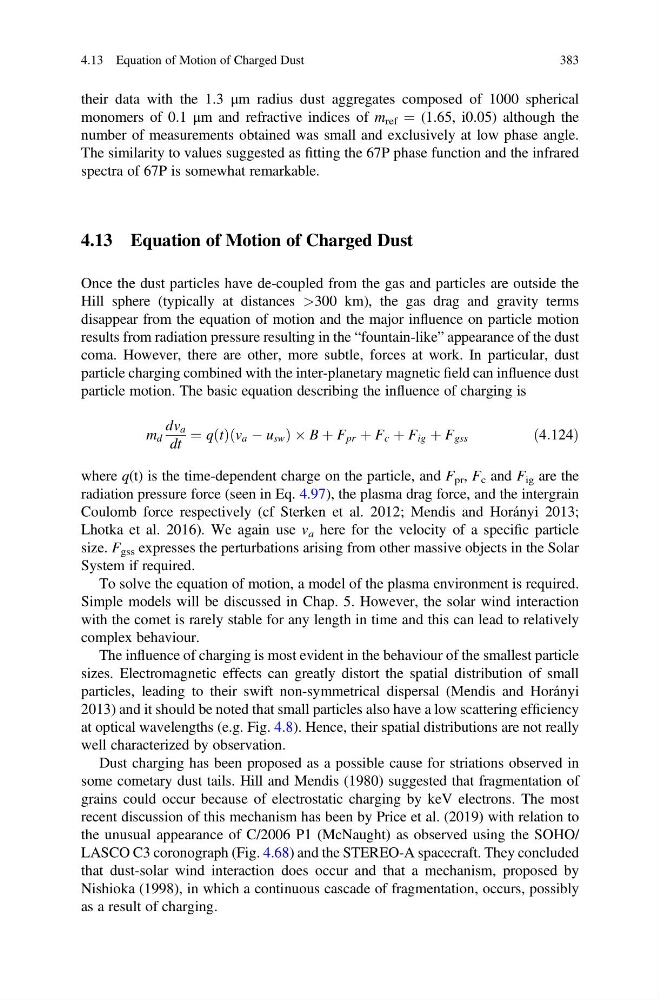
particle motion. The basic equation describing the influence of charging is
m d
dv a
dt
¼ q t
ð Þ v a À u sw
ð
ÞÂB þ F pr þ F c þ F ig þ F gss
ð4:124Þ
where q(t) is the time-dependent charge on the particle, and F pr , F c and F ig are the
radiation pressure force (seen in Eq. 4.97), the plasma drag force, and the intergrain
Coulomb force respectively (cf Sterken et al. 2012; Mendis and Horányi 2013;
Lhotka et al. 2016). We again use v a here for the velocity of a specific particle
size. F gss expresses the perturbations arising from other massive objects in the Solar
System if required.
To solve the equation of motion, a model of the plasma environment is required.
Simple models will be discussed in Chap. 5. However, the solar wind interaction
with the comet is rarely stable for any length in time and this can lead to relatively
complex behaviour.
The influence of charging is most evident in the behaviour of the smallest particle
sizes. Electromagnetic effects can greatly distort the spatial distribution of small
particles, leading to their swift non-symmetrical dispersal (Mendis and Horányi
2013) and it should be noted that small particles also have a low scattering efficiency
at optical wavelengths (e.g. Fig. 4.8). Hence, their spatial distributions are not really
well characterized by observation.
Dust charging has been proposed as a possible cause for striations observed in
some cometary dust tails. Hill and Mendis (1980) suggested that fragmentation of
grains could occur because of electrostatic charging by keV electrons. The most
recent discussion of this mechanism has been by Price et al. (2019) with relation to
the unusual appearance of C/2006 P1 (McNaught) as observed using the SOHO/
LASCO C3 coronograph (Fig. 4.68) and the STEREO-A spacecraft. They concluded
that dust-solar wind interaction does occur and that a mechanism, proposed by
Nishioka (1998), in which a continuous cascade of fragmentation, occurs, possibly
as a result of charging.
4.13 Equation of Motion of Charged Dust
383
monomers of 0.1 μm and refractive indices of m ref ¼ (1.65, i0.05) although the
number of measurements obtained was small and exclusively at low phase angle.
The similarity to values suggested as fitting the 67P phase function and the infrared
spectra of 67P is somewhat remarkable.
4.13 Equation of Motion of Charged Dust
Once the dust particles have de-coupled from the gas and particles are outside the
Hill sphere (typically at distances >300 km), the gas drag and gravity terms
disappear from the equation of motion and the major influence on particle motion
results from radiation pressure resulting in the “fountain-like” appearance of the dust
coma. However, there are other, more subtle, forces at work. In particular, dust
particle charging combined with the inter-planetary magnetic field can influence dust
particle motion. The basic equation describing the influence of charging is
m d
dv a
dt
¼ q t
ð Þ v a À u sw
ð
ÞÂB þ F pr þ F c þ F ig þ F gss
ð4:124Þ
where q(t) is the time-dependent charge on the particle, and F pr , F c and F ig are the
radiation pressure force (seen in Eq. 4.97), the plasma drag force, and the intergrain
Coulomb force respectively (cf Sterken et al. 2012; Mendis and Horányi 2013;
Lhotka et al. 2016). We again use v a here for the velocity of a specific particle
size. F gss expresses the perturbations arising from other massive objects in the Solar
System if required.
To solve the equation of motion, a model of the plasma environment is required.
Simple models will be discussed in Chap. 5. However, the solar wind interaction
with the comet is rarely stable for any length in time and this can lead to relatively
complex behaviour.
The influence of charging is most evident in the behaviour of the smallest particle
sizes. Electromagnetic effects can greatly distort the spatial distribution of small
particles, leading to their swift non-symmetrical dispersal (Mendis and Horányi
2013) and it should be noted that small particles also have a low scattering efficiency
at optical wavelengths (e.g. Fig. 4.8). Hence, their spatial distributions are not really
well characterized by observation.
Dust charging has been proposed as a possible cause for striations observed in
some cometary dust tails. Hill and Mendis (1980) suggested that fragmentation of
grains could occur because of electrostatic charging by keV electrons. The most
recent discussion of this mechanism has been by Price et al. (2019) with relation to
the unusual appearance of C/2006 P1 (McNaught) as observed using the SOHO/
LASCO C3 coronograph (Fig. 4.68) and the STEREO-A spacecraft. They concluded
that dust-solar wind interaction does occur and that a mechanism, proposed by
Nishioka (1998), in which a continuous cascade of fragmentation, occurs, possibly
as a result of charging.
4.13 Equation of Motion of Charged Dust
383