

For phase angles larger than 30–40
, the polarization at a given phase angle
increases with wavelength, a phenomenon sometimes referred to as the polarization
colour effect. A convenient way of representing this effect is to use a polarimetric
colour gradient
ΔƤ
Δλ
¼
Ƥ λ 2
ð Þ À Ƥ λ 1
ð Þ
λ 2 À λ 1
ð4:123Þ
which may be adequate over a limited wavelength range.
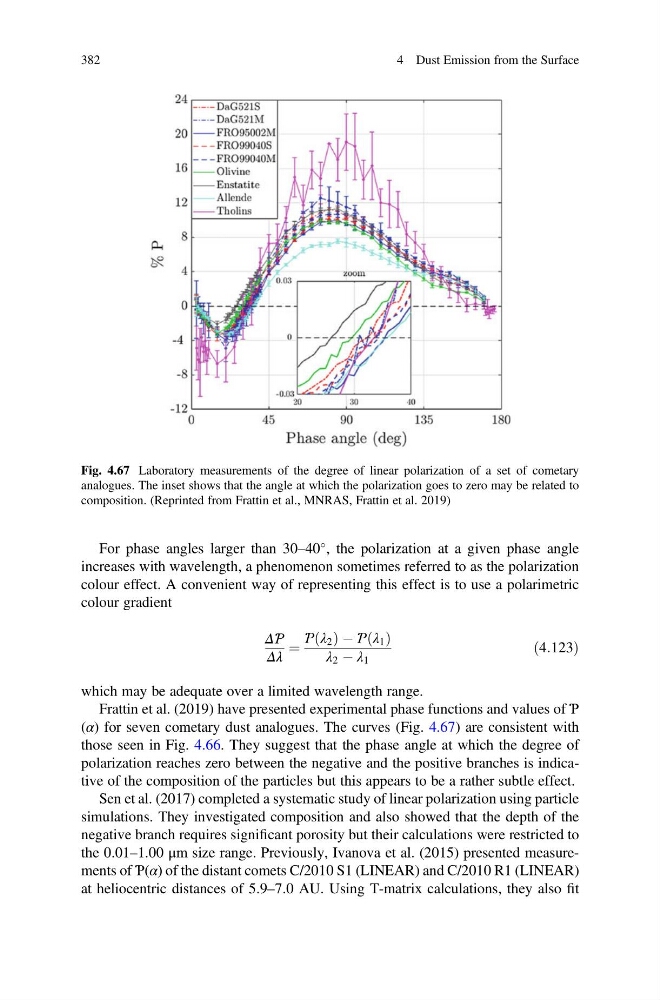
Frattin et al. (2019) have presented experimental phase functions and values of Ƥ
(α) for seven cometary dust analogues. The curves (Fig. 4.67) are consistent with
those seen in Fig. 4.66. They suggest that the phase angle at which the degree of
polarization reaches zero between the negative and the positive branches is indicative of the composition of the particles but this appears to be a rather subtle effect.
Sen et al. (2017) completed a systematic study of linear polarization using particle
simulations. They investigated composition and also showed that the depth of the
negative branch requires significant porosity but their calculations were restricted to
the 0.01–1.00 μm size range. Previously, Ivanova et al. (2015) presented measurements of Ƥ(α) of the distant comets C/2010 S1 (LINEAR) and C/2010 R1 (LINEAR)
at heliocentric distances of 5.9–7.0 AU. Using T-matrix calculations, they also fit
Fig. 4.67 Laboratory measurements of the degree of linear polarization of a set of cometary
analogues. The inset shows that the angle at which the polarization goes to zero may be related to
composition. (Reprinted from Frattin et al., MNRAS, Frattin et al. 2019)
382
4 Dust Emission from the Surface
, the polarization at a given phase angle
increases with wavelength, a phenomenon sometimes referred to as the polarization
colour effect. A convenient way of representing this effect is to use a polarimetric
colour gradient
ΔƤ
Δλ
¼
Ƥ λ 2
ð Þ À Ƥ λ 1
ð Þ
λ 2 À λ 1
ð4:123Þ
which may be adequate over a limited wavelength range.
Frattin et al. (2019) have presented experimental phase functions and values of Ƥ
(α) for seven cometary dust analogues. The curves (Fig. 4.67) are consistent with
those seen in Fig. 4.66. They suggest that the phase angle at which the degree of
polarization reaches zero between the negative and the positive branches is indicative of the composition of the particles but this appears to be a rather subtle effect.
Sen et al. (2017) completed a systematic study of linear polarization using particle
simulations. They investigated composition and also showed that the depth of the
negative branch requires significant porosity but their calculations were restricted to
the 0.01–1.00 μm size range. Previously, Ivanova et al. (2015) presented measurements of Ƥ(α) of the distant comets C/2010 S1 (LINEAR) and C/2010 R1 (LINEAR)
at heliocentric distances of 5.9–7.0 AU. Using T-matrix calculations, they also fit
Fig. 4.67 Laboratory measurements of the degree of linear polarization of a set of cometary
analogues. The inset shows that the angle at which the polarization goes to zero may be related to
composition. (Reprinted from Frattin et al., MNRAS, Frattin et al. 2019)
382
4 Dust Emission from the Surface