

collecting dust particles at a comet, in this case, 81P/Wild 2, and returning these to
Earth. With such a mission there could be little or no discussion about the exact
origin of the collected material and the full capabilities of Earth-based analytical
laboratories could be thrown at the samples. The basic elemental composition
obtained from measurements of particles collected by the Stardust experiment is
also shown in Fig. 4.70 for comparison. Heavier elements were also collected and
their relative abundances provided by Flynn et al. (2006).
The potential link between organic molecules in the interstellar medium and
comets has been discussed in the literature for many years (e.g. Ehrenfreund and
Charnley 2000). The presence of organic material in comets and the knowledge that
their ejected dust has entered the Earth’s atmosphere (Brownlee 1977) has led to the
concept that comets carry and spread complex organics throughout the Solar System.
But how complex can these organics become before they impact a Solar System
body?
The Stardust mission had the detection of organic species as a secondary goal.
The organics associated with the returned particles and the associated particle tracks
in the aerogel collection system were found to be a mixture of aromatic, aliphatic,
and polycyclic aromatic hydrocarbons (PAHs) (Sandford et al. 2006). Glavin et al.
(2008) identified methylamine and ethylamine above background levels in hot-water
extracts of returned Stardust materials. Glycine, the simplest amino acid (NH 2 –CH 2 –
COOH) was also found but was also present in the control sample initially indicating
a terrestrial origin. Subsequently, Elsila et al. (2009) reported detection of glycine in
the samples in addition to β- and L-alanine (2-aminopropanoic acid—C 3 H 7 NO 2 )
which is a left-handed molecule that is incorporated into a significant fraction of
known proteins.
Glycine was detected in the gas phase of 67P by ROSINA (Altwegg et al. 2016).
Hadraoui et al. (2019) suggest that the observations are consistent with an extended
source with the glycine being embedded in water ice that sublimes from dust
particles after ejection from the surface. On the other hand, despite several attempts,
interstellar glycine has not yet been detected (Ohishi et al. 2019) and there are
grounds to suggest that its destruction through energetic particle radiation may be
quite rapid unless it is “shielded” by a sufficient depth of material such as water ice
(Maté et al. 2015).
Some insoluble inorganic matter was also found in the Stardust samples and
analysis determined that it contained a consistent functional group chemistry, dominated by carboxyl and ketone bonding, with a variable amount of aromatic C¼C
bonding (De Gregorio et al. 2011; Westphal et al. 2017).
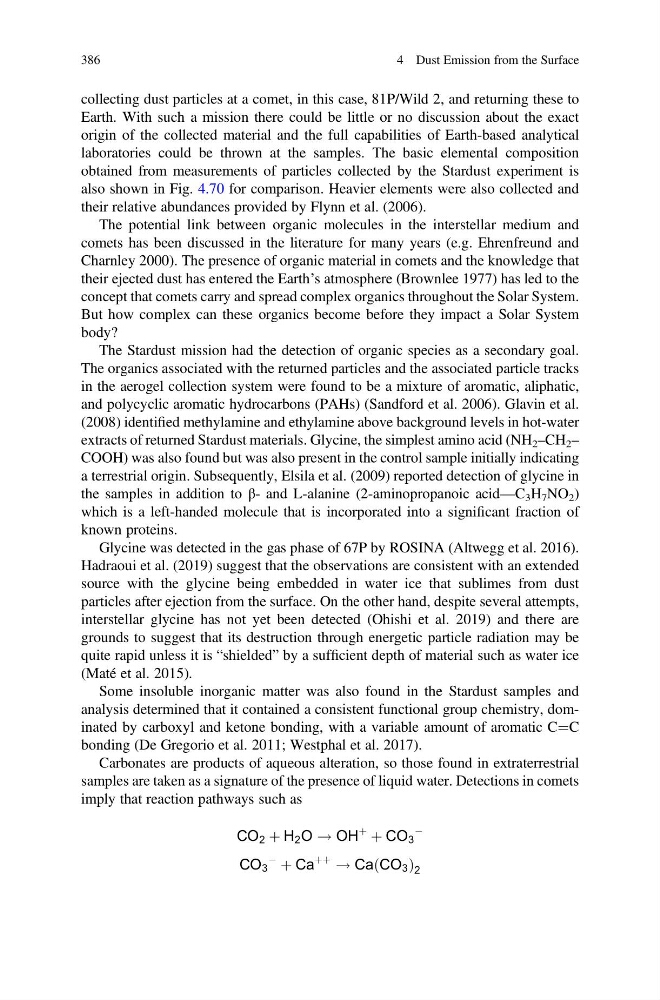
Carbonates are products of aqueous alteration, so those found in extraterrestrial
samples are taken as a signature of the presence of liquid water. Detections in comets
imply that reaction pathways such as
CO 2 þ H 2 O ! OH
þ
þ CO 3
À
CO 3
À þ Ca
þþ ! Ca CO 3
ð
Þ 2
386
4 Dust Emission from the Surface
Earth. With such a mission there could be little or no discussion about the exact
origin of the collected material and the full capabilities of Earth-based analytical
laboratories could be thrown at the samples. The basic elemental composition
obtained from measurements of particles collected by the Stardust experiment is
also shown in Fig. 4.70 for comparison. Heavier elements were also collected and
their relative abundances provided by Flynn et al. (2006).
The potential link between organic molecules in the interstellar medium and
comets has been discussed in the literature for many years (e.g. Ehrenfreund and
Charnley 2000). The presence of organic material in comets and the knowledge that
their ejected dust has entered the Earth’s atmosphere (Brownlee 1977) has led to the
concept that comets carry and spread complex organics throughout the Solar System.
But how complex can these organics become before they impact a Solar System
body?
The Stardust mission had the detection of organic species as a secondary goal.
The organics associated with the returned particles and the associated particle tracks
in the aerogel collection system were found to be a mixture of aromatic, aliphatic,
and polycyclic aromatic hydrocarbons (PAHs) (Sandford et al. 2006). Glavin et al.
(2008) identified methylamine and ethylamine above background levels in hot-water
extracts of returned Stardust materials. Glycine, the simplest amino acid (NH 2 –CH 2 –
COOH) was also found but was also present in the control sample initially indicating
a terrestrial origin. Subsequently, Elsila et al. (2009) reported detection of glycine in
the samples in addition to β- and L-alanine (2-aminopropanoic acid—C 3 H 7 NO 2 )
which is a left-handed molecule that is incorporated into a significant fraction of
known proteins.
Glycine was detected in the gas phase of 67P by ROSINA (Altwegg et al. 2016).
Hadraoui et al. (2019) suggest that the observations are consistent with an extended
source with the glycine being embedded in water ice that sublimes from dust
particles after ejection from the surface. On the other hand, despite several attempts,
interstellar glycine has not yet been detected (Ohishi et al. 2019) and there are
grounds to suggest that its destruction through energetic particle radiation may be
quite rapid unless it is “shielded” by a sufficient depth of material such as water ice
(Maté et al. 2015).
Some insoluble inorganic matter was also found in the Stardust samples and
analysis determined that it contained a consistent functional group chemistry, dominated by carboxyl and ketone bonding, with a variable amount of aromatic C¼C
bonding (De Gregorio et al. 2011; Westphal et al. 2017).
Carbonates are products of aqueous alteration, so those found in extraterrestrial
samples are taken as a signature of the presence of liquid water. Detections in comets
imply that reaction pathways such as
CO 2 þ H 2 O ! OH
þ
þ CO 3
À
CO 3
À þ Ca
þþ ! Ca CO 3
ð
Þ 2
386
4 Dust Emission from the Surface