

an ideal one. Impurities will affect the absorption coefficient and it is straightforward
to imagine that, for example, carbonaceous materials with high absorption at visible
wavelengths could be combined with water ice in particles at the source leading to
more rapid sublimation once the particles have left the surface. However, at present
we have no concrete evidence for such a scenario. On the other hand, we have
already seen (Sect. 3.2) that extended sources of gas species have been seen both in
situ and from the ground.
VIRTIS-H observations of the thermal and reflected dust continuum have been
studied by Bockelée-Morvan et al. (2019). The basic approach is illustrated in
Fig. 4.65 which uses a style of presentation similar to that seen in the BockeléeMorvan paper. The reflected continuum is fit with a Planck function at the temperature of the Sun while the thermal emission from the dust is fit with a Planck function
at a temperature to be determined and found in this case to be 295.2 K. However, the
reflected and thermal continua are not independent because they are linked through
the scattering properties of the particles—the absorbed solar flux needs to be
matched self-consistently with the thermal emission. Here, we use a slightly different
approach to that given by Bockelée-Morvan et al. (2019) for illustrative purposes.
Taking the Sun as a black-body, the reflected spectral intensity
(in [W m
À2 sr
À1 nm
À1
] for example) from a particle is given by
I ref λ
ð Þ ¼
B λ T ⨀
ð Þ
k N
S ⨀
r 2
h
Q sca λ
ð Þ πa
2
Φ α
ð Þ
ð4:119Þ
where S ⨀ is the integrated solar flux, and B λ and k N are defined in Eqs. (2.9) and
(2.10) to normalize the Planck function and B λ is computed at the effective temperature of the Sun, T ⨀ . The phase function is normalized over all solid angles to
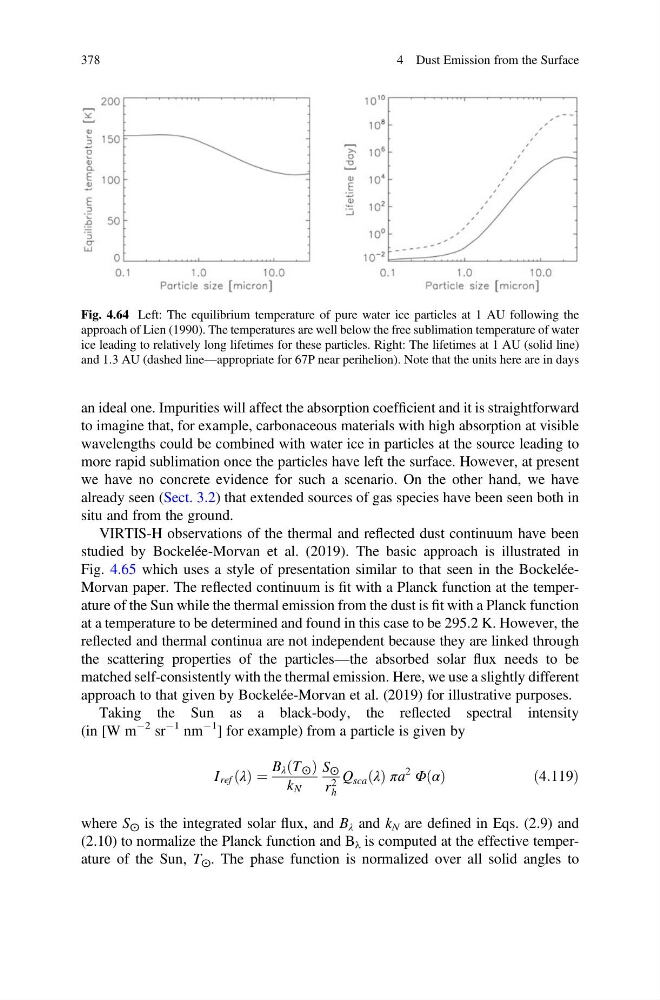
Fig. 4.64 Left: The equilibrium temperature of pure water ice particles at 1 AU following the
approach of Lien (1990). The temperatures are well below the free sublimation temperature of water
ice leading to relatively long lifetimes for these particles. Right: The lifetimes at 1 AU (solid line)
and 1.3 AU (dashed line—appropriate for 67P near perihelion). Note that the units here are in days
378
4 Dust Emission from the Surface
to imagine that, for example, carbonaceous materials with high absorption at visible
wavelengths could be combined with water ice in particles at the source leading to
more rapid sublimation once the particles have left the surface. However, at present
we have no concrete evidence for such a scenario. On the other hand, we have
already seen (Sect. 3.2) that extended sources of gas species have been seen both in
situ and from the ground.
VIRTIS-H observations of the thermal and reflected dust continuum have been
studied by Bockelée-Morvan et al. (2019). The basic approach is illustrated in
Fig. 4.65 which uses a style of presentation similar to that seen in the BockeléeMorvan paper. The reflected continuum is fit with a Planck function at the temperature of the Sun while the thermal emission from the dust is fit with a Planck function
at a temperature to be determined and found in this case to be 295.2 K. However, the
reflected and thermal continua are not independent because they are linked through
the scattering properties of the particles—the absorbed solar flux needs to be
matched self-consistently with the thermal emission. Here, we use a slightly different
approach to that given by Bockelée-Morvan et al. (2019) for illustrative purposes.
Taking the Sun as a black-body, the reflected spectral intensity
(in [W m
À2 sr
À1 nm
À1
] for example) from a particle is given by
I ref λ
ð Þ ¼
B λ T ⨀
ð Þ
k N
S ⨀
r 2
h
Q sca λ
ð Þ πa
2
Φ α
ð Þ
ð4:119Þ
where S ⨀ is the integrated solar flux, and B λ and k N are defined in Eqs. (2.9) and
(2.10) to normalize the Planck function and B λ is computed at the effective temperature of the Sun, T ⨀ . The phase function is normalized over all solid angles to
Fig. 4.64 Left: The equilibrium temperature of pure water ice particles at 1 AU following the
approach of Lien (1990). The temperatures are well below the free sublimation temperature of water
ice leading to relatively long lifetimes for these particles. Right: The lifetimes at 1 AU (solid line)
and 1.3 AU (dashed line—appropriate for 67P near perihelion). Note that the units here are in days
378
4 Dust Emission from the Surface