

As pointed out by Lien (1990), there are additional heating terms arising from
heating by the gas (collision, conduction, and radiation terms), from interaction with
the solar wind, and from re-radiation by the nucleus. In most cases, these factors can
be ignored. However, the heating of slow moving, possibly bound, large particles by
the thermal emission from the nucleus is of potential importance given the large solid
angle that the nucleus can subtend at the particle’s position.
The power thermally re-radiated by the particle can be expressed as
E rad ¼ 4πa
2
Z 1
0
Q abs a, λ
ð ÞB λ T
ð Þ dλ
ð4:118Þ
where B λ (T) is the wavelength-dependent Planck radiation function at the particle’s temperature (Eq. 2.9). Q abs appears in this equation as a consequence of
Kirchhoff’s law because, in equilibrium, the absorption efficiency must equal the
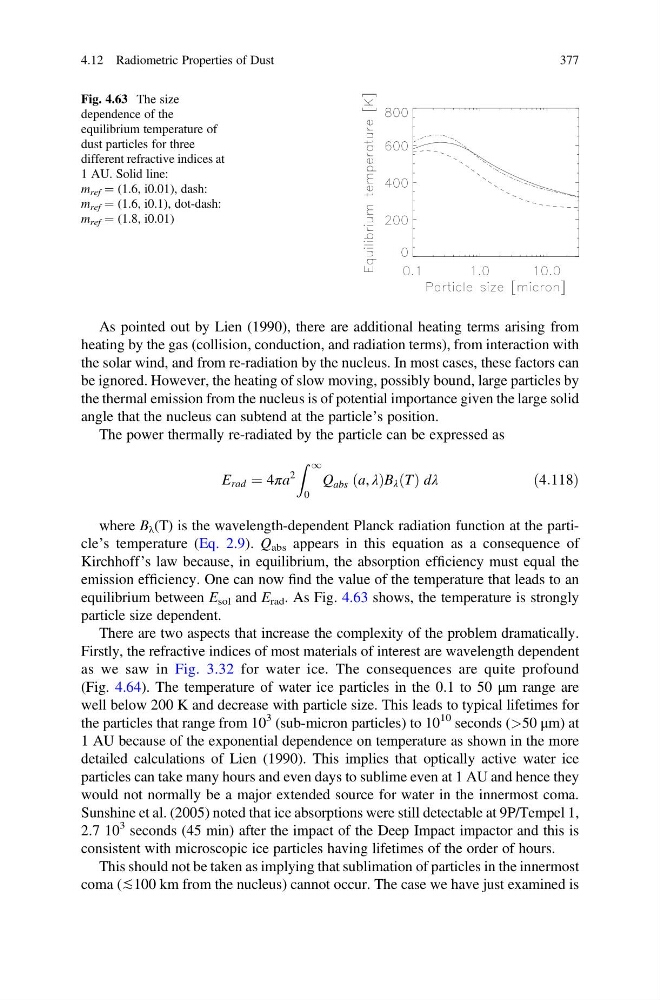
emission efficiency. One can now find the value of the temperature that leads to an
equilibrium between E sol and E rad . As Fig. 4.63 shows, the temperature is strongly
particle size dependent.
There are two aspects that increase the complexity of the problem dramatically.
Firstly, the refractive indices of most materials of interest are wavelength dependent
as we saw in Fig. 3.32 for water ice. The consequences are quite profound
(Fig. 4.64). The temperature of water ice particles in the 0.1 to 50 μm range are
well below 200 K and decrease with particle size. This leads to typical lifetimes for
the particles that range from 10
3 (sub-micron particles) to 10
10 seconds (>50 μm) at
1 AU because of the exponential dependence on temperature as shown in the more
detailed calculations of Lien (1990). This implies that optically active water ice
particles can take many hours and even days to sublime even at 1 AU and hence they
would not normally be a major extended source for water in the innermost coma.
Sunshine et al. (2005) noted that ice absorptions were still detectable at 9P/Tempel 1,
2.7 10
3 seconds (45 min) after the impact of the Deep Impact impactor and this is
consistent with microscopic ice particles having lifetimes of the order of hours.
This should not be taken as implying that sublimation of particles in the innermost
coma (≲100 km from the nucleus) cannot occur. The case we have just examined is
Fig. 4.63 The size
dependence of the
equilibrium temperature of
dust particles for three
different refractive indices at
1 AU. Solid line:
m ref ¼ (1.6, i0.01), dash:
m ref ¼ (1.6, i0.1), dot-dash:
m ref ¼ (1.8, i0.01)
4.12 Radiometric Properties of Dust
377
heating by the gas (collision, conduction, and radiation terms), from interaction with
the solar wind, and from re-radiation by the nucleus. In most cases, these factors can
be ignored. However, the heating of slow moving, possibly bound, large particles by
the thermal emission from the nucleus is of potential importance given the large solid
angle that the nucleus can subtend at the particle’s position.
The power thermally re-radiated by the particle can be expressed as
E rad ¼ 4πa
2
Z 1
0
Q abs a, λ
ð ÞB λ T
ð Þ dλ
ð4:118Þ
where B λ (T) is the wavelength-dependent Planck radiation function at the particle’s temperature (Eq. 2.9). Q abs appears in this equation as a consequence of
Kirchhoff’s law because, in equilibrium, the absorption efficiency must equal the
emission efficiency. One can now find the value of the temperature that leads to an
equilibrium between E sol and E rad . As Fig. 4.63 shows, the temperature is strongly
particle size dependent.
There are two aspects that increase the complexity of the problem dramatically.
Firstly, the refractive indices of most materials of interest are wavelength dependent
as we saw in Fig. 3.32 for water ice. The consequences are quite profound
(Fig. 4.64). The temperature of water ice particles in the 0.1 to 50 μm range are
well below 200 K and decrease with particle size. This leads to typical lifetimes for
the particles that range from 10
3 (sub-micron particles) to 10
10 seconds (>50 μm) at
1 AU because of the exponential dependence on temperature as shown in the more
detailed calculations of Lien (1990). This implies that optically active water ice
particles can take many hours and even days to sublime even at 1 AU and hence they
would not normally be a major extended source for water in the innermost coma.
Sunshine et al. (2005) noted that ice absorptions were still detectable at 9P/Tempel 1,
2.7 10
3 seconds (45 min) after the impact of the Deep Impact impactor and this is
consistent with microscopic ice particles having lifetimes of the order of hours.
This should not be taken as implying that sublimation of particles in the innermost
coma (≲100 km from the nucleus) cannot occur. The case we have just examined is
Fig. 4.63 The size
dependence of the
equilibrium temperature of
dust particles for three
different refractive indices at
1 AU. Solid line:
m ref ¼ (1.6, i0.01), dash:
m ref ¼ (1.6, i0.1), dot-dash:
m ref ¼ (1.8, i0.01)
4.12 Radiometric Properties of Dust
377