

this phenomenon in an atmosphere with an optical depth in the range 0.6–0.8
(Thomas et al. 1999). With the optical depth from the Sun to the surface at 1P/Halley
at the time of the Giotto fly-by also being close to this range, this explanation is
plausible (cf Salo 1988). In cases where the optical depth is <0.1 (as is the case for
most observations of 67P), the influence of this effect on measurements should be
minimal.
Some of the ground-based studies have included the determination of spatial
variations in the colour of dust comae on large scales by subtraction of images
acquired through different filters. A recent example for 67P is given in Rosenbush
et al. (2017). The cause of spatial variations in colour remains somewhat spectulative
with the obvious candidates being variations in size and/or composition at the
source. While Rosetta/OSIRIS observations at 67P might be useful in addressing
this problem, there are issues with “optical ghosts” caused by having weak but
non-negligible internal reflections within the cameras that produce uncertainty with
these subtle effects at low optical depths.
4.12.2 The Thermal Properties of Dust and Sublimation
We have so far focussed on scattering of sunlight by the dust particles. However,
they absorb and re-radiate sunlight if the single scattering albedo is less than 1. As
we have alluded to in the previous section, absorbed energy can sublime residual ice
in the particle (potentially affecting its cross-section). It can also heat the gas (either
through radiation or conduction) and thereby affect the energy available for expansion. The absorbed energy per second is given by (Lien 1990).
E sol ¼ πa
2
Z 1
0
Q abs λ
ð Þ
F ⨀
r 2
h
dλ
ð4:117Þ
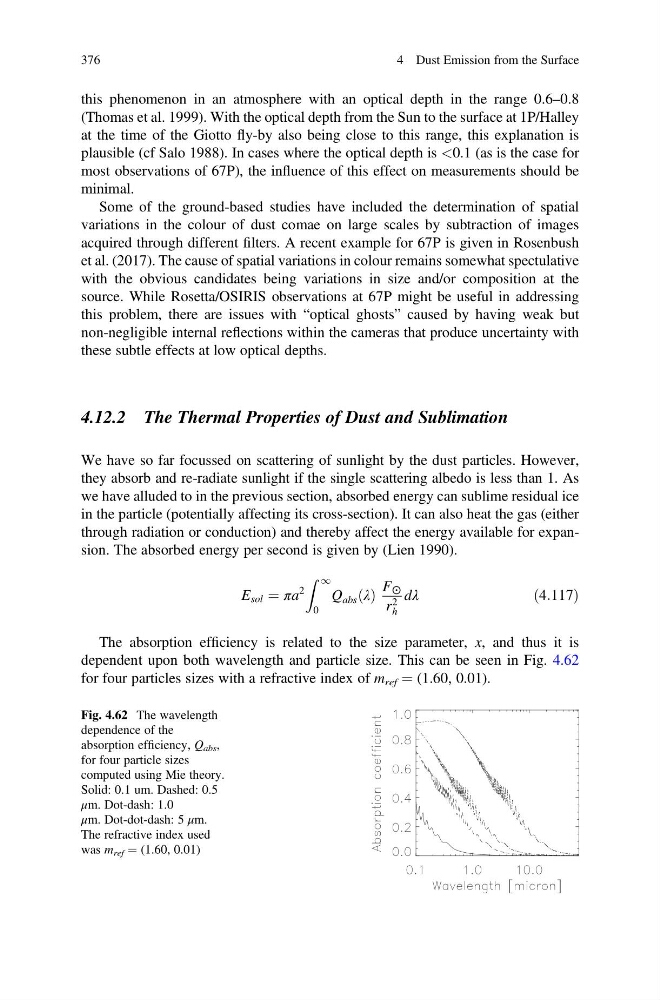
The absorption efficiency is related to the size parameter, x, and thus it is
dependent upon both wavelength and particle size. This can be seen in Fig. 4.62
for four particles sizes with a refractive index of m ref ¼ (1.60, 0.01).
Fig. 4.62 The wavelength
dependence of the
absorption efficiency, Q abs ,
for four particle sizes
computed using Mie theory.
Solid: 0.1 um. Dashed: 0.5
μm. Dot-dash: 1.0
μm. Dot-dot-dash: 5 μm.
The refractive index used
was m ref ¼ (1.60, 0.01)
376
4 Dust Emission from the Surface
(Thomas et al. 1999). With the optical depth from the Sun to the surface at 1P/Halley
at the time of the Giotto fly-by also being close to this range, this explanation is
plausible (cf Salo 1988). In cases where the optical depth is <0.1 (as is the case for
most observations of 67P), the influence of this effect on measurements should be
minimal.
Some of the ground-based studies have included the determination of spatial
variations in the colour of dust comae on large scales by subtraction of images
acquired through different filters. A recent example for 67P is given in Rosenbush
et al. (2017). The cause of spatial variations in colour remains somewhat spectulative
with the obvious candidates being variations in size and/or composition at the
source. While Rosetta/OSIRIS observations at 67P might be useful in addressing
this problem, there are issues with “optical ghosts” caused by having weak but
non-negligible internal reflections within the cameras that produce uncertainty with
these subtle effects at low optical depths.
4.12.2 The Thermal Properties of Dust and Sublimation
We have so far focussed on scattering of sunlight by the dust particles. However,
they absorb and re-radiate sunlight if the single scattering albedo is less than 1. As
we have alluded to in the previous section, absorbed energy can sublime residual ice
in the particle (potentially affecting its cross-section). It can also heat the gas (either
through radiation or conduction) and thereby affect the energy available for expansion. The absorbed energy per second is given by (Lien 1990).
E sol ¼ πa
2
Z 1
0
Q abs λ
ð Þ
F ⨀
r 2
h
dλ
ð4:117Þ
The absorption efficiency is related to the size parameter, x, and thus it is
dependent upon both wavelength and particle size. This can be seen in Fig. 4.62
for four particles sizes with a refractive index of m ref ¼ (1.60, 0.01).
Fig. 4.62 The wavelength
dependence of the
absorption efficiency, Q abs ,
for four particle sizes
computed using Mie theory.
Solid: 0.1 um. Dashed: 0.5
μm. Dot-dash: 1.0
μm. Dot-dot-dash: 5 μm.
The refractive index used
was m ref ¼ (1.60, 0.01)
376
4 Dust Emission from the Surface