

asymptotic behaviour of the azimuthal average in the observation. This should not be
terribly surprising because we are, after all, breaching the main condition that is
required to produce a 1/r dependence of the brightness distribution—namely forcefree radial outflow.
The timescales for motion of large particles within the Hill sphere are very long.
A single loop of an orbit may take several days. (This leads to the long integration
times needed for the numerical models we have just discussed.) As a result, small
forces acting on large, slow moving, particles may have a significant effect if
integrated over long periods. For example, while the dust may be “de-coupled”
from the gas on short timescales, momentum transfer from expanding gas to the dust
particles would never be exactly zero. Perhaps more importantly, solar radiation
pressure on a centimetre-sized particle can result in an anti-sunward velocity change
of 5–10 cm s
À1 at 1 AU. This force dominates Lorentz force, Poynting-Robertson
effect, and ion drag by several orders of magnitude for particles of this size
(e.g. Grün 2007). This implies that particles with apoapses approaching the edge
of the Hill sphere do not follow purely ballistic trajectories and will not re-impact the
nucleus at pericentre. Consequently, particles producing airfall deposits on the
nucleus are not those that have ejection velocities just below escape velocity for
objects of the size of 67P.
4.11.2 Individual Particle Dynamics
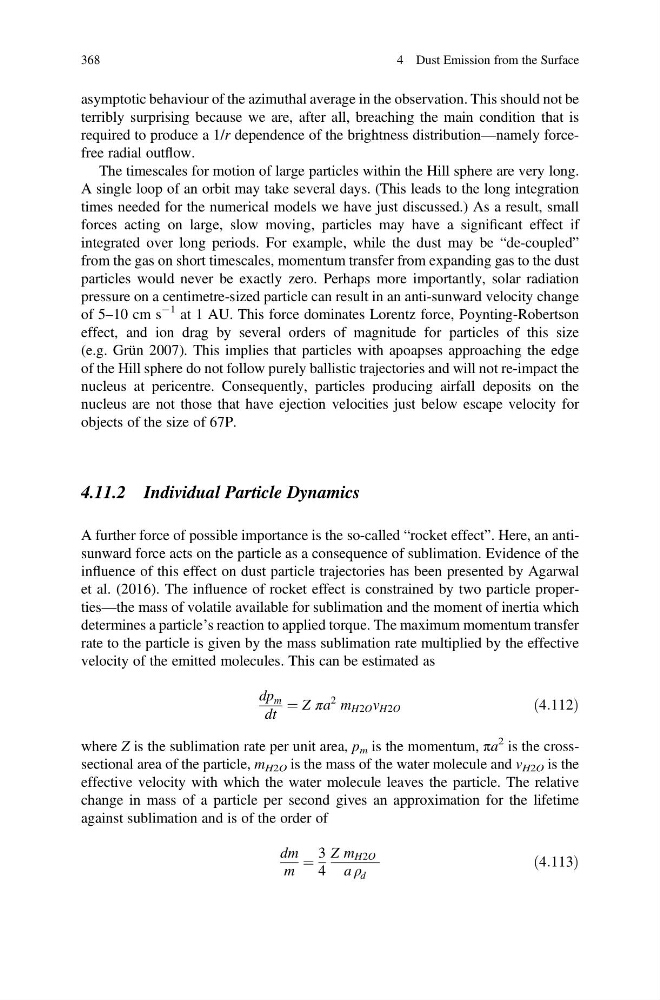
A further force of possible importance is the so-called “rocket effect”. Here, an antisunward force acts on the particle as a consequence of sublimation. Evidence of the
influence of this effect on dust particle trajectories has been presented by Agarwal
et al. (2016). The influence of rocket effect is constrained by two particle properties—the mass of volatile available for sublimation and the moment of inertia which
determines a particle’s reaction to applied torque. The maximum momentum transfer
rate to the particle is given by the mass sublimation rate multiplied by the effective
velocity of the emitted molecules. This can be estimated as
dp m
dt
¼ Z πa
2 m H2O v H2O
ð4:112Þ
where Z is the sublimation rate per unit area, p m is the momentum, πa
2 is the crosssectional area of the particle, m H2O is the mass of the water molecule and v H2O is the
effective velocity with which the water molecule leaves the particle. The relative
change in mass of a particle per second gives an approximation for the lifetime
against sublimation and is of the order of
dm
m
¼
3
4
Z m H2O
a ρ d
ð4:113Þ
368
4 Dust Emission from the Surface
terribly surprising because we are, after all, breaching the main condition that is
required to produce a 1/r dependence of the brightness distribution—namely forcefree radial outflow.
The timescales for motion of large particles within the Hill sphere are very long.
A single loop of an orbit may take several days. (This leads to the long integration
times needed for the numerical models we have just discussed.) As a result, small
forces acting on large, slow moving, particles may have a significant effect if
integrated over long periods. For example, while the dust may be “de-coupled”
from the gas on short timescales, momentum transfer from expanding gas to the dust
particles would never be exactly zero. Perhaps more importantly, solar radiation
pressure on a centimetre-sized particle can result in an anti-sunward velocity change
of 5–10 cm s
À1 at 1 AU. This force dominates Lorentz force, Poynting-Robertson
effect, and ion drag by several orders of magnitude for particles of this size
(e.g. Grün 2007). This implies that particles with apoapses approaching the edge
of the Hill sphere do not follow purely ballistic trajectories and will not re-impact the
nucleus at pericentre. Consequently, particles producing airfall deposits on the
nucleus are not those that have ejection velocities just below escape velocity for
objects of the size of 67P.
4.11.2 Individual Particle Dynamics
A further force of possible importance is the so-called “rocket effect”. Here, an antisunward force acts on the particle as a consequence of sublimation. Evidence of the
influence of this effect on dust particle trajectories has been presented by Agarwal
et al. (2016). The influence of rocket effect is constrained by two particle properties—the mass of volatile available for sublimation and the moment of inertia which
determines a particle’s reaction to applied torque. The maximum momentum transfer
rate to the particle is given by the mass sublimation rate multiplied by the effective
velocity of the emitted molecules. This can be estimated as
dp m
dt
¼ Z πa
2 m H2O v H2O
ð4:112Þ
where Z is the sublimation rate per unit area, p m is the momentum, πa
2 is the crosssectional area of the particle, m H2O is the mass of the water molecule and v H2O is the
effective velocity with which the water molecule leaves the particle. The relative
change in mass of a particle per second gives an approximation for the lifetime
against sublimation and is of the order of
dm
m
¼
3
4
Z m H2O
a ρ d
ð4:113Þ
368
4 Dust Emission from the Surface