

where ρ d is the particle density. dm/m takes a value of around 2 10
À4 s
À1 for 1 mm
particles giving a lifetime of just over 1 h. We shall see shortly that there are
significant issues with this calculation because of the requirement for a high absorption coefficient at optical wavelengths. However, it indicates that sublimation rates
from particles at levels comparable to the free sublimation rate cannot be maintained
and are required to be orders of magnitude lower to allow there to be significant
numbers of large particles with lifetimes long enough to populate the Hill sphere if
the large particles are mostly composed of ice.
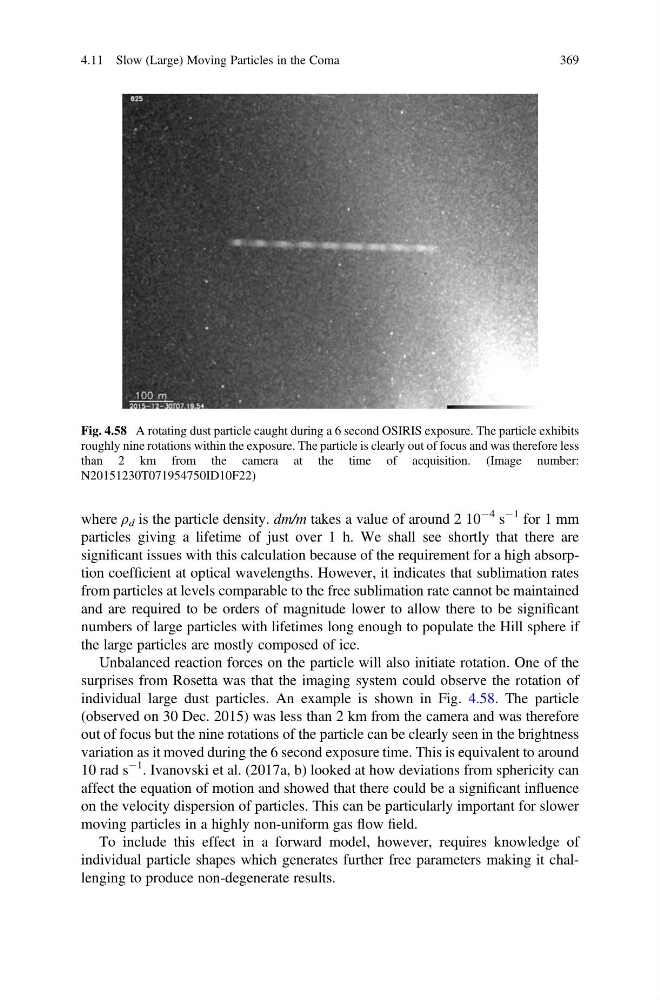
Unbalanced reaction forces on the particle will also initiate rotation. One of the
surprises from Rosetta was that the imaging system could observe the rotation of
individual large dust particles. An example is shown in Fig. 4.58. The particle
(observed on 30 Dec. 2015) was less than 2 km from the camera and was therefore
out of focus but the nine rotations of the particle can be clearly seen in the brightness
variation as it moved during the 6 second exposure time. This is equivalent to around
10 rad s
À1 . Ivanovski et al. (2017a, b) looked at how deviations from sphericity can
affect the equation of motion and showed that there could be a significant influence
on the velocity dispersion of particles. This can be particularly important for slower
moving particles in a highly non-uniform gas flow field.
To include this effect in a forward model, however, requires knowledge of
individual particle shapes which generates further free parameters making it challenging to produce non-degenerate results.
Fig. 4.58 A rotating dust particle caught during a 6 second OSIRIS exposure. The particle exhibits
roughly nine rotations within the exposure. The particle is clearly out of focus and was therefore less
than 2 km from the camera at the time of acquisition. (Image number:
N20151230T071954750ID10F22)
4.11 Slow (Large) Moving Particles in the Coma
369
À4 s
À1 for 1 mm
particles giving a lifetime of just over 1 h. We shall see shortly that there are
significant issues with this calculation because of the requirement for a high absorption coefficient at optical wavelengths. However, it indicates that sublimation rates
from particles at levels comparable to the free sublimation rate cannot be maintained
and are required to be orders of magnitude lower to allow there to be significant
numbers of large particles with lifetimes long enough to populate the Hill sphere if
the large particles are mostly composed of ice.
Unbalanced reaction forces on the particle will also initiate rotation. One of the
surprises from Rosetta was that the imaging system could observe the rotation of
individual large dust particles. An example is shown in Fig. 4.58. The particle
(observed on 30 Dec. 2015) was less than 2 km from the camera and was therefore
out of focus but the nine rotations of the particle can be clearly seen in the brightness
variation as it moved during the 6 second exposure time. This is equivalent to around
10 rad s
À1 . Ivanovski et al. (2017a, b) looked at how deviations from sphericity can
affect the equation of motion and showed that there could be a significant influence
on the velocity dispersion of particles. This can be particularly important for slower
moving particles in a highly non-uniform gas flow field.
To include this effect in a forward model, however, requires knowledge of
individual particle shapes which generates further free parameters making it challenging to produce non-degenerate results.
Fig. 4.58 A rotating dust particle caught during a 6 second OSIRIS exposure. The particle exhibits
roughly nine rotations within the exposure. The particle is clearly out of focus and was therefore less
than 2 km from the camera at the time of acquisition. (Image number:
N20151230T071954750ID10F22)
4.11 Slow (Large) Moving Particles in the Coma
369