

even below the escape velocity. Particles with speeds less than the escape velocity do
not follow radial trajectories and populate the Hill sphere of the nucleus.
The Hill sphere of a body is the region in which the body dominates the
gravitational force acting on particles within it. The outer shell of the Hill sphere
constitutes a zero-velocity surface. To be retained by the nucleus, any particle must
have an orbit that lies within the Hill sphere. The radius of the Hill sphere can be
approximated by the equation
r Hill % a 1 À e
ð
Þ
ffiffiffiffiffiffiffiffiffiffi
M N
3M ⨀
3
r
ð4:108Þ
The actual surface within which closed orbits about the nucleus can be found also
depends upon the solar gravitational field and, if the nucleus makes a close fly-by of
a planet for example, other gravitational perturbations.
Figure 4.52 shows a nice example of the emission of slow moving particles from
the Bes region. The image on the left shows that the emission here was from one of
the cliffs when it was close to the terminator. Processing the image reveals the jet and
the particles emerging into sunlight (position A). A large number of individual
particles can be seen. (As a curiosity, there is also an image of a large particle very
close to the camera. It is clearly out of focus and moving with respect to the
spacecraft.) Using a rough estimate of the distance to the particles and the exposure
time for this image, we can place an upper limit on the velocity component of the
particles in the image plane of <10.5 m/s. In this particular case, it is not a strong
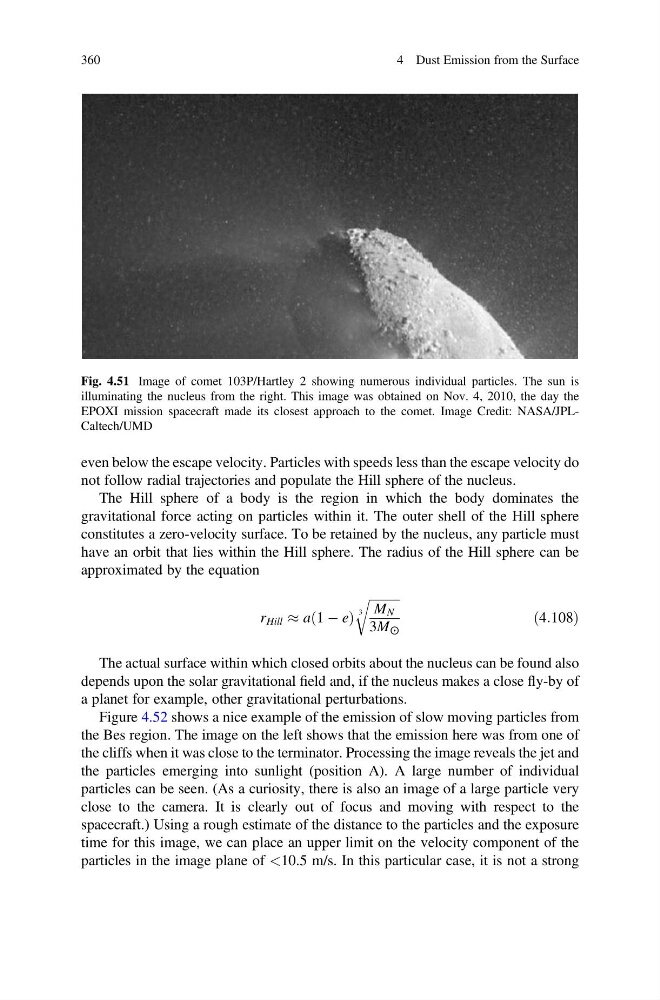
Fig. 4.51 Image of comet 103P/Hartley 2 showing numerous individual particles. The sun is
illuminating the nucleus from the right. This image was obtained on Nov. 4, 2010, the day the
EPOXI mission spacecraft made its closest approach to the comet. Image Credit: NASA/JPLCaltech/UMD
360
4 Dust Emission from the Surface
not follow radial trajectories and populate the Hill sphere of the nucleus.
The Hill sphere of a body is the region in which the body dominates the
gravitational force acting on particles within it. The outer shell of the Hill sphere
constitutes a zero-velocity surface. To be retained by the nucleus, any particle must
have an orbit that lies within the Hill sphere. The radius of the Hill sphere can be
approximated by the equation
r Hill % a 1 À e
ð
Þ
ffiffiffiffiffiffiffiffiffiffi
M N
3M ⨀
3
r
ð4:108Þ
The actual surface within which closed orbits about the nucleus can be found also
depends upon the solar gravitational field and, if the nucleus makes a close fly-by of
a planet for example, other gravitational perturbations.
Figure 4.52 shows a nice example of the emission of slow moving particles from
the Bes region. The image on the left shows that the emission here was from one of
the cliffs when it was close to the terminator. Processing the image reveals the jet and
the particles emerging into sunlight (position A). A large number of individual
particles can be seen. (As a curiosity, there is also an image of a large particle very
close to the camera. It is clearly out of focus and moving with respect to the
spacecraft.) Using a rough estimate of the distance to the particles and the exposure
time for this image, we can place an upper limit on the velocity component of the
particles in the image plane of <10.5 m/s. In this particular case, it is not a strong
Fig. 4.51 Image of comet 103P/Hartley 2 showing numerous individual particles. The sun is
illuminating the nucleus from the right. This image was obtained on Nov. 4, 2010, the day the
EPOXI mission spacecraft made its closest approach to the comet. Image Credit: NASA/JPLCaltech/UMD
360
4 Dust Emission from the Surface