

indicator of bound particles but other less spectacular images have revealed tighter
constraints (Thomas et al. 2015a).
Not all jet emissions show this level of large particle ejection. Figure 4.53 is an
illustration of this. The strong jet is smooth indicating that any large particles in the
flow, if they exist, are moving quickly compared to the exposure time for the image.
The arrow points to a series of dark traces in the image that may be large particles
between the camera and the jet. These particles are either dark compared to the
background or not illuminated and therefore occult a small part of the jet in the
far-field.
Large particles become increasingly evident when looking off the nucleus
(Fig. 4.54). The brightness of the smaller particles that form the diffuse (smeared)
brightness drops as approximately 1/b (where b is the impact parameter) while the
brightness of individual large particles remains constant. Long exposures reveal the
presence of large individuals and provides information about their motion. Repeat
imaging is normally desirable to ensure that observations are not affected by cosmic
ray events. An example of a short sequence to view individuals is shown in Fig. 4.54.
Three images are displayed. They were obtained 24 seconds apart with exposure
times of 12.5 seconds. The spacecraft was 145 km from the centre of the nucleus and
the viewing direction was pointed around 73 km off the nucleus. Individual particles
seen in all three images are identified by the same coloured arrow. Not all individuals
evident have been identified. Static bright points in the field are likely to be stars with
the SIMBAD database indicating more than 350 stars brighter than magnitude
15 should be present. Hence motion is needed to identify a particle. Nonetheless
there are clearly large numbers of individuals just in this one observation.
Figure 4.55 shows an OSIRIS NAC image in which more than 1750 individual
particles have been identified using an edge detection algorithm. The orientation of
the tracks is shown in the centre panel of Fig. 4.55 while the apparent velocity is
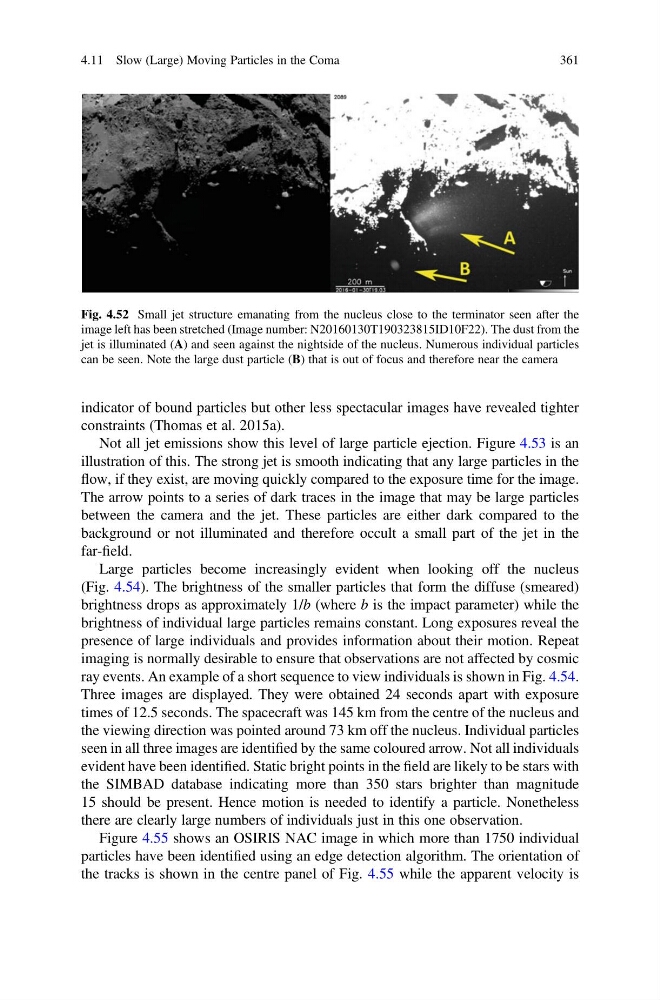
Fig. 4.52 Small jet structure emanating from the nucleus close to the terminator seen after the
image left has been stretched (Image number: N20160130T190323815ID10F22). The dust from the
jet is illuminated (A) and seen against the nightside of the nucleus. Numerous individual particles
can be seen. Note the large dust particle (B) that is out of focus and therefore near the camera
4.11 Slow (Large) Moving Particles in the Coma
361
constraints (Thomas et al. 2015a).
Not all jet emissions show this level of large particle ejection. Figure 4.53 is an
illustration of this. The strong jet is smooth indicating that any large particles in the
flow, if they exist, are moving quickly compared to the exposure time for the image.
The arrow points to a series of dark traces in the image that may be large particles
between the camera and the jet. These particles are either dark compared to the
background or not illuminated and therefore occult a small part of the jet in the
far-field.
Large particles become increasingly evident when looking off the nucleus
(Fig. 4.54). The brightness of the smaller particles that form the diffuse (smeared)
brightness drops as approximately 1/b (where b is the impact parameter) while the
brightness of individual large particles remains constant. Long exposures reveal the
presence of large individuals and provides information about their motion. Repeat
imaging is normally desirable to ensure that observations are not affected by cosmic
ray events. An example of a short sequence to view individuals is shown in Fig. 4.54.
Three images are displayed. They were obtained 24 seconds apart with exposure
times of 12.5 seconds. The spacecraft was 145 km from the centre of the nucleus and
the viewing direction was pointed around 73 km off the nucleus. Individual particles
seen in all three images are identified by the same coloured arrow. Not all individuals
evident have been identified. Static bright points in the field are likely to be stars with
the SIMBAD database indicating more than 350 stars brighter than magnitude
15 should be present. Hence motion is needed to identify a particle. Nonetheless
there are clearly large numbers of individuals just in this one observation.
Figure 4.55 shows an OSIRIS NAC image in which more than 1750 individual
particles have been identified using an edge detection algorithm. The orientation of
the tracks is shown in the centre panel of Fig. 4.55 while the apparent velocity is
Fig. 4.52 Small jet structure emanating from the nucleus close to the terminator seen after the
image left has been stretched (Image number: N20160130T190323815ID10F22). The dust from the
jet is illuminated (A) and seen against the nightside of the nucleus. Numerous individual particles
can be seen. Note the large dust particle (B) that is out of focus and therefore near the camera
4.11 Slow (Large) Moving Particles in the Coma
361