

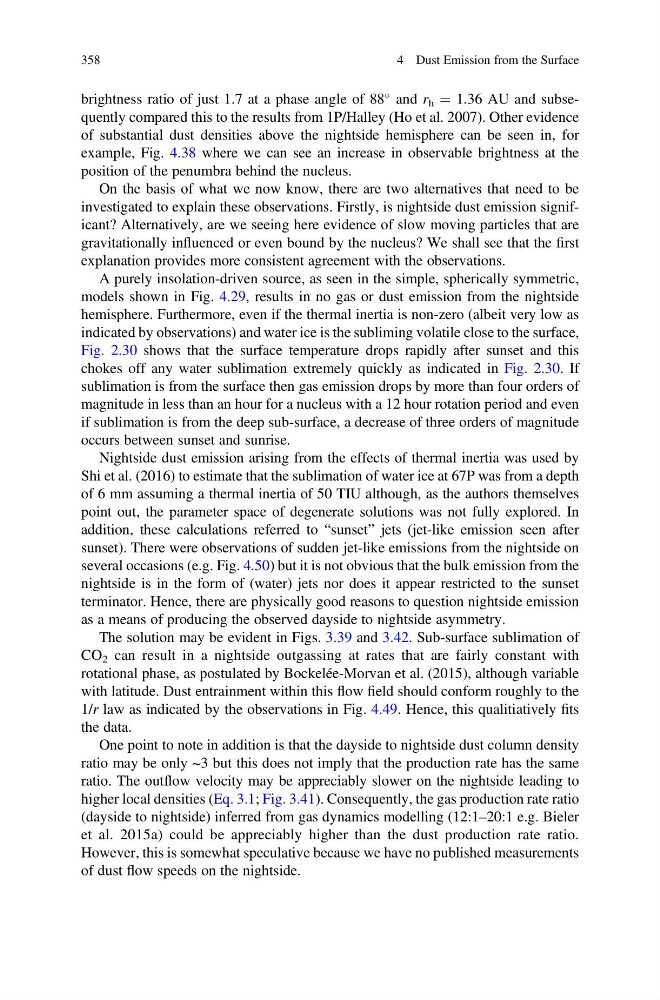
brightness ratio of just 1.7 at a phase angle of 88
and r h ¼ 1.36 AU and subsequently compared this to the results from 1P/Halley (Ho et al. 2007). Other evidence
of substantial dust densities above the nightside hemisphere can be seen in, for
example, Fig. 4.38 where we can see an increase in observable brightness at the
position of the penumbra behind the nucleus.
On the basis of what we now know, there are two alternatives that need to be
investigated to explain these observations. Firstly, is nightside dust emission significant? Alternatively, are we seeing here evidence of slow moving particles that are
gravitationally influenced or even bound by the nucleus? We shall see that the first
explanation provides more consistent agreement with the observations.
A purely insolation-driven source, as seen in the simple, spherically symmetric,
models shown in Fig. 4.29, results in no gas or dust emission from the nightside
hemisphere. Furthermore, even if the thermal inertia is non-zero (albeit very low as
indicated by observations) and water ice is the subliming volatile close to the surface,
Fig. 2.30 shows that the surface temperature drops rapidly after sunset and this
chokes off any water sublimation extremely quickly as indicated in Fig. 2.30. If
sublimation is from the surface then gas emission drops by more than four orders of
magnitude in less than an hour for a nucleus with a 12 hour rotation period and even
if sublimation is from the deep sub-surface, a decrease of three orders of magnitude
occurs between sunset and sunrise.
Nightside dust emission arising from the effects of thermal inertia was used by
Shi et al. (2016) to estimate that the sublimation of water ice at 67P was from a depth
of 6 mm assuming a thermal inertia of 50 TIU although, as the authors themselves
point out, the parameter space of degenerate solutions was not fully explored. In
addition, these calculations referred to “sunset” jets (jet-like emission seen after
sunset). There were observations of sudden jet-like emissions from the nightside on
several occasions (e.g. Fig. 4.50) but it is not obvious that the bulk emission from the
nightside is in the form of (water) jets nor does it appear restricted to the sunset
terminator. Hence, there are physically good reasons to question nightside emission
as a means of producing the observed dayside to nightside asymmetry.
The solution may be evident in Figs. 3.39 and 3.42. Sub-surface sublimation of
CO 2 can result in a nightside outgassing at rates that are fairly constant with
rotational phase, as postulated by Bockelée-Morvan et al. (2015), although variable
with latitude. Dust entrainment within this flow field should conform roughly to the
1/r law as indicated by the observations in Fig. 4.49. Hence, this qualitiatively fits
the data.
One point to note in addition is that the dayside to nightside dust column density
ratio may be only ~3 but this does not imply that the production rate has the same
ratio. The outflow velocity may be appreciably slower on the nightside leading to
higher local densities (Eq. 3.1; Fig. 3.41). Consequently, the gas production rate ratio
(dayside to nightside) inferred from gas dynamics modelling (12:1–20:1 e.g. Bieler
et al. 2015a) could be appreciably higher than the dust production rate ratio.
However, this is somewhat speculative because we have no published measurements
of dust flow speeds on the nightside.
358
4 Dust Emission from the Surface
and r h ¼ 1.36 AU and subsequently compared this to the results from 1P/Halley (Ho et al. 2007). Other evidence
of substantial dust densities above the nightside hemisphere can be seen in, for
example, Fig. 4.38 where we can see an increase in observable brightness at the
position of the penumbra behind the nucleus.
On the basis of what we now know, there are two alternatives that need to be
investigated to explain these observations. Firstly, is nightside dust emission significant? Alternatively, are we seeing here evidence of slow moving particles that are
gravitationally influenced or even bound by the nucleus? We shall see that the first
explanation provides more consistent agreement with the observations.
A purely insolation-driven source, as seen in the simple, spherically symmetric,
models shown in Fig. 4.29, results in no gas or dust emission from the nightside
hemisphere. Furthermore, even if the thermal inertia is non-zero (albeit very low as
indicated by observations) and water ice is the subliming volatile close to the surface,
Fig. 2.30 shows that the surface temperature drops rapidly after sunset and this
chokes off any water sublimation extremely quickly as indicated in Fig. 2.30. If
sublimation is from the surface then gas emission drops by more than four orders of
magnitude in less than an hour for a nucleus with a 12 hour rotation period and even
if sublimation is from the deep sub-surface, a decrease of three orders of magnitude
occurs between sunset and sunrise.
Nightside dust emission arising from the effects of thermal inertia was used by
Shi et al. (2016) to estimate that the sublimation of water ice at 67P was from a depth
of 6 mm assuming a thermal inertia of 50 TIU although, as the authors themselves
point out, the parameter space of degenerate solutions was not fully explored. In
addition, these calculations referred to “sunset” jets (jet-like emission seen after
sunset). There were observations of sudden jet-like emissions from the nightside on
several occasions (e.g. Fig. 4.50) but it is not obvious that the bulk emission from the
nightside is in the form of (water) jets nor does it appear restricted to the sunset
terminator. Hence, there are physically good reasons to question nightside emission
as a means of producing the observed dayside to nightside asymmetry.
The solution may be evident in Figs. 3.39 and 3.42. Sub-surface sublimation of
CO 2 can result in a nightside outgassing at rates that are fairly constant with
rotational phase, as postulated by Bockelée-Morvan et al. (2015), although variable
with latitude. Dust entrainment within this flow field should conform roughly to the
1/r law as indicated by the observations in Fig. 4.49. Hence, this qualitiatively fits
the data.
One point to note in addition is that the dayside to nightside dust column density
ratio may be only ~3 but this does not imply that the production rate has the same
ratio. The outflow velocity may be appreciably slower on the nightside leading to
higher local densities (Eq. 3.1; Fig. 3.41). Consequently, the gas production rate ratio
(dayside to nightside) inferred from gas dynamics modelling (12:1–20:1 e.g. Bieler
et al. 2015a) could be appreciably higher than the dust production rate ratio.
However, this is somewhat speculative because we have no published measurements
of dust flow speeds on the nightside.
358
4 Dust Emission from the Surface