

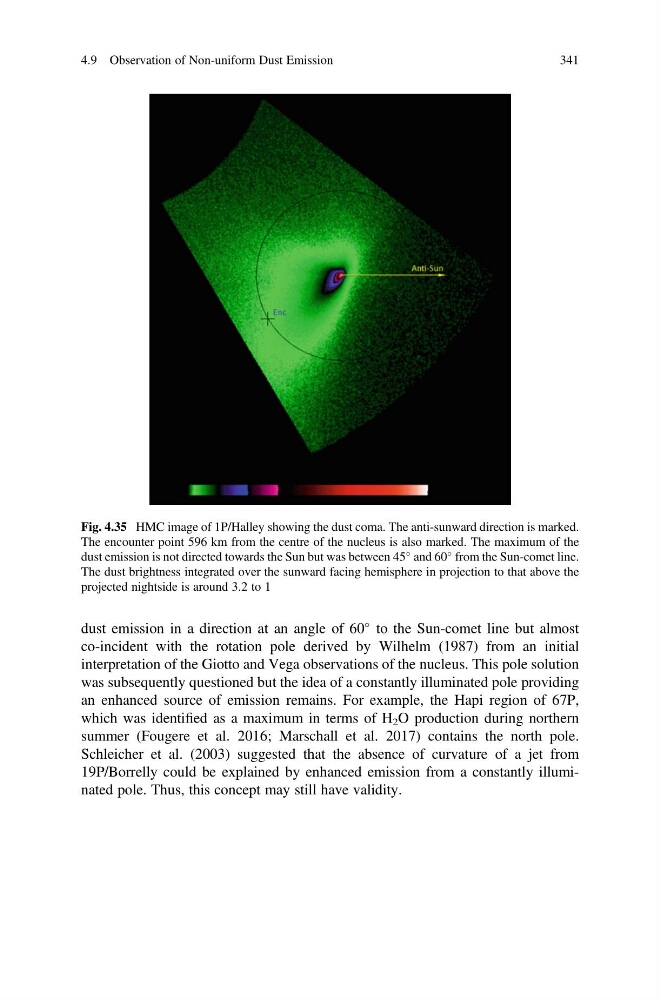
dust emission in a direction at an angle of 60
to the Sun-comet line but almost
co-incident with the rotation pole derived by Wilhelm (1987) from an initial
interpretation of the Giotto and Vega observations of the nucleus. This pole solution
was subsequently questioned but the idea of a constantly illuminated pole providing
an enhanced source of emission remains. For example, the Hapi region of 67P,
which was identified as a maximum in terms of H 2 O production during northern
summer (Fougere et al. 2016; Marschall et al. 2017) contains the north pole.
Schleicher et al. (2003) suggested that the absence of curvature of a jet from
19P/Borrelly could be explained by enhanced emission from a constantly illuminated pole. Thus, this concept may still have validity.
Fig. 4.35 HMC image of 1P/Halley showing the dust coma. The anti-sunward direction is marked.
The encounter point 596 km from the centre of the nucleus is also marked. The maximum of the
dust emission is not directed towards the Sun but was between 45
and 60
from the Sun-comet line.
The dust brightness integrated over the sunward facing hemisphere in projection to that above the
projected nightside is around 3.2 to 1
4.9 Observation of Non-uniform Dust Emission
341
to the Sun-comet line but almost
co-incident with the rotation pole derived by Wilhelm (1987) from an initial
interpretation of the Giotto and Vega observations of the nucleus. This pole solution
was subsequently questioned but the idea of a constantly illuminated pole providing
an enhanced source of emission remains. For example, the Hapi region of 67P,
which was identified as a maximum in terms of H 2 O production during northern
summer (Fougere et al. 2016; Marschall et al. 2017) contains the north pole.
Schleicher et al. (2003) suggested that the absence of curvature of a jet from
19P/Borrelly could be explained by enhanced emission from a constantly illuminated pole. Thus, this concept may still have validity.
Fig. 4.35 HMC image of 1P/Halley showing the dust coma. The anti-sunward direction is marked.
The encounter point 596 km from the centre of the nucleus is also marked. The maximum of the
dust emission is not directed towards the Sun but was between 45
and 60
from the Sun-comet line.
The dust brightness integrated over the sunward facing hemisphere in projection to that above the
projected nightside is around 3.2 to 1
4.9 Observation of Non-uniform Dust Emission
341