

4.9.2 Small-Scale Structures
Larger scale structures similar to those seen in Figs. 4.35 and 4.36 are properly called
jets and are related to either the non-spherical shape of the nucleus and/or variations
in the dust emission rate that are not solely arising from changes in illumination
(energy input). The latter are deviations from a purely insolation-driven dust emission from the nucleus.
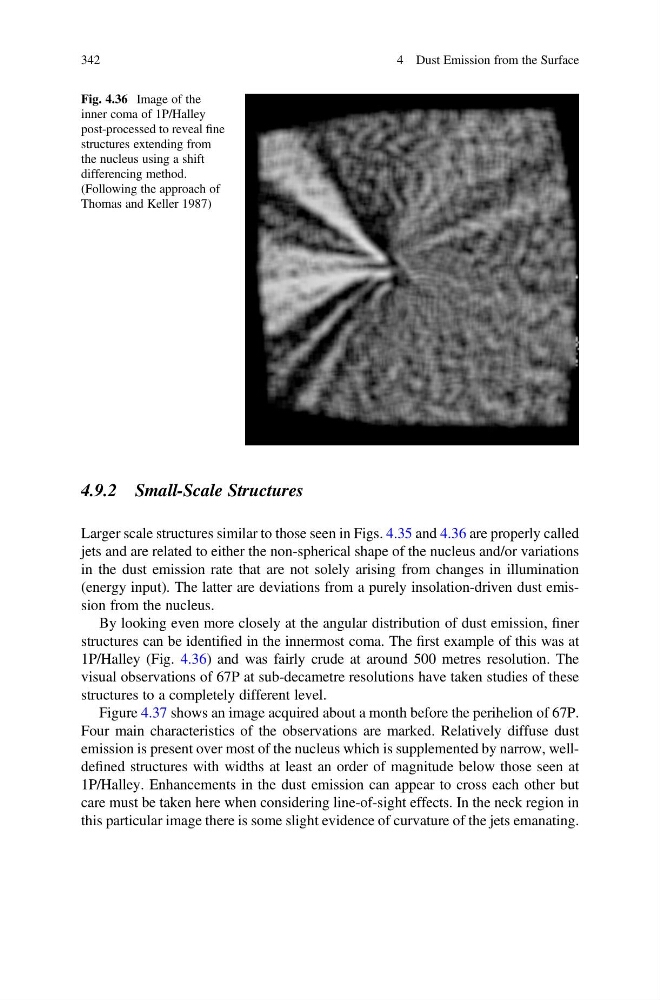
By looking even more closely at the angular distribution of dust emission, finer
structures can be identified in the innermost coma. The first example of this was at
1P/Halley (Fig. 4.36) and was fairly crude at around 500 metres resolution. The
visual observations of 67P at sub-decametre resolutions have taken studies of these
structures to a completely different level.
Figure 4.37 shows an image acquired about a month before the perihelion of 67P.
Four main characteristics of the observations are marked. Relatively diffuse dust
emission is present over most of the nucleus which is supplemented by narrow, welldefined structures with widths at least an order of magnitude below those seen at
1P/Halley. Enhancements in the dust emission can appear to cross each other but
care must be taken here when considering line-of-sight effects. In the neck region in
this particular image there is some slight evidence of curvature of the jets emanating.
Fig. 4.36 Image of the
inner coma of 1P/Halley
post-processed to reveal fine
structures extending from
the nucleus using a shift
differencing method.
(Following the approach of
Thomas and Keller 1987)
342
4 Dust Emission from the Surface
Larger scale structures similar to those seen in Figs. 4.35 and 4.36 are properly called
jets and are related to either the non-spherical shape of the nucleus and/or variations
in the dust emission rate that are not solely arising from changes in illumination
(energy input). The latter are deviations from a purely insolation-driven dust emission from the nucleus.
By looking even more closely at the angular distribution of dust emission, finer
structures can be identified in the innermost coma. The first example of this was at
1P/Halley (Fig. 4.36) and was fairly crude at around 500 metres resolution. The
visual observations of 67P at sub-decametre resolutions have taken studies of these
structures to a completely different level.
Figure 4.37 shows an image acquired about a month before the perihelion of 67P.
Four main characteristics of the observations are marked. Relatively diffuse dust
emission is present over most of the nucleus which is supplemented by narrow, welldefined structures with widths at least an order of magnitude below those seen at
1P/Halley. Enhancements in the dust emission can appear to cross each other but
care must be taken here when considering line-of-sight effects. In the neck region in
this particular image there is some slight evidence of curvature of the jets emanating.
Fig. 4.36 Image of the
inner coma of 1P/Halley
post-processed to reveal fine
structures extending from
the nucleus using a shift
differencing method.
(Following the approach of
Thomas and Keller 1987)
342
4 Dust Emission from the Surface