

and enhance fine structures in the comae of comets observed with ground-based
telescopes so that they were clearly visible. The basic idea was to subtract from an
image, a rotated version of itself leading to the name of “shift-differencing”. This
technique revealed curved jet-like structures emanating from the nucleus that were
interpreted as non-uniform emission from the surface combined with the effects of
nucleus rotation. Subsequent works by Sekanina and co-workers attempted to derive
the number of jets (enhancements in the dust emission) and the rotational properties
of several comets using this approach. However, it was not quantitative and the
angles used to generate the “best” result were arbitrary. On the other hand, this
showed that the nucleus was a source of non-uniform dust emission and that large
scale jet structures were to be expected in the inner coma.
More sophisticated image processing studies used a technique referred to as
“ring-masking” (e.g. Hoban et al. 1988). Here, the observed intensities on circles
of constant distance, b, from the nucleus in projection were multiplied by b and
averaged (note the similarity here to Eq. 4.60). These values were subtracted from
the original image. This is effectively producing an image of deviations from a coma
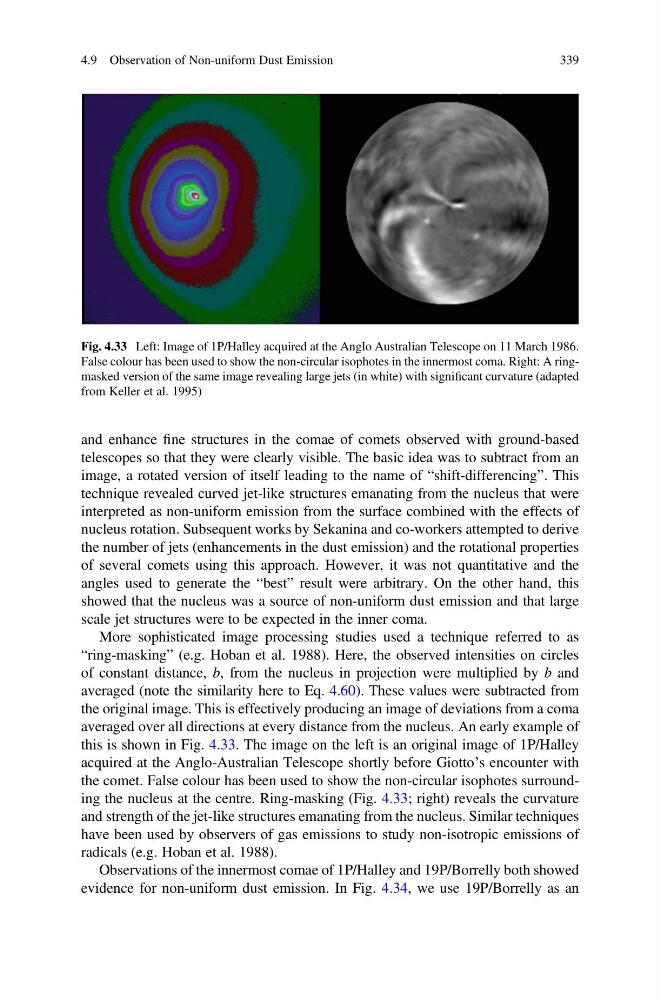
averaged over all directions at every distance from the nucleus. An early example of
this is shown in Fig. 4.33. The image on the left is an original image of 1P/Halley
acquired at the Anglo-Australian Telescope shortly before Giotto’s encounter with
the comet. False colour has been used to show the non-circular isophotes surrounding the nucleus at the centre. Ring-masking (Fig. 4.33; right) reveals the curvature
and strength of the jet-like structures emanating from the nucleus. Similar techniques
have been used by observers of gas emissions to study non-isotropic emissions of
radicals (e.g. Hoban et al. 1988).
Observations of the innermost comae of 1P/Halley and 19P/Borrelly both showed
evidence for non-uniform dust emission. In Fig. 4.34, we use 19P/Borrelly as an
Fig. 4.33 Left: Image of 1P/Halley acquired at the Anglo Australian Telescope on 11 March 1986.
False colour has been used to show the non-circular isophotes in the innermost coma. Right: A ringmasked version of the same image revealing large jets (in white) with significant curvature (adapted
from Keller et al. 1995)
4.9 Observation of Non-uniform Dust Emission
339
telescopes so that they were clearly visible. The basic idea was to subtract from an
image, a rotated version of itself leading to the name of “shift-differencing”. This
technique revealed curved jet-like structures emanating from the nucleus that were
interpreted as non-uniform emission from the surface combined with the effects of
nucleus rotation. Subsequent works by Sekanina and co-workers attempted to derive
the number of jets (enhancements in the dust emission) and the rotational properties
of several comets using this approach. However, it was not quantitative and the
angles used to generate the “best” result were arbitrary. On the other hand, this
showed that the nucleus was a source of non-uniform dust emission and that large
scale jet structures were to be expected in the inner coma.
More sophisticated image processing studies used a technique referred to as
“ring-masking” (e.g. Hoban et al. 1988). Here, the observed intensities on circles
of constant distance, b, from the nucleus in projection were multiplied by b and
averaged (note the similarity here to Eq. 4.60). These values were subtracted from
the original image. This is effectively producing an image of deviations from a coma
averaged over all directions at every distance from the nucleus. An early example of
this is shown in Fig. 4.33. The image on the left is an original image of 1P/Halley
acquired at the Anglo-Australian Telescope shortly before Giotto’s encounter with
the comet. False colour has been used to show the non-circular isophotes surrounding the nucleus at the centre. Ring-masking (Fig. 4.33; right) reveals the curvature
and strength of the jet-like structures emanating from the nucleus. Similar techniques
have been used by observers of gas emissions to study non-isotropic emissions of
radicals (e.g. Hoban et al. 1988).
Observations of the innermost comae of 1P/Halley and 19P/Borrelly both showed
evidence for non-uniform dust emission. In Fig. 4.34, we use 19P/Borrelly as an
Fig. 4.33 Left: Image of 1P/Halley acquired at the Anglo Australian Telescope on 11 March 1986.
False colour has been used to show the non-circular isophotes in the innermost coma. Right: A ringmasked version of the same image revealing large jets (in white) with significant curvature (adapted
from Keller et al. 1995)
4.9 Observation of Non-uniform Dust Emission
339