

does not keep pace with the mass increase. So the mass needed to produce the same
Afρ again increases.
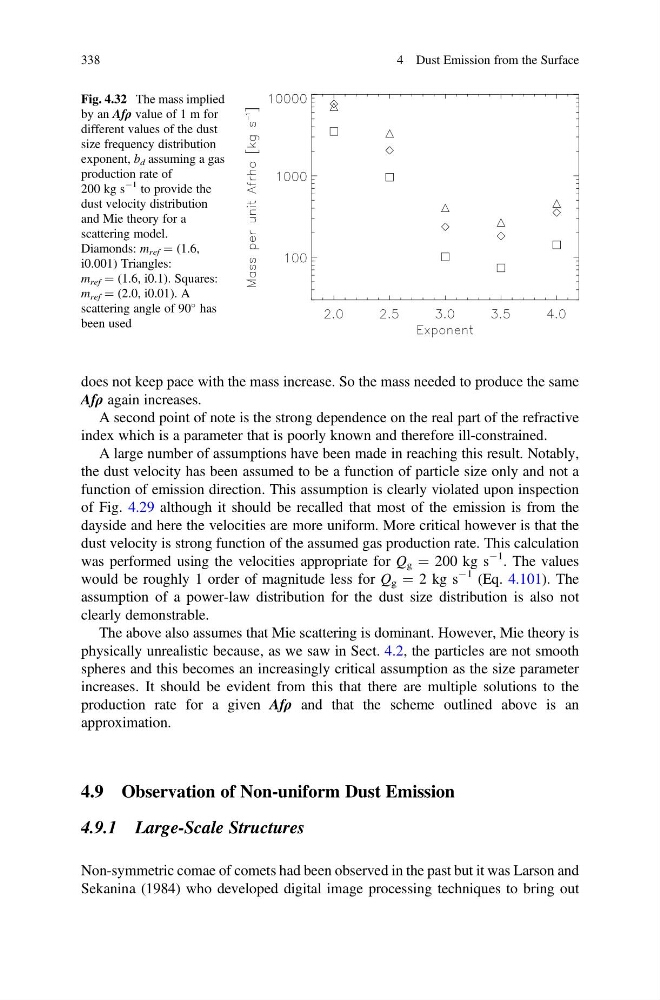
A second point of note is the strong dependence on the real part of the refractive
index which is a parameter that is poorly known and therefore ill-constrained.
A large number of assumptions have been made in reaching this result. Notably,
the dust velocity has been assumed to be a function of particle size only and not a
function of emission direction. This assumption is clearly violated upon inspection
of Fig. 4.29 although it should be recalled that most of the emission is from the
dayside and here the velocities are more uniform. More critical however is that the
dust velocity is strong function of the assumed gas production rate. This calculation
was performed using the velocities appropriate for Q g ¼ 200 kg s
À1 . The values
would be roughly 1 order of magnitude less for Q g ¼ 2 kg s
À1 (Eq. 4.101). The
assumption of a power-law distribution for the dust size distribution is also not
clearly demonstrable.
The above also assumes that Mie scattering is dominant. However, Mie theory is
physically unrealistic because, as we saw in Sect. 4.2, the particles are not smooth
spheres and this becomes an increasingly critical assumption as the size parameter
increases. It should be evident from this that there are multiple solutions to the
production rate for a given Afρ and that the scheme outlined above is an
approximation.
4.9 Observation of Non-uniform Dust Emission
4.9.1 Large-Scale Structures
Non-symmetric comae of comets had been observed in the past but it was Larson and
Sekanina (1984) who developed digital image processing techniques to bring out
Fig. 4.32 The mass implied
by an Afρ value of 1 m for
different values of the dust
size frequency distribution
exponent, b d assuming a gas
production rate of
200 kg s
À1 to provide the
dust velocity distribution
and Mie theory for a
scattering model.
Diamonds: m ref ¼ (1.6,
i0.001) Triangles:
m ref ¼ (1.6, i0.1). Squares:
m ref ¼ (2.0, i0.01). A
scattering angle of 90
has
been used
338
4 Dust Emission from the Surface
Afρ again increases.
A second point of note is the strong dependence on the real part of the refractive
index which is a parameter that is poorly known and therefore ill-constrained.
A large number of assumptions have been made in reaching this result. Notably,
the dust velocity has been assumed to be a function of particle size only and not a
function of emission direction. This assumption is clearly violated upon inspection
of Fig. 4.29 although it should be recalled that most of the emission is from the
dayside and here the velocities are more uniform. More critical however is that the
dust velocity is strong function of the assumed gas production rate. This calculation
was performed using the velocities appropriate for Q g ¼ 200 kg s
À1 . The values
would be roughly 1 order of magnitude less for Q g ¼ 2 kg s
À1 (Eq. 4.101). The
assumption of a power-law distribution for the dust size distribution is also not
clearly demonstrable.
The above also assumes that Mie scattering is dominant. However, Mie theory is
physically unrealistic because, as we saw in Sect. 4.2, the particles are not smooth
spheres and this becomes an increasingly critical assumption as the size parameter
increases. It should be evident from this that there are multiple solutions to the
production rate for a given Afρ and that the scheme outlined above is an
approximation.
4.9 Observation of Non-uniform Dust Emission
4.9.1 Large-Scale Structures
Non-symmetric comae of comets had been observed in the past but it was Larson and
Sekanina (1984) who developed digital image processing techniques to bring out
Fig. 4.32 The mass implied
by an Afρ value of 1 m for
different values of the dust
size frequency distribution
exponent, b d assuming a gas
production rate of
200 kg s
À1 to provide the
dust velocity distribution
and Mie theory for a
scattering model.
Diamonds: m ref ¼ (1.6,
i0.001) Triangles:
m ref ¼ (1.6, i0.1). Squares:
m ref ¼ (2.0, i0.01). A
scattering angle of 90
has
been used
338
4 Dust Emission from the Surface