

partially compensated for by the decrease in velocity with particle size which
increases the local density of larger particles. However, the effect of the scattering
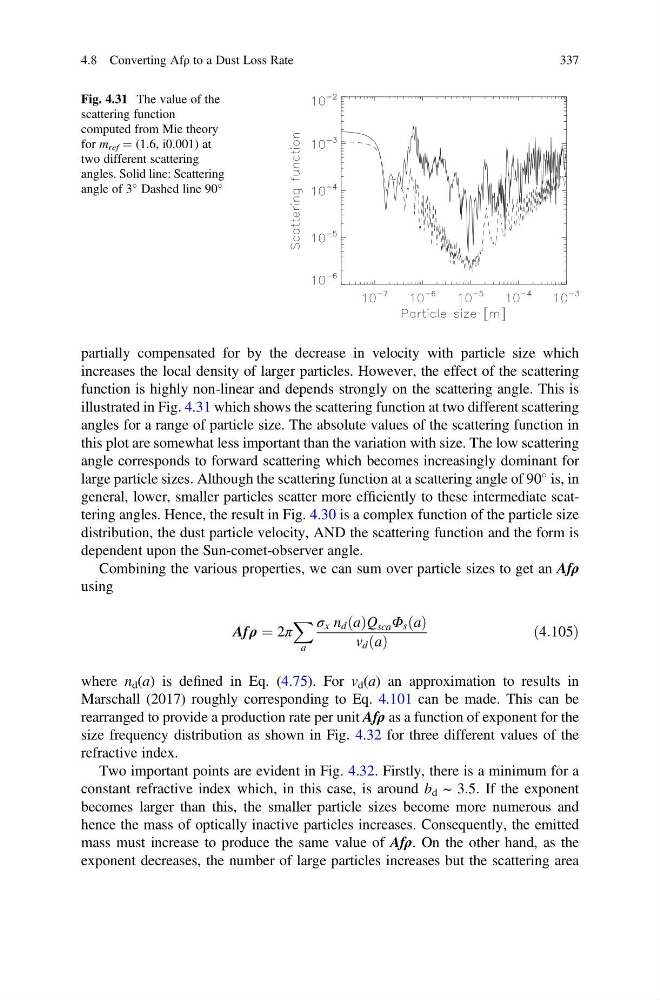
function is highly non-linear and depends strongly on the scattering angle. This is
illustrated in Fig. 4.31 which shows the scattering function at two different scattering
angles for a range of particle size. The absolute values of the scattering function in
this plot are somewhat less important than the variation with size. The low scattering
angle corresponds to forward scattering which becomes increasingly dominant for
large particle sizes. Although the scattering function at a scattering angle of 90
is, in
general, lower, smaller particles scatter more efficiently to these intermediate scattering angles. Hence, the result in Fig. 4.30 is a complex function of the particle size
distribution, the dust particle velocity, AND the scattering function and the form is
dependent upon the Sun-comet-observer angle.
Combining the various properties, we can sum over particle sizes to get an Afρ
using
Af ρ ¼ 2π
X
a
σ x n d a
ð ÞQ sca Φ s a
ð Þ
v d a
ð Þ
ð4:105Þ
where n d (a) is defined in Eq. (4.75). For v d (a) an approximation to results in
Marschall (2017) roughly corresponding to Eq. 4.101 can be made. This can be
rearranged to provide a production rate per unit Afρ as a function of exponent for the
size frequency distribution as shown in Fig. 4.32 for three different values of the
refractive index.
Two important points are evident in Fig. 4.32. Firstly, there is a minimum for a
constant refractive index which, in this case, is around b d ~ 3.5. If the exponent
becomes larger than this, the smaller particle sizes become more numerous and
hence the mass of optically inactive particles increases. Consequently, the emitted
mass must increase to produce the same value of Afρ. On the other hand, as the
exponent decreases, the number of large particles increases but the scattering area
Fig. 4.31 The value of the
scattering function
computed from Mie theory
for m ref ¼ (1.6, i0.001) at
two different scattering
angles. Solid line: Scattering
angle of 3
Dashed line 90
4.8 Converting Afρ to a Dust Loss Rate
337
increases the local density of larger particles. However, the effect of the scattering
function is highly non-linear and depends strongly on the scattering angle. This is
illustrated in Fig. 4.31 which shows the scattering function at two different scattering
angles for a range of particle size. The absolute values of the scattering function in
this plot are somewhat less important than the variation with size. The low scattering
angle corresponds to forward scattering which becomes increasingly dominant for
large particle sizes. Although the scattering function at a scattering angle of 90
is, in
general, lower, smaller particles scatter more efficiently to these intermediate scattering angles. Hence, the result in Fig. 4.30 is a complex function of the particle size
distribution, the dust particle velocity, AND the scattering function and the form is
dependent upon the Sun-comet-observer angle.
Combining the various properties, we can sum over particle sizes to get an Afρ
using
Af ρ ¼ 2π
X
a
σ x n d a
ð ÞQ sca Φ s a
ð Þ
v d a
ð Þ
ð4:105Þ
where n d (a) is defined in Eq. (4.75). For v d (a) an approximation to results in
Marschall (2017) roughly corresponding to Eq. 4.101 can be made. This can be
rearranged to provide a production rate per unit Afρ as a function of exponent for the
size frequency distribution as shown in Fig. 4.32 for three different values of the
refractive index.
Two important points are evident in Fig. 4.32. Firstly, there is a minimum for a
constant refractive index which, in this case, is around b d ~ 3.5. If the exponent
becomes larger than this, the smaller particle sizes become more numerous and
hence the mass of optically inactive particles increases. Consequently, the emitted
mass must increase to produce the same value of Afρ. On the other hand, as the
exponent decreases, the number of large particles increases but the scattering area
Fig. 4.31 The value of the
scattering function
computed from Mie theory
for m ref ¼ (1.6, i0.001) at
two different scattering
angles. Solid line: Scattering
angle of 3
Dashed line 90
4.8 Converting Afρ to a Dust Loss Rate
337