

how gas drag influences the acceleration of the dust within 10 km of the nucleus
surface.
A semi-analytical approach has been developed by Zakharov et al. (2018) which
includes the drag, gravity and solar radiation pressure forces that have already been
introduced. We can take Eq. (4.90) and write
m d
dv a
dt
¼
1
2
πa
2 C D ρ g v g À v a
v g À v a
À
Á À m d
GM N
r 2 À
πa
2 L ⨀ Q pr
4πr 2
h c
ð4:97Þ
where again we are referring to a single particle size. Note that we have substituted
for the particle mass and added the solar radiation pressure term. The radiation
pressure term can be neglected close to the nucleus in most cases. The particle
velocity is then
dr
dt
¼ v a
ð4:98Þ
Zakharov et al. have shown that, if the nucleus is assumed to be homogeneous,
spherical, and uniformly active, then the equation of motion can be re-written in a
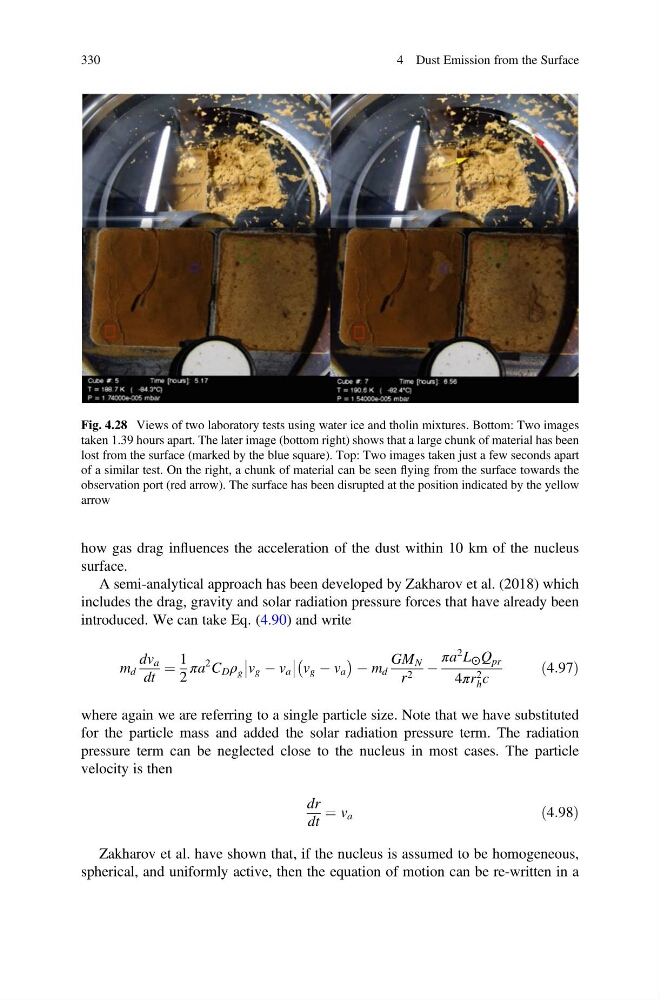
Fig. 4.28 Views of two laboratory tests using water ice and tholin mixtures. Bottom: Two images
taken 1.39 hours apart. The later image (bottom right) shows that a large chunk of material has been
lost from the surface (marked by the blue square). Top: Two images taken just a few seconds apart
of a similar test. On the right, a chunk of material can be seen flying from the surface towards the
observation port (red arrow). The surface has been disrupted at the position indicated by the yellow
arrow
330
4 Dust Emission from the Surface
surface.
A semi-analytical approach has been developed by Zakharov et al. (2018) which
includes the drag, gravity and solar radiation pressure forces that have already been
introduced. We can take Eq. (4.90) and write
m d
dv a
dt
¼
1
2
πa
2 C D ρ g v g À v a
v g À v a
À
Á À m d
GM N
r 2 À
πa
2 L ⨀ Q pr
4πr 2
h c
ð4:97Þ
where again we are referring to a single particle size. Note that we have substituted
for the particle mass and added the solar radiation pressure term. The radiation
pressure term can be neglected close to the nucleus in most cases. The particle
velocity is then
dr
dt
¼ v a
ð4:98Þ
Zakharov et al. have shown that, if the nucleus is assumed to be homogeneous,
spherical, and uniformly active, then the equation of motion can be re-written in a
Fig. 4.28 Views of two laboratory tests using water ice and tholin mixtures. Bottom: Two images
taken 1.39 hours apart. The later image (bottom right) shows that a large chunk of material has been
lost from the surface (marked by the blue square). Top: Two images taken just a few seconds apart
of a similar test. On the right, a chunk of material can be seen flying from the surface towards the
observation port (red arrow). The surface has been disrupted at the position indicated by the yellow
arrow
330
4 Dust Emission from the Surface