

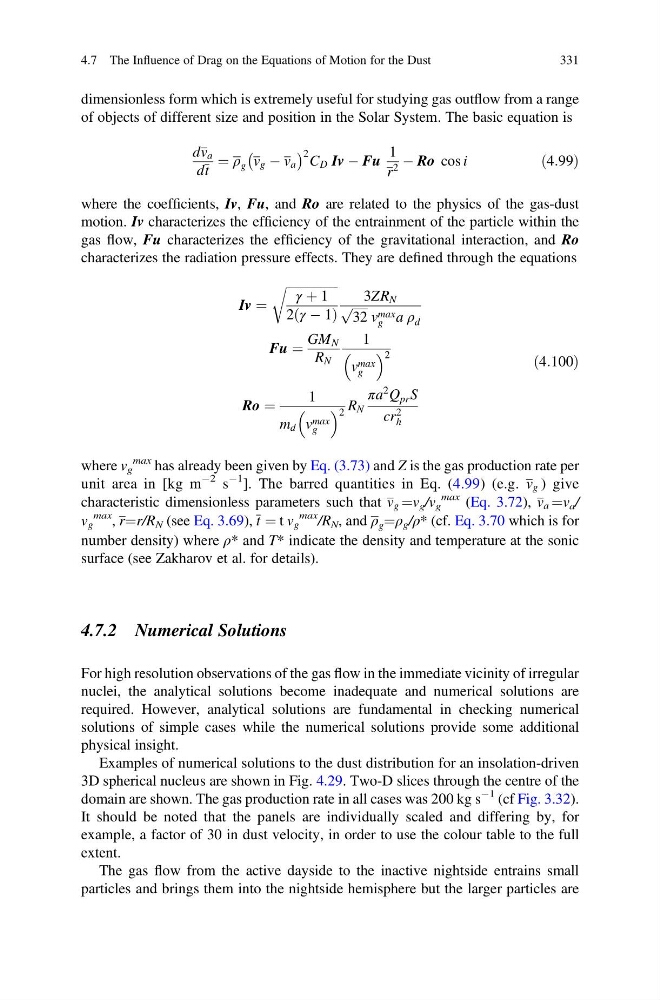
dimensionless form which is extremely useful for studying gas outflow from a range
of objects of different size and position in the Solar System. The basic equation is
dv a
dt
¼ ρ g v g À v a
À
Á 2 C D Iv À Fu
1
r
2
À Ro cos i
ð4:99Þ
where the coefficients, Iv, Fu, and Ro are related to the physics of the gas-dust
motion. Iv characterizes the efficiency of the entrainment of the particle within the
gas flow, Fu characterizes the efficiency of the gravitational interaction, and Ro
characterizes the radiation pressure effects. They are defined through the equations
Iv ¼
ffiffiffiffiffiffiffiffiffiffiffiffiffiffiffiffiffi
γ þ 1
2 γ À 1
ð
Þ
r
3ZR N
ffiffiffiffiffi
32
p
v max
g a ρ d
Fu ¼
GM N
R N
1
v max
g
2
Ro ¼
1
m d v max
g
2 R N
πa
2 Q pr S
cr 2
h
ð4:100Þ
where v g
max has already been given by Eq. (3.73) and Z is the gas production rate per
unit area in [kg m
À2 s
À1 ]. The barred quantities in Eq. (4.99) (e.g. v g ) give
characteristic dimensionless parameters such that v g ¼v g /v g
max (Eq. 3.72), v a ¼v a /
v g
max , r¼r/R N (see Eq. 3.69), t ¼ t v g
max /R N , and ρ g ¼ρ g /ρ* (cf. Eq. 3.70 which is for
number density) where ρ* and T* indicate the density and temperature at the sonic
surface (see Zakharov et al. for details).
4.7.2 Numerical Solutions
For high resolution observations of the gas flow in the immediate vicinity of irregular
nuclei, the analytical solutions become inadequate and numerical solutions are
required. However, analytical solutions are fundamental in checking numerical
solutions of simple cases while the numerical solutions provide some additional
physical insight.
Examples of numerical solutions to the dust distribution for an insolation-driven
3D spherical nucleus are shown in Fig. 4.29. Two-D slices through the centre of the
domain are shown. The gas production rate in all cases was 200 kg s
À1 (cf Fig. 3.32).
It should be noted that the panels are individually scaled and differing by, for
example, a factor of 30 in dust velocity, in order to use the colour table to the full
extent.
The gas flow from the active dayside to the inactive nightside entrains small
particles and brings them into the nightside hemisphere but the larger particles are
4.7 The Influence of Drag on the Equations of Motion for the Dust
331
of objects of different size and position in the Solar System. The basic equation is
dv a
dt
¼ ρ g v g À v a
À
Á 2 C D Iv À Fu
1
r
2
À Ro cos i
ð4:99Þ
where the coefficients, Iv, Fu, and Ro are related to the physics of the gas-dust
motion. Iv characterizes the efficiency of the entrainment of the particle within the
gas flow, Fu characterizes the efficiency of the gravitational interaction, and Ro
characterizes the radiation pressure effects. They are defined through the equations
Iv ¼
ffiffiffiffiffiffiffiffiffiffiffiffiffiffiffiffiffi
γ þ 1
2 γ À 1
ð
Þ
r
3ZR N
ffiffiffiffiffi
32
p
v max
g a ρ d
Fu ¼
GM N
R N
1
v max
g
2
Ro ¼
1
m d v max
g
2 R N
πa
2 Q pr S
cr 2
h
ð4:100Þ
where v g
max has already been given by Eq. (3.73) and Z is the gas production rate per
unit area in [kg m
À2 s
À1 ]. The barred quantities in Eq. (4.99) (e.g. v g ) give
characteristic dimensionless parameters such that v g ¼v g /v g
max (Eq. 3.72), v a ¼v a /
v g
max , r¼r/R N (see Eq. 3.69), t ¼ t v g
max /R N , and ρ g ¼ρ g /ρ* (cf. Eq. 3.70 which is for
number density) where ρ* and T* indicate the density and temperature at the sonic
surface (see Zakharov et al. for details).
4.7.2 Numerical Solutions
For high resolution observations of the gas flow in the immediate vicinity of irregular
nuclei, the analytical solutions become inadequate and numerical solutions are
required. However, analytical solutions are fundamental in checking numerical
solutions of simple cases while the numerical solutions provide some additional
physical insight.
Examples of numerical solutions to the dust distribution for an insolation-driven
3D spherical nucleus are shown in Fig. 4.29. Two-D slices through the centre of the
domain are shown. The gas production rate in all cases was 200 kg s
À1 (cf Fig. 3.32).
It should be noted that the panels are individually scaled and differing by, for
example, a factor of 30 in dust velocity, in order to use the colour table to the full
extent.
The gas flow from the active dayside to the inactive nightside entrains small
particles and brings them into the nightside hemisphere but the larger particles are
4.7 The Influence of Drag on the Equations of Motion for the Dust
331