

response to illumination. The material took on a fluffy texture and could be seen
moving in the gas flow arising from the sublimation of the water ice. In the image to
the right, pieces of material of the order of 0.5 cm in diameter were seen to be ejected
from the surface. It is to be noted that this was against the retarding force of Earth’s
gravity—i.e. several orders of magnitude greater than the retarding force on 67P.
Consequently, the ejected size was well above that expected from calculation using
Eq. (4.92).
4.7 The Influence of Drag on the Equations of Motion
for the Dust
4.7.1 Analytical Solutions
The point source approximation and the fountain model have their uses but the two
approaches require us to assume a dust particle velocity, v d . Consequently, it is
necessary not merely to look at how drag lifts the particles but also to look in detail at
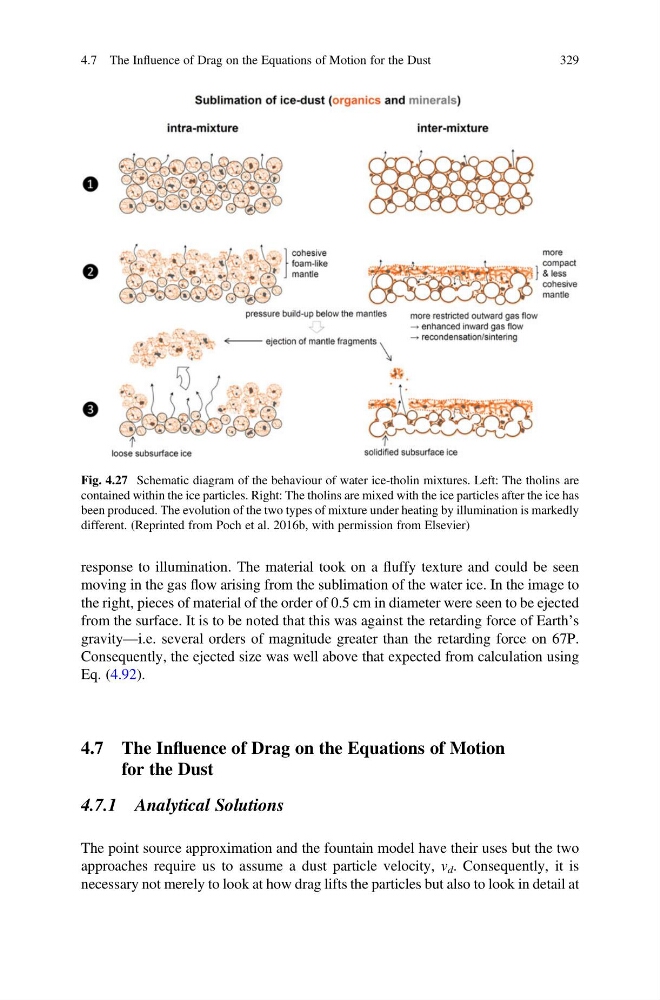
Fig. 4.27 Schematic diagram of the behaviour of water ice-tholin mixtures. Left: The tholins are
contained within the ice particles. Right: The tholins are mixed with the ice particles after the ice has
been produced. The evolution of the two types of mixture under heating by illumination is markedly
different. (Reprinted from Poch et al. 2016b, with permission from Elsevier)
4.7 The Influence of Drag on the Equations of Motion for the Dust
329
moving in the gas flow arising from the sublimation of the water ice. In the image to
the right, pieces of material of the order of 0.5 cm in diameter were seen to be ejected
from the surface. It is to be noted that this was against the retarding force of Earth’s
gravity—i.e. several orders of magnitude greater than the retarding force on 67P.
Consequently, the ejected size was well above that expected from calculation using
Eq. (4.92).
4.7 The Influence of Drag on the Equations of Motion
for the Dust
4.7.1 Analytical Solutions
The point source approximation and the fountain model have their uses but the two
approaches require us to assume a dust particle velocity, v d . Consequently, it is
necessary not merely to look at how drag lifts the particles but also to look in detail at
Fig. 4.27 Schematic diagram of the behaviour of water ice-tholin mixtures. Left: The tholins are
contained within the ice particles. Right: The tholins are mixed with the ice particles after the ice has
been produced. The evolution of the two types of mixture under heating by illumination is markedly
different. (Reprinted from Poch et al. 2016b, with permission from Elsevier)
4.7 The Influence of Drag on the Equations of Motion for the Dust
329