

acceleration included a term accounting for the ratio of tortuosity and porosity—
effectively providing locally modified accelerations so that a m is not a rigorous upper
limit. However, Eq. (4.92) does provide the notable (and unsurprising) result that the
largest liftable mass is proportional to the gas flux at the surface. As this varies
strongly with heliocentric distance, it implies that the particle distribution function in
the coma will change significantly as the comet approaches and recedes from the
Sun. Given that the gas production rate of 67P increased by two orders of magnitude
from 3 AU to perihelion, Eq. (4.92) indicates that the largest liftable mass should
increase proportionally. This has also been clearly illustrated in the context of
numerical model calculations by, for example, Marschall (2017) (see also Thomas
et al. 2015b; Fig. 11).
4.6.2 Cohesive Forces
The equations for the maximum liftable mass/radius given above exclude any
cohesive forces between the masses being lifted and the surface they are initially
attached to. The significance of cohesive forces was recognized more than 20 years
ago (Kührt and Keller 1996) but it remains a difficult subject because the surface
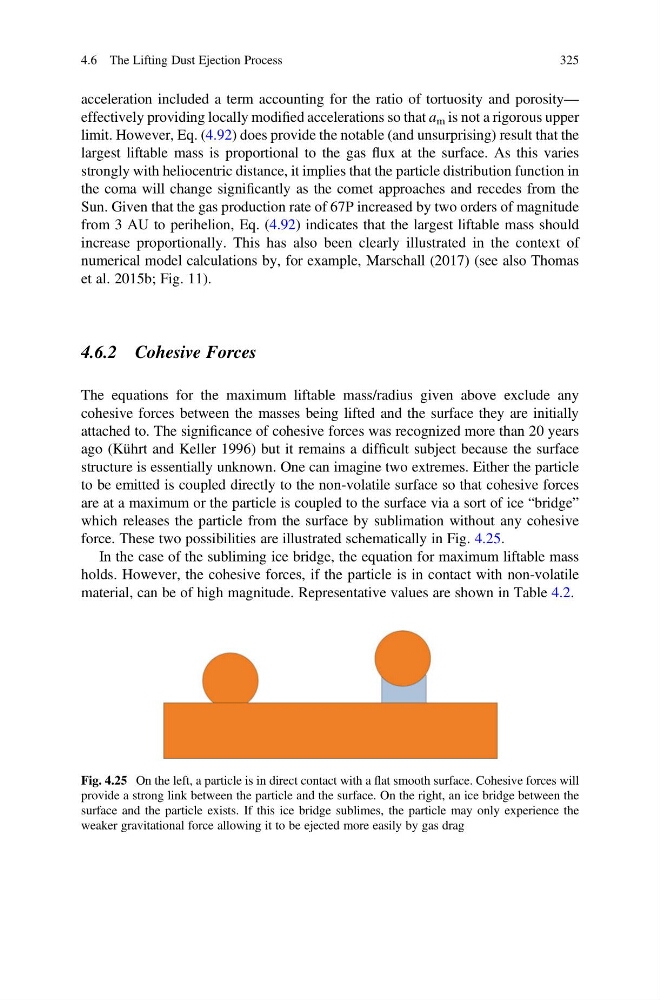
structure is essentially unknown. One can imagine two extremes. Either the particle
to be emitted is coupled directly to the non-volatile surface so that cohesive forces
are at a maximum or the particle is coupled to the surface via a sort of ice “bridge”
which releases the particle from the surface by sublimation without any cohesive
force. These two possibilities are illustrated schematically in Fig. 4.25.
In the case of the subliming ice bridge, the equation for maximum liftable mass
holds. However, the cohesive forces, if the particle is in contact with non-volatile
material, can be of high magnitude. Representative values are shown in Table 4.2.
Fig. 4.25 On the left, a particle is in direct contact with a flat smooth surface. Cohesive forces will
provide a strong link between the particle and the surface. On the right, an ice bridge between the
surface and the particle exists. If this ice bridge sublimes, the particle may only experience the
weaker gravitational force allowing it to be ejected more easily by gas drag
4.6 The Lifting Dust Ejection Process
325
effectively providing locally modified accelerations so that a m is not a rigorous upper
limit. However, Eq. (4.92) does provide the notable (and unsurprising) result that the
largest liftable mass is proportional to the gas flux at the surface. As this varies
strongly with heliocentric distance, it implies that the particle distribution function in
the coma will change significantly as the comet approaches and recedes from the
Sun. Given that the gas production rate of 67P increased by two orders of magnitude
from 3 AU to perihelion, Eq. (4.92) indicates that the largest liftable mass should
increase proportionally. This has also been clearly illustrated in the context of
numerical model calculations by, for example, Marschall (2017) (see also Thomas
et al. 2015b; Fig. 11).
4.6.2 Cohesive Forces
The equations for the maximum liftable mass/radius given above exclude any
cohesive forces between the masses being lifted and the surface they are initially
attached to. The significance of cohesive forces was recognized more than 20 years
ago (Kührt and Keller 1996) but it remains a difficult subject because the surface
structure is essentially unknown. One can imagine two extremes. Either the particle
to be emitted is coupled directly to the non-volatile surface so that cohesive forces
are at a maximum or the particle is coupled to the surface via a sort of ice “bridge”
which releases the particle from the surface by sublimation without any cohesive
force. These two possibilities are illustrated schematically in Fig. 4.25.
In the case of the subliming ice bridge, the equation for maximum liftable mass
holds. However, the cohesive forces, if the particle is in contact with non-volatile
material, can be of high magnitude. Representative values are shown in Table 4.2.
Fig. 4.25 On the left, a particle is in direct contact with a flat smooth surface. Cohesive forces will
provide a strong link between the particle and the surface. On the right, an ice bridge between the
surface and the particle exists. If this ice bridge sublimes, the particle may only experience the
weaker gravitational force allowing it to be ejected more easily by gas drag
4.6 The Lifting Dust Ejection Process
325