

The simplest computation of the van der Waals force is given by
F vdW ¼
Ha
6z 2
0
ð4:95Þ
where H is the Hamaker constant (typically 3 10
À20 J), a is the grain size (radius) and
z 0 is the particle to surface distance and often assumed to be around 0.4 nm. This
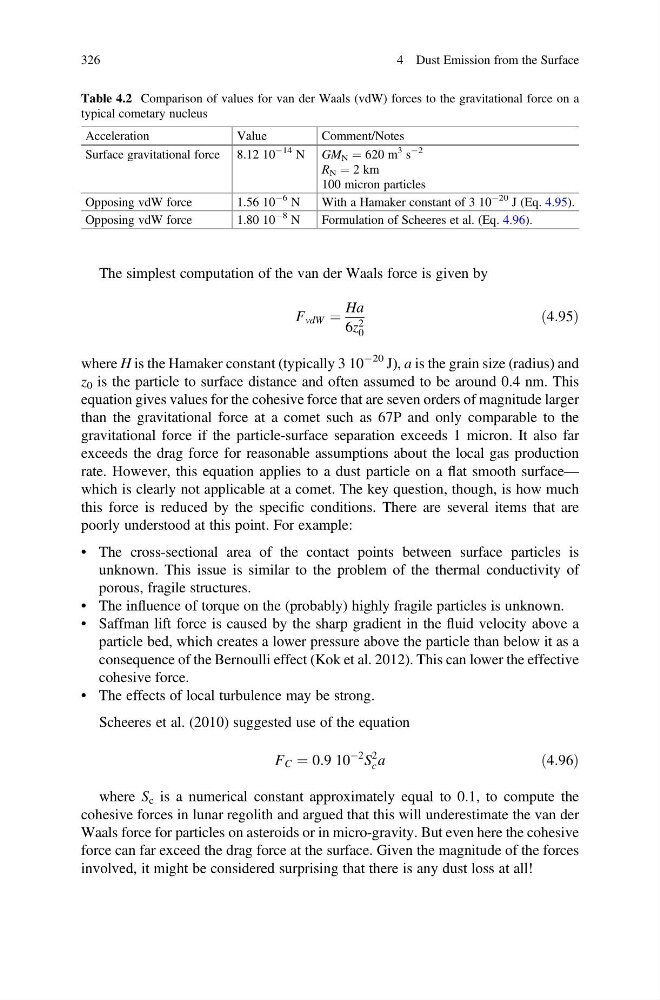
equation gives values for the cohesive force that are seven orders of magnitude larger
than the gravitational force at a comet such as 67P and only comparable to the
gravitational force if the particle-surface separation exceeds 1 micron. It also far
exceeds the drag force for reasonable assumptions about the local gas production
rate. However, this equation applies to a dust particle on a flat smooth surface—
which is clearly not applicable at a comet. The key question, though, is how much
this force is reduced by the specific conditions. There are several items that are
poorly understood at this point. For example:
• The cross-sectional area of the contact points between surface particles is
unknown. This issue is similar to the problem of the thermal conductivity of
porous, fragile structures.
• The influence of torque on the (probably) highly fragile particles is unknown.
• Saffman lift force is caused by the sharp gradient in the fluid velocity above a
particle bed, which creates a lower pressure above the particle than below it as a
consequence of the Bernoulli effect (Kok et al. 2012). This can lower the effective
cohesive force.
• The effects of local turbulence may be strong.
Scheeres et al. (2010) suggested use of the equation
F C ¼ 0:9 10
À2 S
2
c a
ð4:96Þ
where S c is a numerical constant approximately equal to 0.1, to compute the
cohesive forces in lunar regolith and argued that this will underestimate the van der
Waals force for particles on asteroids or in micro-gravity. But even here the cohesive
force can far exceed the drag force at the surface. Given the magnitude of the forces
involved, it might be considered surprising that there is any dust loss at all!
Table 4.2 Comparison of values for van der Waals (vdW) forces to the gravitational force on a
typical cometary nucleus
Acceleration
Value
Comment/Notes
Surface gravitational force 8.12 10
À14 N GM N ¼ 620 m
3 s
À2
R N ¼ 2 km
100 micron particles
Opposing vdW force
1.56 10
À6 N
With a Hamaker constant of 3 10
À20 J (Eq. 4.95).
Opposing vdW force
1.80 10
À8 N
Formulation of Scheeres et al. (Eq. 4.96).
326
4 Dust Emission from the Surface
F vdW ¼
Ha
6z 2
0
ð4:95Þ
where H is the Hamaker constant (typically 3 10
À20 J), a is the grain size (radius) and
z 0 is the particle to surface distance and often assumed to be around 0.4 nm. This
equation gives values for the cohesive force that are seven orders of magnitude larger
than the gravitational force at a comet such as 67P and only comparable to the
gravitational force if the particle-surface separation exceeds 1 micron. It also far
exceeds the drag force for reasonable assumptions about the local gas production
rate. However, this equation applies to a dust particle on a flat smooth surface—
which is clearly not applicable at a comet. The key question, though, is how much
this force is reduced by the specific conditions. There are several items that are
poorly understood at this point. For example:
• The cross-sectional area of the contact points between surface particles is
unknown. This issue is similar to the problem of the thermal conductivity of
porous, fragile structures.
• The influence of torque on the (probably) highly fragile particles is unknown.
• Saffman lift force is caused by the sharp gradient in the fluid velocity above a
particle bed, which creates a lower pressure above the particle than below it as a
consequence of the Bernoulli effect (Kok et al. 2012). This can lower the effective
cohesive force.
• The effects of local turbulence may be strong.
Scheeres et al. (2010) suggested use of the equation
F C ¼ 0:9 10
À2 S
2
c a
ð4:96Þ
where S c is a numerical constant approximately equal to 0.1, to compute the
cohesive forces in lunar regolith and argued that this will underestimate the van der
Waals force for particles on asteroids or in micro-gravity. But even here the cohesive
force can far exceed the drag force at the surface. Given the magnitude of the forces
involved, it might be considered surprising that there is any dust loss at all!
Table 4.2 Comparison of values for van der Waals (vdW) forces to the gravitational force on a
typical cometary nucleus
Acceleration
Value
Comment/Notes
Surface gravitational force 8.12 10
À14 N GM N ¼ 620 m
3 s
À2
R N ¼ 2 km
100 micron particles
Opposing vdW force
1.56 10
À6 N
With a Hamaker constant of 3 10
À20 J (Eq. 4.95).
Opposing vdW force
1.80 10
À8 N
Formulation of Scheeres et al. (Eq. 4.96).
326
4 Dust Emission from the Surface