

concluded that it can be ignored given the size of the other uncertainties in gas
dynamics modelling.
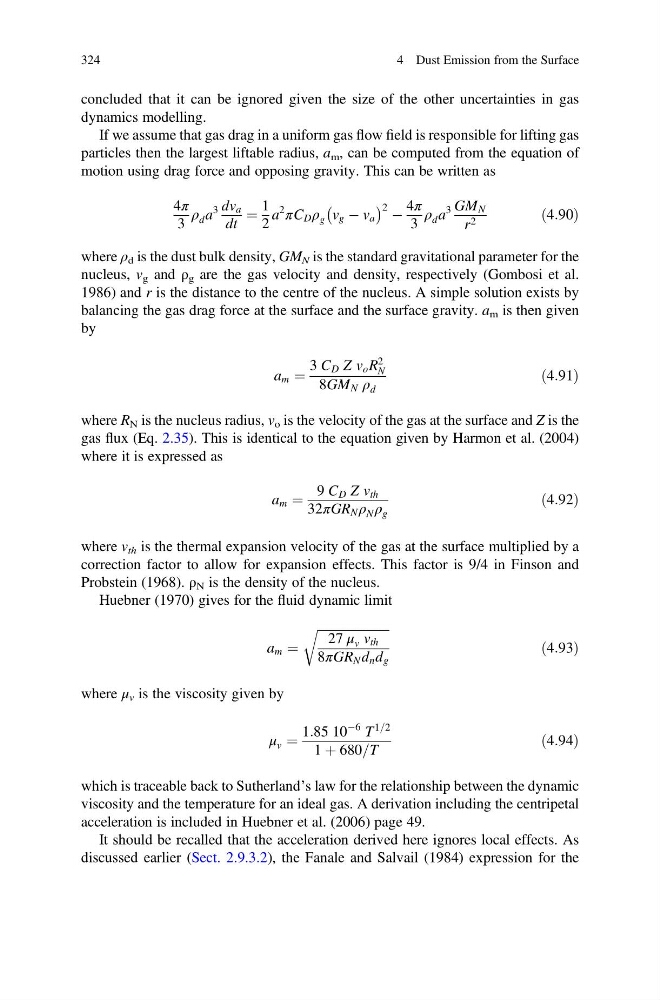
If we assume that gas drag in a uniform gas flow field is responsible for lifting gas
particles then the largest liftable radius, a m , can be computed from the equation of
motion using drag force and opposing gravity. This can be written as
4π
3
ρ d a
3 dv a
dt
¼
1
2
a
2
πC D ρ g v g À v a
À
Á 2 À
4π
3
ρ d a
3 GM N
r 2
ð4:90Þ
where ρ d is the dust bulk density, GM N is the standard gravitational parameter for the
nucleus, v g and ρ g are the gas velocity and density, respectively (Gombosi et al.
1986) and r is the distance to the centre of the nucleus. A simple solution exists by
balancing the gas drag force at the surface and the surface gravity. a m is then given
by
a m ¼
3 C D Z v o R
2
N
8GM N ρ d
ð4:91Þ
where R N is the nucleus radius, v o is the velocity of the gas at the surface and Z is the
gas flux (Eq. 2.35). This is identical to the equation given by Harmon et al. (2004)
where it is expressed as
a m ¼
9 C D Z v th
32πGR N ρ N ρ g
ð4:92Þ
where v th is the thermal expansion velocity of the gas at the surface multiplied by a
correction factor to allow for expansion effects. This factor is 9/4 in Finson and
Probstein (1968). ρ N is the density of the nucleus.
Huebner (1970) gives for the fluid dynamic limit
a m ¼
ffiffiffiffiffiffiffiffiffiffiffiffiffiffiffiffiffiffiffiffiffiffiffi
27 μ v v th
8πGR N d n d g
r
ð4:93Þ
where μ v is the viscosity given by
μ v ¼
1:85 10
À6 T
1=2
1 þ 680=T
ð4:94Þ
which is traceable back to Sutherland’s law for the relationship between the dynamic
viscosity and the temperature for an ideal gas. A derivation including the centripetal
acceleration is included in Huebner et al. (2006) page 49.
It should be recalled that the acceleration derived here ignores local effects. As
discussed earlier (Sect. 2.9.3.2), the Fanale and Salvail (1984) expression for the
324
4 Dust Emission from the Surface
dynamics modelling.
If we assume that gas drag in a uniform gas flow field is responsible for lifting gas
particles then the largest liftable radius, a m , can be computed from the equation of
motion using drag force and opposing gravity. This can be written as
4π
3
ρ d a
3 dv a
dt
¼
1
2
a
2
πC D ρ g v g À v a
À
Á 2 À
4π
3
ρ d a
3 GM N
r 2
ð4:90Þ
where ρ d is the dust bulk density, GM N is the standard gravitational parameter for the
nucleus, v g and ρ g are the gas velocity and density, respectively (Gombosi et al.
1986) and r is the distance to the centre of the nucleus. A simple solution exists by
balancing the gas drag force at the surface and the surface gravity. a m is then given
by
a m ¼
3 C D Z v o R
2
N
8GM N ρ d
ð4:91Þ
where R N is the nucleus radius, v o is the velocity of the gas at the surface and Z is the
gas flux (Eq. 2.35). This is identical to the equation given by Harmon et al. (2004)
where it is expressed as
a m ¼
9 C D Z v th
32πGR N ρ N ρ g
ð4:92Þ
where v th is the thermal expansion velocity of the gas at the surface multiplied by a
correction factor to allow for expansion effects. This factor is 9/4 in Finson and
Probstein (1968). ρ N is the density of the nucleus.
Huebner (1970) gives for the fluid dynamic limit
a m ¼
ffiffiffiffiffiffiffiffiffiffiffiffiffiffiffiffiffiffiffiffiffiffiffi
27 μ v v th
8πGR N d n d g
r
ð4:93Þ
where μ v is the viscosity given by
μ v ¼
1:85 10
À6 T
1=2
1 þ 680=T
ð4:94Þ
which is traceable back to Sutherland’s law for the relationship between the dynamic
viscosity and the temperature for an ideal gas. A derivation including the centripetal
acceleration is included in Huebner et al. (2006) page 49.
It should be recalled that the acceleration derived here ignores local effects. As
discussed earlier (Sect. 2.9.3.2), the Fanale and Salvail (1984) expression for the
324
4 Dust Emission from the Surface