

C D ¼
2s
2
þ 1
ffiffiffi
π
p
s 3 e
Às
2 þ
4s
4
þ 4s
2
À 1
2s 4
erf s
ð Þ þ
2 1 À ε s
ð
Þ
ffiffiffi
π
p
3s
ffiffiffiffiffi ffi
T d
T g
r
ð4:88Þ
where
s ¼
v g À v a
ffiffiffiffiffiffiffi
2kT g
m g
q
ð4:89Þ
(Baines et al. 1965) where the parameter ε s accounts for specular reflection from
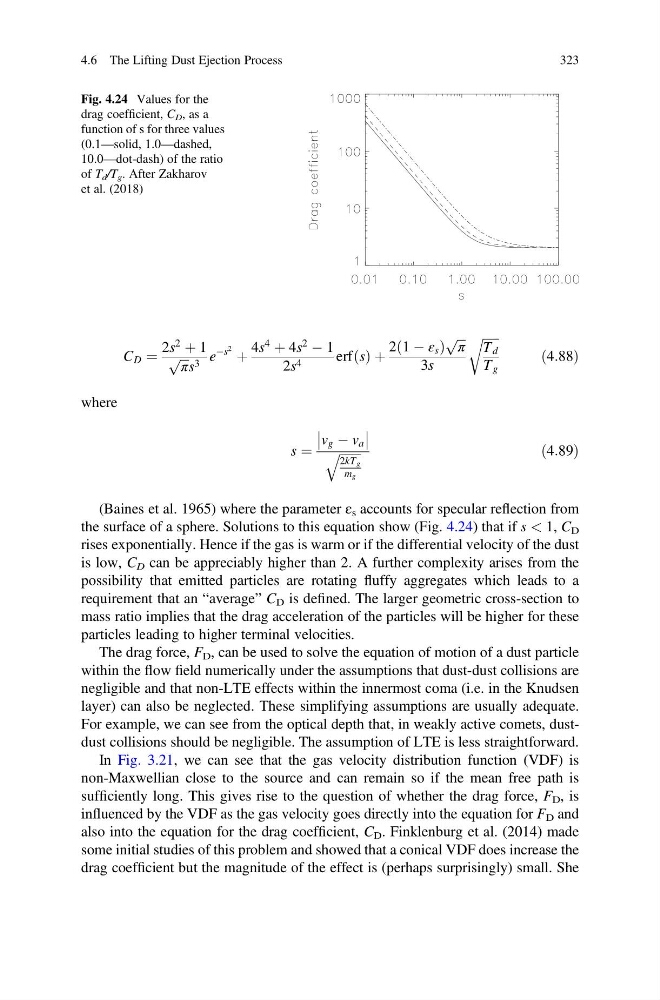
the surface of a sphere. Solutions to this equation show (Fig. 4.24) that if s < 1, C D
rises exponentially. Hence if the gas is warm or if the differential velocity of the dust
is low, C D can be appreciably higher than 2. A further complexity arises from the
possibility that emitted particles are rotating fluffy aggregates which leads to a
requirement that an “average” C D is defined. The larger geometric cross-section to
mass ratio implies that the drag acceleration of the particles will be higher for these
particles leading to higher terminal velocities.
The drag force, F D , can be used to solve the equation of motion of a dust particle
within the flow field numerically under the assumptions that dust-dust collisions are
negligible and that non-LTE effects within the innermost coma (i.e. in the Knudsen
layer) can also be neglected. These simplifying assumptions are usually adequate.
For example, we can see from the optical depth that, in weakly active comets, dustdust collisions should be negligible. The assumption of LTE is less straightforward.
In Fig. 3.21, we can see that the gas velocity distribution function (VDF) is
non-Maxwellian close to the source and can remain so if the mean free path is
sufficiently long. This gives rise to the question of whether the drag force, F D , is
influenced by the VDF as the gas velocity goes directly into the equation for F D and
also into the equation for the drag coefficient, C D . Finklenburg et al. (2014) made
some initial studies of this problem and showed that a conical VDF does increase the
drag coefficient but the magnitude of the effect is (perhaps surprisingly) small. She
Fig. 4.24 Values for the
drag coefficient, C D , as a
function of s for three values
(0.1—solid, 1.0—dashed,
10.0—dot-dash) of the ratio
of T d /T g . After Zakharov
et al. (2018)
4.6 The Lifting Dust Ejection Process
323
2s
2
þ 1
ffiffiffi
π
p
s 3 e
Às
2 þ
4s
4
þ 4s
2
À 1
2s 4
erf s
ð Þ þ
2 1 À ε s
ð
Þ
ffiffiffi
π
p
3s
ffiffiffiffiffi ffi
T d
T g
r
ð4:88Þ
where
s ¼
v g À v a
ffiffiffiffiffiffiffi
2kT g
m g
q
ð4:89Þ
(Baines et al. 1965) where the parameter ε s accounts for specular reflection from
the surface of a sphere. Solutions to this equation show (Fig. 4.24) that if s < 1, C D
rises exponentially. Hence if the gas is warm or if the differential velocity of the dust
is low, C D can be appreciably higher than 2. A further complexity arises from the
possibility that emitted particles are rotating fluffy aggregates which leads to a
requirement that an “average” C D is defined. The larger geometric cross-section to
mass ratio implies that the drag acceleration of the particles will be higher for these
particles leading to higher terminal velocities.
The drag force, F D , can be used to solve the equation of motion of a dust particle
within the flow field numerically under the assumptions that dust-dust collisions are
negligible and that non-LTE effects within the innermost coma (i.e. in the Knudsen
layer) can also be neglected. These simplifying assumptions are usually adequate.
For example, we can see from the optical depth that, in weakly active comets, dustdust collisions should be negligible. The assumption of LTE is less straightforward.
In Fig. 3.21, we can see that the gas velocity distribution function (VDF) is
non-Maxwellian close to the source and can remain so if the mean free path is
sufficiently long. This gives rise to the question of whether the drag force, F D , is
influenced by the VDF as the gas velocity goes directly into the equation for F D and
also into the equation for the drag coefficient, C D . Finklenburg et al. (2014) made
some initial studies of this problem and showed that a conical VDF does increase the
drag coefficient but the magnitude of the effect is (perhaps surprisingly) small. She
Fig. 4.24 Values for the
drag coefficient, C D , as a
function of s for three values
(0.1—solid, 1.0—dashed,
10.0—dot-dash) of the ratio
of T d /T g . After Zakharov
et al. (2018)
4.6 The Lifting Dust Ejection Process
323