

S b ¼
D
b d
min ln D min
ð
Þ d
Àb d À D
Àb d
max
À
Á
1 À
D min
D max
2
þ
D
b d
min D min =D max
ð
Þ
b d d
Àb d À D
Àb d
max
À
Á
ln D min =D max
ð
Þ
1 À
D min
D max
b d
2
þ
D
b d
min D
Àb d
max ln D max
ð
ÞÀd
Àb d ln d
À
Á
1 À
D min
D max
2
ð4:86Þ
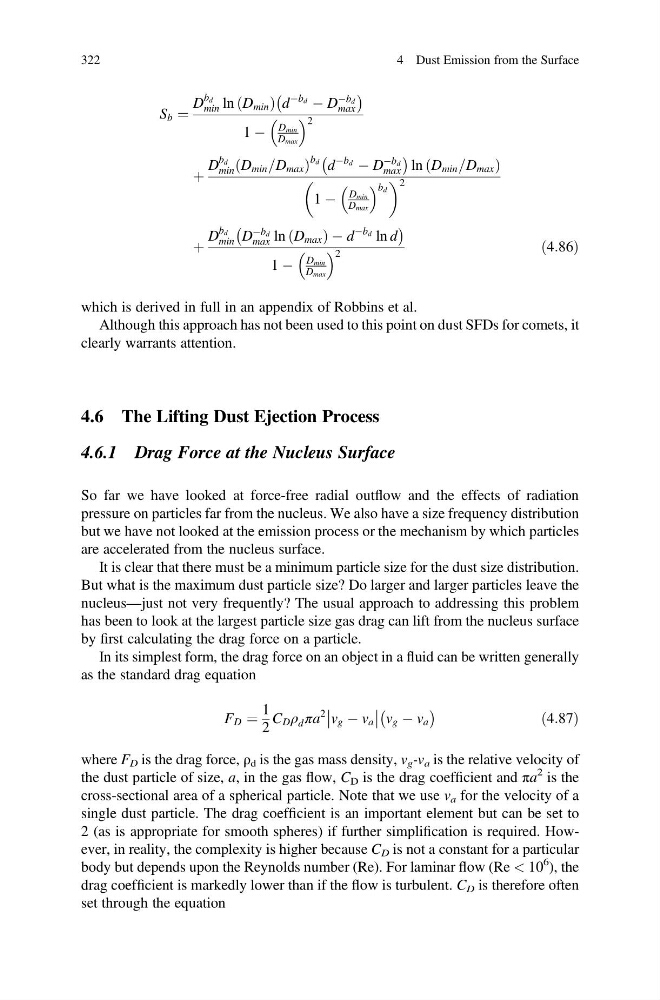
which is derived in full in an appendix of Robbins et al.
Although this approach has not been used to this point on dust SFDs for comets, it
clearly warrants attention.
4.6 The Lifting Dust Ejection Process
4.6.1 Drag Force at the Nucleus Surface
So far we have looked at force-free radial outflow and the effects of radiation
pressure on particles far from the nucleus. We also have a size frequency distribution
but we have not looked at the emission process or the mechanism by which particles
are accelerated from the nucleus surface.
It is clear that there must be a minimum particle size for the dust size distribution.
But what is the maximum dust particle size? Do larger and larger particles leave the
nucleus—just not very frequently? The usual approach to addressing this problem
has been to look at the largest particle size gas drag can lift from the nucleus surface
by first calculating the drag force on a particle.
In its simplest form, the drag force on an object in a fluid can be written generally
as the standard drag equation
F D ¼
1
2
C D ρ d πa
2 v g À v a
v g À v a
À
Á
ð4:87Þ
where F D is the drag force, ρ d is the gas mass density, v g -v a is the relative velocity of
the dust particle of size, a, in the gas flow, C D is the drag coefficient and πa
2 is the
cross-sectional area of a spherical particle. Note that we use v a for the velocity of a
single dust particle. The drag coefficient is an important element but can be set to
2 (as is appropriate for smooth spheres) if further simplification is required. However, in reality, the complexity is higher because C D is not a constant for a particular
body but depends upon the Reynolds number (Re). For laminar flow (Re < 10
6 ), the
drag coefficient is markedly lower than if the flow is turbulent. C D is therefore often
set through the equation
322
4 Dust Emission from the Surface
D
b d
min ln D min
ð
Þ d
Àb d À D
Àb d
max
À
Á
1 À
D min
D max
2
þ
D
b d
min D min =D max
ð
Þ
b d d
Àb d À D
Àb d
max
À
Á
ln D min =D max
ð
Þ
1 À
D min
D max
b d
2
þ
D
b d
min D
Àb d
max ln D max
ð
ÞÀd
Àb d ln d
À
Á
1 À
D min
D max
2
ð4:86Þ
which is derived in full in an appendix of Robbins et al.
Although this approach has not been used to this point on dust SFDs for comets, it
clearly warrants attention.
4.6 The Lifting Dust Ejection Process
4.6.1 Drag Force at the Nucleus Surface
So far we have looked at force-free radial outflow and the effects of radiation
pressure on particles far from the nucleus. We also have a size frequency distribution
but we have not looked at the emission process or the mechanism by which particles
are accelerated from the nucleus surface.
It is clear that there must be a minimum particle size for the dust size distribution.
But what is the maximum dust particle size? Do larger and larger particles leave the
nucleus—just not very frequently? The usual approach to addressing this problem
has been to look at the largest particle size gas drag can lift from the nucleus surface
by first calculating the drag force on a particle.
In its simplest form, the drag force on an object in a fluid can be written generally
as the standard drag equation
F D ¼
1
2
C D ρ d πa
2 v g À v a
v g À v a
À
Á
ð4:87Þ
where F D is the drag force, ρ d is the gas mass density, v g -v a is the relative velocity of
the dust particle of size, a, in the gas flow, C D is the drag coefficient and πa
2 is the
cross-sectional area of a spherical particle. Note that we use v a for the velocity of a
single dust particle. The drag coefficient is an important element but can be set to
2 (as is appropriate for smooth spheres) if further simplification is required. However, in reality, the complexity is higher because C D is not a constant for a particular
body but depends upon the Reynolds number (Re). For laminar flow (Re < 10
6 ), the
drag coefficient is markedly lower than if the flow is turbulent. C D is therefore often
set through the equation
322
4 Dust Emission from the Surface