

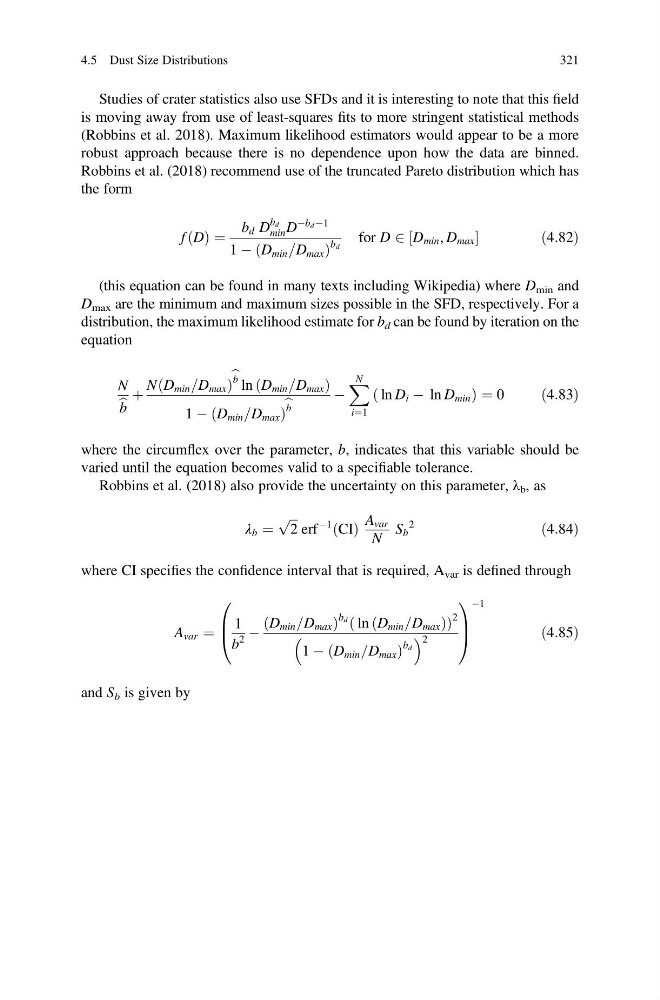
Studies of crater statistics also use SFDs and it is interesting to note that this field
is moving away from use of least-squares fits to more stringent statistical methods
(Robbins et al. 2018). Maximum likelihood estimators would appear to be a more
robust approach because there is no dependence upon how the data are binned.
Robbins et al. (2018) recommend use of the truncated Pareto distribution which has
the form
f D
ð Þ ¼
b d D
b d
min D
Àb d À1
1 À D min =D max
ð
Þ
b d
for D 2 D min , D max
½
ð 4:82Þ
(this equation can be found in many texts including Wikipedia) where D min and
D max are the minimum and maximum sizes possible in the SFD, respectively. For a
distribution, the maximum likelihood estimate for b d can be found by iteration on the
equation
N
b b
þ
N D min =D max
ð
Þ
b b ln D min =D max
ð
Þ
1 À D min =D max
ð
Þ
b b
À
X N
i¼1
ln D i À ln D min
ð
Þ ¼ 0
ð4:83Þ
where the circumflex over the parameter, b, indicates that this variable should be
varied until the equation becomes valid to a specifiable tolerance.
Robbins et al. (2018) also provide the uncertainty on this parameter, λ b , as
λ b ¼
ffiffi ffi
2
p
erf
À1 CI
ð Þ
A var
N
S b
2
ð4:84Þ
where CI specifies the confidence interval that is required, A var is defined through
A var ¼
1
b
2
À
D min =D max
ð
Þ
b d ln D min =D max
ð
Þ
ð
Þ
2
1 À D min =D max
ð
Þ
b d
2
0
B
@
1
C
A
À1
ð4:85Þ
and S b is given by
4.5 Dust Size Distributions
321
is moving away from use of least-squares fits to more stringent statistical methods
(Robbins et al. 2018). Maximum likelihood estimators would appear to be a more
robust approach because there is no dependence upon how the data are binned.
Robbins et al. (2018) recommend use of the truncated Pareto distribution which has
the form
f D
ð Þ ¼
b d D
b d
min D
Àb d À1
1 À D min =D max
ð
Þ
b d
for D 2 D min , D max
½
ð 4:82Þ
(this equation can be found in many texts including Wikipedia) where D min and
D max are the minimum and maximum sizes possible in the SFD, respectively. For a
distribution, the maximum likelihood estimate for b d can be found by iteration on the
equation
N
b b
þ
N D min =D max
ð
Þ
b b ln D min =D max
ð
Þ
1 À D min =D max
ð
Þ
b b
À
X N
i¼1
ln D i À ln D min
ð
Þ ¼ 0
ð4:83Þ
where the circumflex over the parameter, b, indicates that this variable should be
varied until the equation becomes valid to a specifiable tolerance.
Robbins et al. (2018) also provide the uncertainty on this parameter, λ b , as
λ b ¼
ffiffi ffi
2
p
erf
À1 CI
ð Þ
A var
N
S b
2
ð4:84Þ
where CI specifies the confidence interval that is required, A var is defined through
A var ¼
1
b
2
À
D min =D max
ð
Þ
b d ln D min =D max
ð
Þ
ð
Þ
2
1 À D min =D max
ð
Þ
b d
2
0
B
@
1
C
A
À1
ð4:85Þ
and S b is given by
4.5 Dust Size Distributions
321