

nightside dust brightness ratio of 3.2:1 was observed in this case. But how much of
that dust came directly from the nucleus when compared to the dust on reflected
trajectories? We can use the fountain model to indicate when this effect becomes
important.
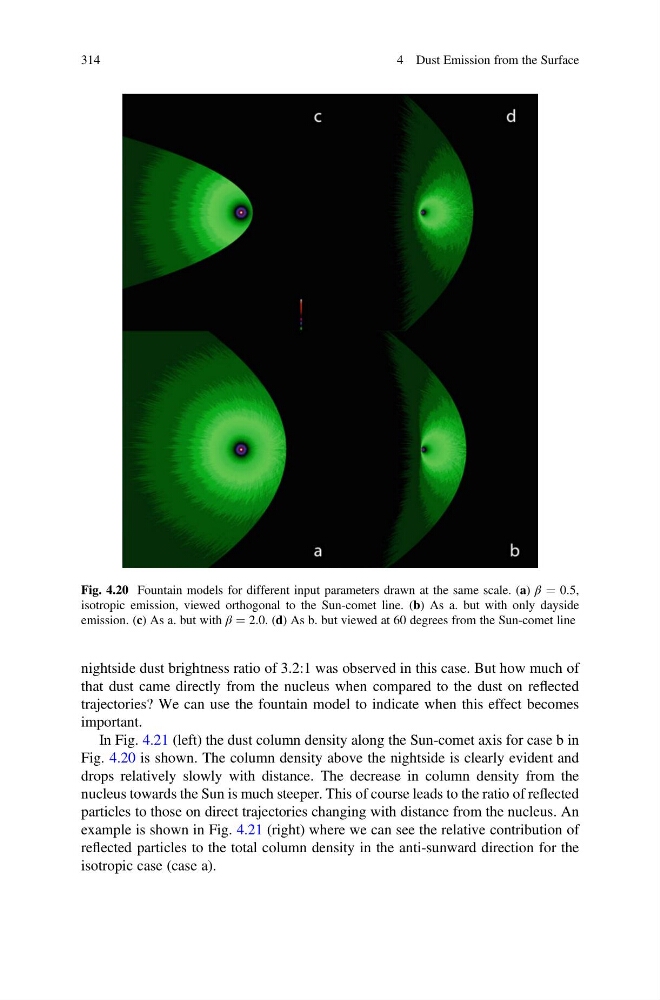
In Fig. 4.21 (left) the dust column density along the Sun-comet axis for case b in
Fig. 4.20 is shown. The column density above the nightside is clearly evident and
drops relatively slowly with distance. The decrease in column density from the
nucleus towards the Sun is much steeper. This of course leads to the ratio of reflected
particles to those on direct trajectories changing with distance from the nucleus. An
example is shown in Fig. 4.21 (right) where we can see the relative contribution of
reflected particles to the total column density in the anti-sunward direction for the
isotropic case (case a).
Fig. 4.20 Fountain models for different input parameters drawn at the same scale. (a) β ¼ 0.5,
isotropic emission, viewed orthogonal to the Sun-comet line. (b) As a. but with only dayside
emission. (c) As a. but with β ¼ 2.0. (d) As b. but viewed at 60 degrees from the Sun-comet line
314
4 Dust Emission from the Surface
that dust came directly from the nucleus when compared to the dust on reflected
trajectories? We can use the fountain model to indicate when this effect becomes
important.
In Fig. 4.21 (left) the dust column density along the Sun-comet axis for case b in
Fig. 4.20 is shown. The column density above the nightside is clearly evident and
drops relatively slowly with distance. The decrease in column density from the
nucleus towards the Sun is much steeper. This of course leads to the ratio of reflected
particles to those on direct trajectories changing with distance from the nucleus. An
example is shown in Fig. 4.21 (right) where we can see the relative contribution of
reflected particles to the total column density in the anti-sunward direction for the
isotropic case (case a).
Fig. 4.20 Fountain models for different input parameters drawn at the same scale. (a) β ¼ 0.5,
isotropic emission, viewed orthogonal to the Sun-comet line. (b) As a. but with only dayside
emission. (c) As a. but with β ¼ 2.0. (d) As b. but viewed at 60 degrees from the Sun-comet line
314
4 Dust Emission from the Surface