

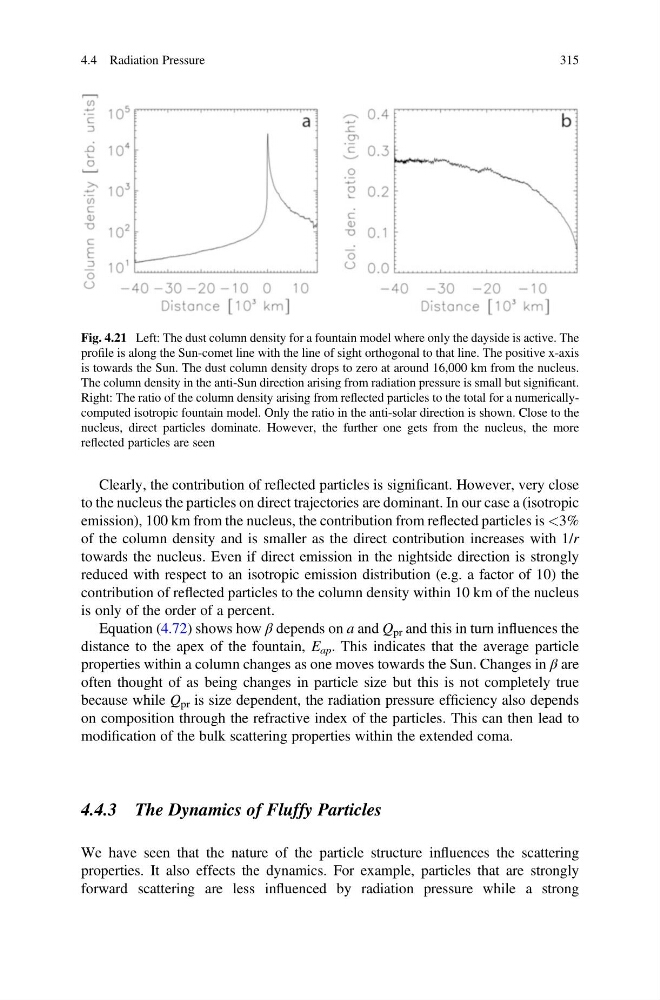
Clearly, the contribution of reflected particles is significant. However, very close
to the nucleus the particles on direct trajectories are dominant. In our case a (isotropic
emission), 100 km from the nucleus, the contribution from reflected particles is <3%
of the column density and is smaller as the direct contribution increases with 1/r
towards the nucleus. Even if direct emission in the nightside direction is strongly
reduced with respect to an isotropic emission distribution (e.g. a factor of 10) the
contribution of reflected particles to the column density within 10 km of the nucleus
is only of the order of a percent.
Equation (4.72) shows how β depends on a and Q pr and this in turn influences the
distance to the apex of the fountain, E ap . This indicates that the average particle
properties within a column changes as one moves towards the Sun. Changes in β are
often thought of as being changes in particle size but this is not completely true
because while Q pr is size dependent, the radiation pressure efficiency also depends
on composition through the refractive index of the particles. This can then lead to
modification of the bulk scattering properties within the extended coma.
4.4.3 The Dynamics of Fluffy Particles
We have seen that the nature of the particle structure influences the scattering
properties. It also effects the dynamics. For example, particles that are strongly
forward scattering are less influenced by radiation pressure while a strong
Fig. 4.21 Left: The dust column density for a fountain model where only the dayside is active. The
profile is along the Sun-comet line with the line of sight orthogonal to that line. The positive x-axis
is towards the Sun. The dust column density drops to zero at around 16,000 km from the nucleus.
The column density in the anti-Sun direction arising from radiation pressure is small but significant.
Right: The ratio of the column density arising from reflected particles to the total for a numericallycomputed isotropic fountain model. Only the ratio in the anti-solar direction is shown. Close to the
nucleus, direct particles dominate. However, the further one gets from the nucleus, the more
reflected particles are seen
4.4 Radiation Pressure
315
to the nucleus the particles on direct trajectories are dominant. In our case a (isotropic
emission), 100 km from the nucleus, the contribution from reflected particles is <3%
of the column density and is smaller as the direct contribution increases with 1/r
towards the nucleus. Even if direct emission in the nightside direction is strongly
reduced with respect to an isotropic emission distribution (e.g. a factor of 10) the
contribution of reflected particles to the column density within 10 km of the nucleus
is only of the order of a percent.
Equation (4.72) shows how β depends on a and Q pr and this in turn influences the
distance to the apex of the fountain, E ap . This indicates that the average particle
properties within a column changes as one moves towards the Sun. Changes in β are
often thought of as being changes in particle size but this is not completely true
because while Q pr is size dependent, the radiation pressure efficiency also depends
on composition through the refractive index of the particles. This can then lead to
modification of the bulk scattering properties within the extended coma.
4.4.3 The Dynamics of Fluffy Particles
We have seen that the nature of the particle structure influences the scattering
properties. It also effects the dynamics. For example, particles that are strongly
forward scattering are less influenced by radiation pressure while a strong
Fig. 4.21 Left: The dust column density for a fountain model where only the dayside is active. The
profile is along the Sun-comet line with the line of sight orthogonal to that line. The positive x-axis
is towards the Sun. The dust column density drops to zero at around 16,000 km from the nucleus.
The column density in the anti-Sun direction arising from radiation pressure is small but significant.
Right: The ratio of the column density arising from reflected particles to the total for a numericallycomputed isotropic fountain model. Only the ratio in the anti-solar direction is shown. Close to the
nucleus, direct particles dominate. However, the further one gets from the nucleus, the more
reflected particles are seen
4.4 Radiation Pressure
315