

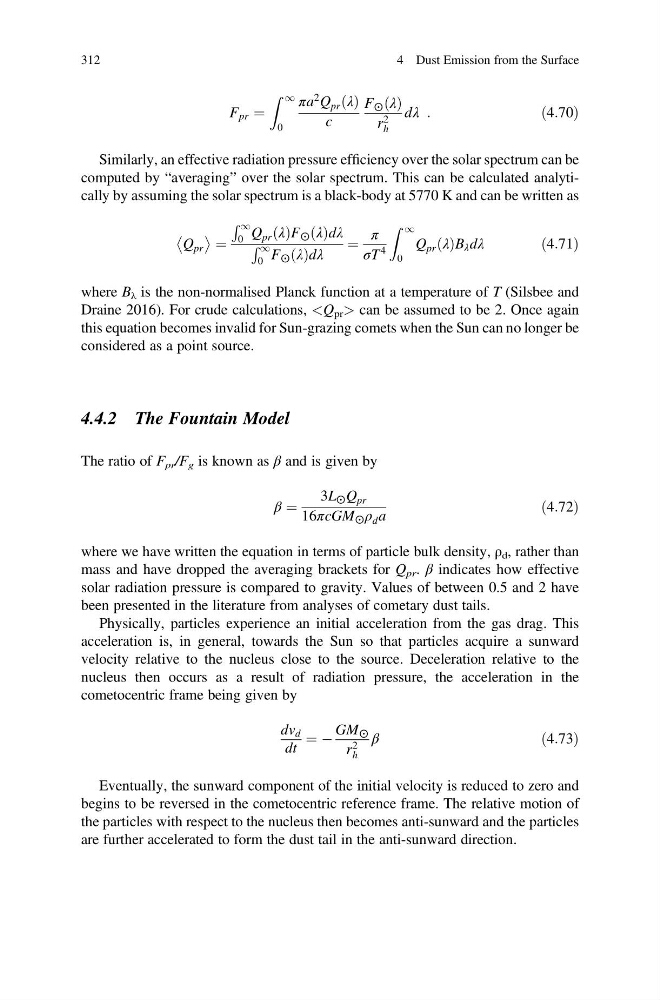
F pr ¼
Z 1
0
πa
2 Q pr λ
ð Þ
c
F ⨀ λ
ð Þ
r 2
h
dλ :
ð4:70Þ
Similarly, an effective radiation pressure efficiency over the solar spectrum can be
computed by “averaging” over the solar spectrum. This can be calculated analytically by assuming the solar spectrum is a black-body at 5770 K and can be written as
Q pr
¼
R 1
0 Q pr λ
ð ÞF ⨀ λ
ð Þdλ
R 1
0 F ⨀ λ
ð Þdλ
¼
π
σT
4
Z 1
0
Q pr λ
ð ÞB λ dλ
ð4:71Þ
where B λ is the non-normalised Planck function at a temperature of T (Silsbee and
Draine 2016). For crude calculations,
Z 1
0
πa
2 Q pr λ
ð Þ
c
F ⨀ λ
ð Þ
r 2
h
dλ :
ð4:70Þ
Similarly, an effective radiation pressure efficiency over the solar spectrum can be
computed by “averaging” over the solar spectrum. This can be calculated analytically by assuming the solar spectrum is a black-body at 5770 K and can be written as
Q pr
¼
R 1
0 Q pr λ
ð ÞF ⨀ λ
ð Þdλ
R 1
0 F ⨀ λ
ð Þdλ
¼
π
σT
4
Z 1
0
Q pr λ
ð ÞB λ dλ
ð4:71Þ
where B λ is the non-normalised Planck function at a temperature of T (Silsbee and
Draine 2016). For crude calculations,
can be assumed to be 2. Once again
this equation becomes invalid for Sun-grazing comets when the Sun can no longer be
considered as a point source.
4.4.2 The Fountain Model
The ratio of F pr /F g is known as β and is given by
β ¼
3L ⨀ Q pr
16πcGM ⨀ ρ d a
ð4:72Þ
where we have written the equation in terms of particle bulk density, ρ d , rather than
mass and have dropped the averaging brackets for Q pr . β indicates how effective
solar radiation pressure is compared to gravity. Values of between 0.5 and 2 have
been presented in the literature from analyses of cometary dust tails.
Physically, particles experience an initial acceleration from the gas drag. This
acceleration is, in general, towards the Sun so that particles acquire a sunward
velocity relative to the nucleus close to the source. Deceleration relative to the
nucleus then occurs as a result of radiation pressure, the acceleration in the
cometocentric frame being given by
dv d
dt
¼ À
GM ⨀
r 2
h
β
ð4:73Þ
Eventually, the sunward component of the initial velocity is reduced to zero and
begins to be reversed in the cometocentric reference frame. The relative motion of
the particles with respect to the nucleus then becomes anti-sunward and the particles
are further accelerated to form the dust tail in the anti-sunward direction.
312
4 Dust Emission from the Surface