

4.4.1 Radiation Pressure Efficiency
After the dust has de-coupled from the gas, the equation of motion needs to include
more slowly acting forces such as solar gravity and solar radiation pressure. The
gravitational force can be described in its simplest form as
F g ¼
GM ⨀ m d
r 2
h
ð4:65Þ
where GM ⨀ is the geopotential of the Sun and m d is the particle mass. It should be
noted that the Newtonian approximation for studies of dust particle motion will
break down close to the Sun in, for example, investigations of the outgassing of the
Kreutz family comets.
The dust particle mass can be expressed in terms of its radius under the assumption of spherical particles according to the trivial equation
m d ¼
4
3
πa
3
ρ a
ð4:66Þ
where ρ a is the particle bulk density. Solar radiation pressure is an opposing force
and, by use of de Broglie’s hypothesis in combination with the solar flux and
assuming spherical particles, we can obtain
F pr ¼
πa
2 L ⨀ Q pr
4πr 2
h c
ð4:67Þ
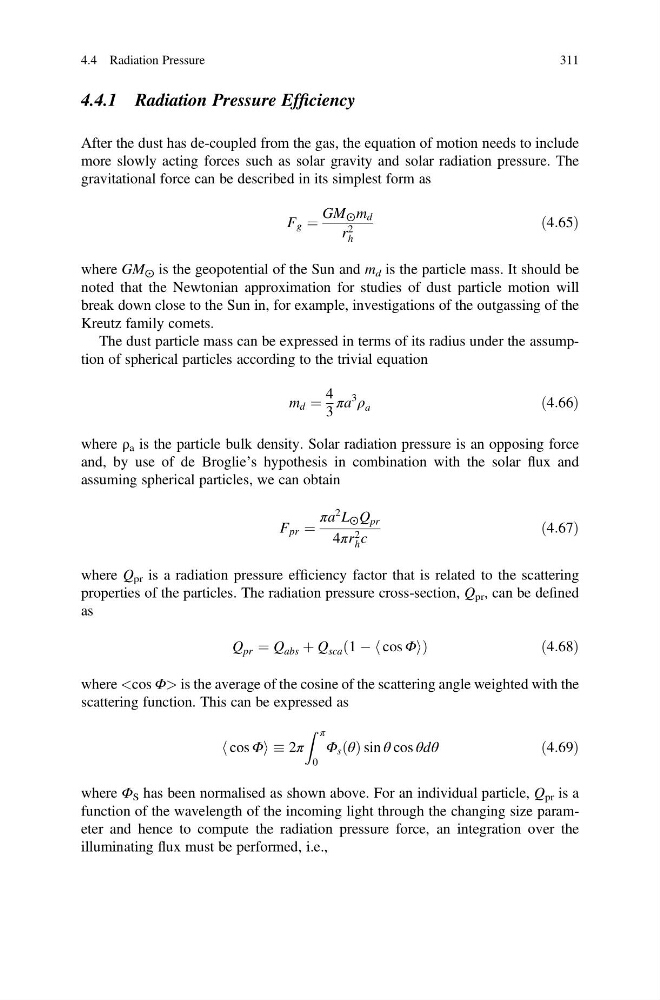
where Q pr is a radiation pressure efficiency factor that is related to the scattering
properties of the particles. The radiation pressure cross-section, Q pr , can be defined
as
Q pr ¼ Q abs þ Q sca 1 À cos Φ
h
i
ð
Þ
ð 4:68Þ
where is the average of the cosine of the scattering angle weighted with the
scattering function. This can be expressed as
cos Φ
h
i 2π
Z π
0
Φ s θ
ð Þ sin θ cos θdθ
ð4:69Þ
where Φ S has been normalised as shown above. For an individual particle, Q pr is a
function of the wavelength of the incoming light through the changing size parameter and hence to compute the radiation pressure force, an integration over the
illuminating flux must be performed, i.e.,
4.4 Radiation Pressure
311
After the dust has de-coupled from the gas, the equation of motion needs to include
more slowly acting forces such as solar gravity and solar radiation pressure. The
gravitational force can be described in its simplest form as
F g ¼
GM ⨀ m d
r 2
h
ð4:65Þ
where GM ⨀ is the geopotential of the Sun and m d is the particle mass. It should be
noted that the Newtonian approximation for studies of dust particle motion will
break down close to the Sun in, for example, investigations of the outgassing of the
Kreutz family comets.
The dust particle mass can be expressed in terms of its radius under the assumption of spherical particles according to the trivial equation
m d ¼
4
3
πa
3
ρ a
ð4:66Þ
where ρ a is the particle bulk density. Solar radiation pressure is an opposing force
and, by use of de Broglie’s hypothesis in combination with the solar flux and
assuming spherical particles, we can obtain
F pr ¼
πa
2 L ⨀ Q pr
4πr 2
h c
ð4:67Þ
where Q pr is a radiation pressure efficiency factor that is related to the scattering
properties of the particles. The radiation pressure cross-section, Q pr , can be defined
as
Q pr ¼ Q abs þ Q sca 1 À cos Φ
h
i
ð
Þ
ð 4:68Þ
where
scattering function. This can be expressed as
cos Φ
h
i 2π
Z π
0
Φ s θ
ð Þ sin θ cos θdθ
ð4:69Þ
where Φ S has been normalised as shown above. For an individual particle, Q pr is a
function of the wavelength of the incoming light through the changing size parameter and hence to compute the radiation pressure force, an integration over the
illuminating flux must be performed, i.e.,
4.4 Radiation Pressure
311