

angle of 90
using one of the phase functions determined by Bertini et al. (2017).
The phase function is a critical component of A in the equation for Afρ and
comparisons between ground-based observations require careful consideration of
this, especially at low scattering angles. Figure 4.18 shows that the lag in the
production rate of 67P relative to perihelion seen in the gas (Figs. 1.18 and 3.48)
is also evident in the dust. The maximum here is about 20 days after perihelion.
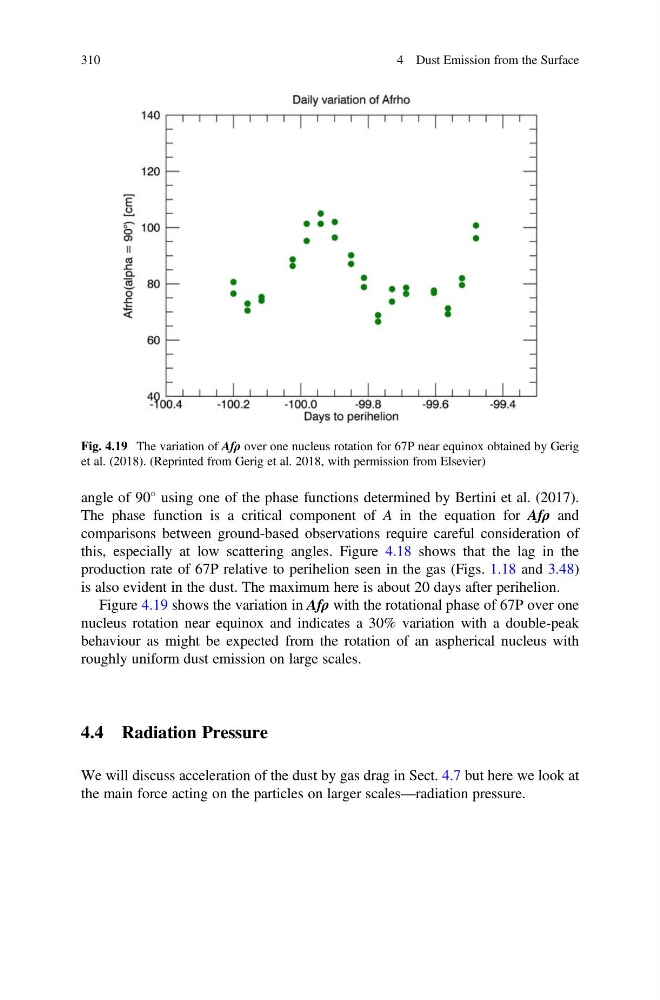
Figure 4.19 shows the variation in Afρ with the rotational phase of 67P over one
nucleus rotation near equinox and indicates a 30% variation with a double-peak
behaviour as might be expected from the rotation of an aspherical nucleus with
roughly uniform dust emission on large scales.
4.4 Radiation Pressure
We will discuss acceleration of the dust by gas drag in Sect. 4.7 but here we look at
the main force acting on the particles on larger scales—radiation pressure.
Fig. 4.19 The variation of Afρ over one nucleus rotation for 67P near equinox obtained by Gerig
et al. (2018). (Reprinted from Gerig et al. 2018, with permission from Elsevier)
310
4 Dust Emission from the Surface
using one of the phase functions determined by Bertini et al. (2017).
The phase function is a critical component of A in the equation for Afρ and
comparisons between ground-based observations require careful consideration of
this, especially at low scattering angles. Figure 4.18 shows that the lag in the
production rate of 67P relative to perihelion seen in the gas (Figs. 1.18 and 3.48)
is also evident in the dust. The maximum here is about 20 days after perihelion.
Figure 4.19 shows the variation in Afρ with the rotational phase of 67P over one
nucleus rotation near equinox and indicates a 30% variation with a double-peak
behaviour as might be expected from the rotation of an aspherical nucleus with
roughly uniform dust emission on large scales.
4.4 Radiation Pressure
We will discuss acceleration of the dust by gas drag in Sect. 4.7 but here we look at
the main force acting on the particles on larger scales—radiation pressure.
Fig. 4.19 The variation of Afρ over one nucleus rotation for 67P near equinox obtained by Gerig
et al. (2018). (Reprinted from Gerig et al. 2018, with permission from Elsevier)
310
4 Dust Emission from the Surface