

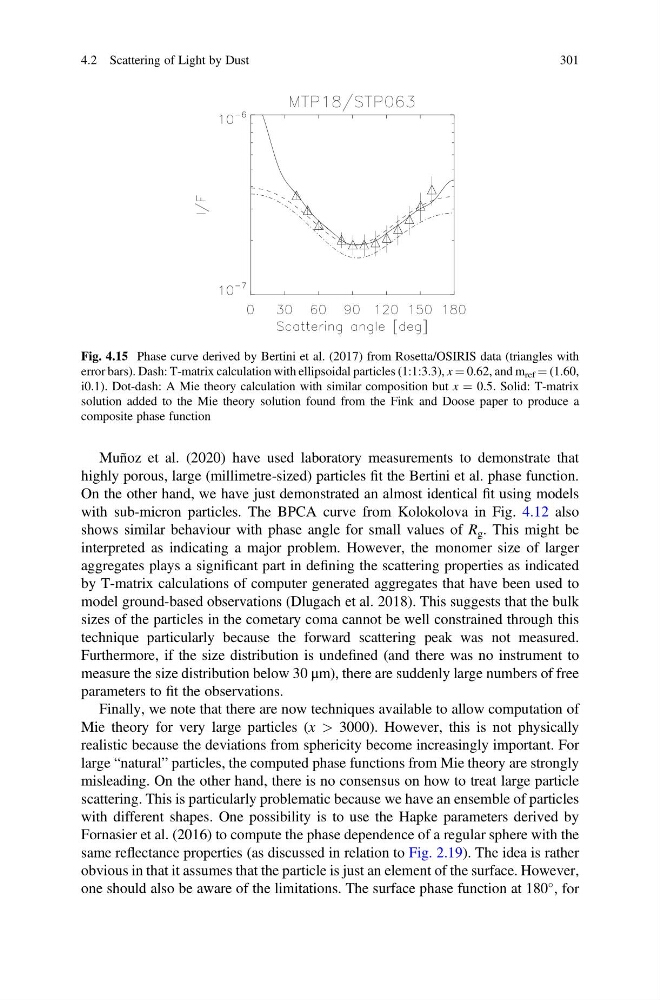
Muñoz et al. (2020) have used laboratory measurements to demonstrate that
highly porous, large (millimetre-sized) particles fit the Bertini et al. phase function.
On the other hand, we have just demonstrated an almost identical fit using models
with sub-micron particles. The BPCA curve from Kolokolova in Fig. 4.12 also
shows similar behaviour with phase angle for small values of R g . This might be
interpreted as indicating a major problem. However, the monomer size of larger
aggregates plays a significant part in defining the scattering properties as indicated
by T-matrix calculations of computer generated aggregates that have been used to
model ground-based observations (Dlugach et al. 2018). This suggests that the bulk
sizes of the particles in the cometary coma cannot be well constrained through this
technique particularly because the forward scattering peak was not measured.
Furthermore, if the size distribution is undefined (and there was no instrument to
measure the size distribution below 30 μm), there are suddenly large numbers of free
parameters to fit the observations.
Finally, we note that there are now techniques available to allow computation of
Mie theory for very large particles (x > 3000). However, this is not physically
realistic because the deviations from sphericity become increasingly important. For
large “natural” particles, the computed phase functions from Mie theory are strongly
misleading. On the other hand, there is no consensus on how to treat large particle
scattering. This is particularly problematic because we have an ensemble of particles
with different shapes. One possibility is to use the Hapke parameters derived by
Fornasier et al. (2016) to compute the phase dependence of a regular sphere with the
same reflectance properties (as discussed in relation to Fig. 2.19). The idea is rather
obvious in that it assumes that the particle is just an element of the surface. However,
one should also be aware of the limitations. The surface phase function at 180
, for
Fig. 4.15 Phase curve derived by Bertini et al. (2017) from Rosetta/OSIRIS data (triangles with
error bars). Dash: T-matrix calculation with ellipsoidal particles (1:1:3.3), x ¼ 0.62, and m ref ¼ (1.60,
i0.1). Dot-dash: A Mie theory calculation with similar composition but x ¼ 0.5. Solid: T-matrix
solution added to the Mie theory solution found from the Fink and Doose paper to produce a
composite phase function
4.2 Scattering of Light by Dust
301
highly porous, large (millimetre-sized) particles fit the Bertini et al. phase function.
On the other hand, we have just demonstrated an almost identical fit using models
with sub-micron particles. The BPCA curve from Kolokolova in Fig. 4.12 also
shows similar behaviour with phase angle for small values of R g . This might be
interpreted as indicating a major problem. However, the monomer size of larger
aggregates plays a significant part in defining the scattering properties as indicated
by T-matrix calculations of computer generated aggregates that have been used to
model ground-based observations (Dlugach et al. 2018). This suggests that the bulk
sizes of the particles in the cometary coma cannot be well constrained through this
technique particularly because the forward scattering peak was not measured.
Furthermore, if the size distribution is undefined (and there was no instrument to
measure the size distribution below 30 μm), there are suddenly large numbers of free
parameters to fit the observations.
Finally, we note that there are now techniques available to allow computation of
Mie theory for very large particles (x > 3000). However, this is not physically
realistic because the deviations from sphericity become increasingly important. For
large “natural” particles, the computed phase functions from Mie theory are strongly
misleading. On the other hand, there is no consensus on how to treat large particle
scattering. This is particularly problematic because we have an ensemble of particles
with different shapes. One possibility is to use the Hapke parameters derived by
Fornasier et al. (2016) to compute the phase dependence of a regular sphere with the
same reflectance properties (as discussed in relation to Fig. 2.19). The idea is rather
obvious in that it assumes that the particle is just an element of the surface. However,
one should also be aware of the limitations. The surface phase function at 180
, for
Fig. 4.15 Phase curve derived by Bertini et al. (2017) from Rosetta/OSIRIS data (triangles with
error bars). Dash: T-matrix calculation with ellipsoidal particles (1:1:3.3), x ¼ 0.62, and m ref ¼ (1.60,
i0.1). Dot-dash: A Mie theory calculation with similar composition but x ¼ 0.5. Solid: T-matrix
solution added to the Mie theory solution found from the Fink and Doose paper to produce a
composite phase function
4.2 Scattering of Light by Dust
301