

example, is zero and large particles certainly do have non-zero forward scattering.
Hence, this “phase function” is potentially unreliable at high phase (low scattering)
angles. The particle shape also influences the backscattering. On the other hand, if
one can make this assumption, conversion of column densities to brightnesses
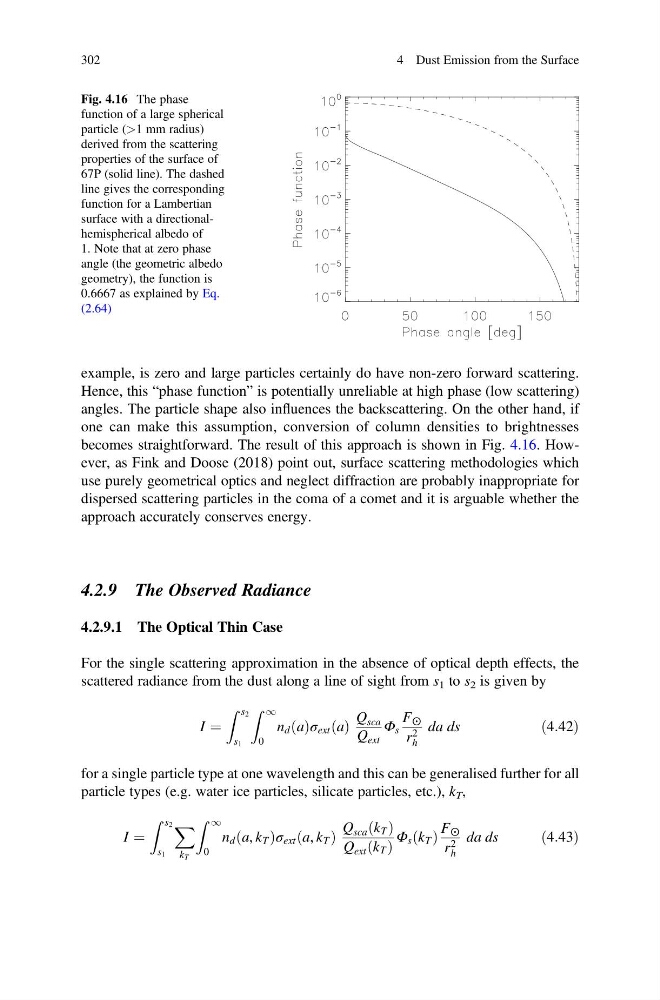
becomes straightforward. The result of this approach is shown in Fig. 4.16. However, as Fink and Doose (2018) point out, surface scattering methodologies which
use purely geometrical optics and neglect diffraction are probably inappropriate for
dispersed scattering particles in the coma of a comet and it is arguable whether the
approach accurately conserves energy.
4.2.9 The Observed Radiance
4.2.9.1 The Optical Thin Case
For the single scattering approximation in the absence of optical depth effects, the
scattered radiance from the dust along a line of sight from s 1 to s 2 is given by
I ¼
Z s 2
s 1
Z 1
0
n d a
ð Þσ ext a
ð Þ
Q sca
Q ext
Φ s
F ⨀
r 2
h
da ds
ð4:42Þ
for a single particle type at one wavelength and this can be generalised further for all
particle types (e.g. water ice particles, silicate particles, etc.), k T ,
I ¼
Z s 2
s 1
X
k T
Z 1
0
n d a, k T
ð
Þσ ext a, k T
ð
Þ
Q sca k T
ð Þ
Q ext k T
ð Þ
Φ s k T
ð Þ
F ⨀
r 2
h
da ds
ð4:43Þ
Fig. 4.16 The phase
function of a large spherical
particle (>1 mm radius)
derived from the scattering
properties of the surface of
67P (solid line). The dashed
line gives the corresponding
function for a Lambertian
surface with a directionalhemispherical albedo of
1. Note that at zero phase
angle (the geometric albedo
geometry), the function is
0.6667 as explained by Eq.
(2.64)
302
4 Dust Emission from the Surface
Hence, this “phase function” is potentially unreliable at high phase (low scattering)
angles. The particle shape also influences the backscattering. On the other hand, if
one can make this assumption, conversion of column densities to brightnesses
becomes straightforward. The result of this approach is shown in Fig. 4.16. However, as Fink and Doose (2018) point out, surface scattering methodologies which
use purely geometrical optics and neglect diffraction are probably inappropriate for
dispersed scattering particles in the coma of a comet and it is arguable whether the
approach accurately conserves energy.
4.2.9 The Observed Radiance
4.2.9.1 The Optical Thin Case
For the single scattering approximation in the absence of optical depth effects, the
scattered radiance from the dust along a line of sight from s 1 to s 2 is given by
I ¼
Z s 2
s 1
Z 1
0
n d a
ð Þσ ext a
ð Þ
Q sca
Q ext
Φ s
F ⨀
r 2
h
da ds
ð4:42Þ
for a single particle type at one wavelength and this can be generalised further for all
particle types (e.g. water ice particles, silicate particles, etc.), k T ,
I ¼
Z s 2
s 1
X
k T
Z 1
0
n d a, k T
ð
Þσ ext a, k T
ð
Þ
Q sca k T
ð Þ
Q ext k T
ð Þ
Φ s k T
ð Þ
F ⨀
r 2
h
da ds
ð4:43Þ
Fig. 4.16 The phase
function of a large spherical
particle (>1 mm radius)
derived from the scattering
properties of the surface of
67P (solid line). The dashed
line gives the corresponding
function for a Lambertian
surface with a directionalhemispherical albedo of
1. Note that at zero phase
angle (the geometric albedo
geometry), the function is
0.6667 as explained by Eq.
(2.64)
302
4 Dust Emission from the Surface