

chain-like properties. Nanometre-scale analysis by Mannel et al. (2019) resulted in
the description of three types of particles
• ~1 μm sized particles with surface features at the 100 nm scale
• larger ~10 μm agglomerates with 1 μm subunits in a fragile arrangement with
moderate packing density
• other ~10 μm agglomerates with chain-like (D f < 2) properties.
MIDAS data do not show evidence for solid particles but this could have been
caused by instrumental biases.
4.2.7 The Discrete Dipole Approximation
The properties of the BPCA and BCCA particles were computed using the T-matrix
method. Another well-known method to compute the scattering behaviour of complex particle shapes is the discrete dipole approximation (DDA). DDA (Draine 1988;
Draine and Flatau 2012) addresses the deficiencies of Mie theory but at the cost of
greater computational time. It was first proposed by Purcell and Pennypacker (1973)
and approximates individual dust particles as a combination of dipoles. Maxwell’s
equations are then solved precisely to obtain the scattering function.
The approach has many advantages over Mie Theory. Dust particles can be
accurately modelled through the particle construction procedures outlined above
and run through the DDA algorithm. One thereby obtains an accurate result even for
complex particles. Thus the spherical assumption of Mie theory is removed and
particles of mixed composition can also be addressed.
The applicability is only limited by the need to have a separation between the
dipoles, d sep , that is small compared to both the size of the particle and the size of the
wavelength being considered. The applicability with respect to wavelength can be
tested using the criterion |m ref |k N d sep < 0.5. On the other hand, the limit of its
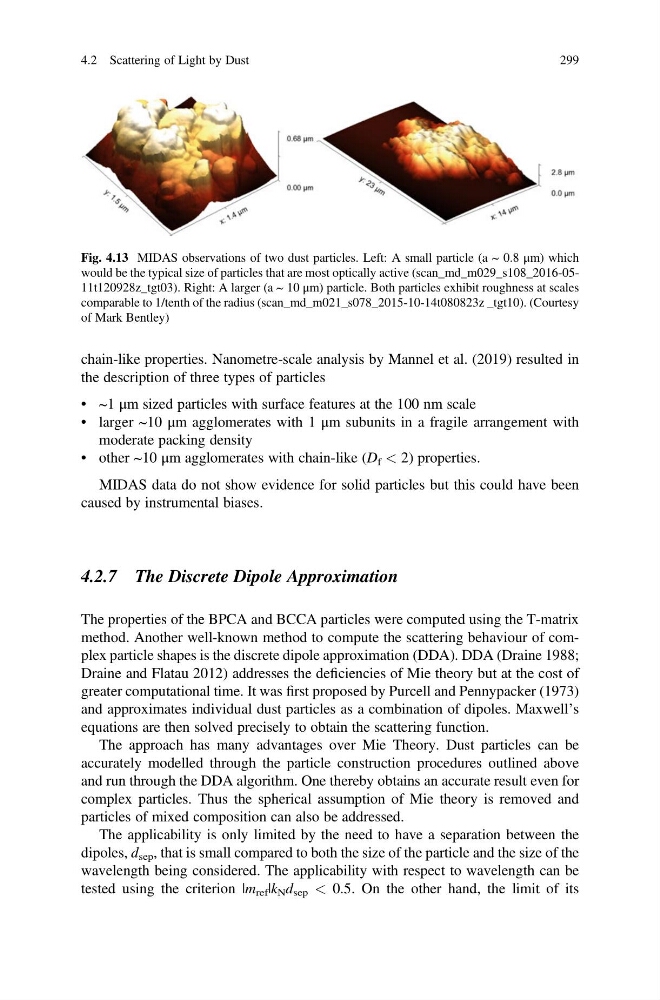
Fig. 4.13 MIDAS observations of two dust particles. Left: A small particle (a ~ 0.8 μm) which
would be the typical size of particles that are most optically active (scan_md_m029_s108_2016-0511t120928z_tgt03). Right: A larger (a ~ 10 μm) particle. Both particles exhibit roughness at scales
comparable to 1/tenth of the radius (scan_md_m021_s078_2015-10-14t080823z _tgt10). (Courtesy
of Mark Bentley)
4.2 Scattering of Light by Dust
299
the description of three types of particles
• ~1 μm sized particles with surface features at the 100 nm scale
• larger ~10 μm agglomerates with 1 μm subunits in a fragile arrangement with
moderate packing density
• other ~10 μm agglomerates with chain-like (D f < 2) properties.
MIDAS data do not show evidence for solid particles but this could have been
caused by instrumental biases.
4.2.7 The Discrete Dipole Approximation
The properties of the BPCA and BCCA particles were computed using the T-matrix
method. Another well-known method to compute the scattering behaviour of complex particle shapes is the discrete dipole approximation (DDA). DDA (Draine 1988;
Draine and Flatau 2012) addresses the deficiencies of Mie theory but at the cost of
greater computational time. It was first proposed by Purcell and Pennypacker (1973)
and approximates individual dust particles as a combination of dipoles. Maxwell’s
equations are then solved precisely to obtain the scattering function.
The approach has many advantages over Mie Theory. Dust particles can be
accurately modelled through the particle construction procedures outlined above
and run through the DDA algorithm. One thereby obtains an accurate result even for
complex particles. Thus the spherical assumption of Mie theory is removed and
particles of mixed composition can also be addressed.
The applicability is only limited by the need to have a separation between the
dipoles, d sep , that is small compared to both the size of the particle and the size of the
wavelength being considered. The applicability with respect to wavelength can be
tested using the criterion |m ref |k N d sep < 0.5. On the other hand, the limit of its
Fig. 4.13 MIDAS observations of two dust particles. Left: A small particle (a ~ 0.8 μm) which
would be the typical size of particles that are most optically active (scan_md_m029_s108_2016-0511t120928z_tgt03). Right: A larger (a ~ 10 μm) particle. Both particles exhibit roughness at scales
comparable to 1/tenth of the radius (scan_md_m021_s078_2015-10-14t080823z _tgt10). (Courtesy
of Mark Bentley)
4.2 Scattering of Light by Dust
299