

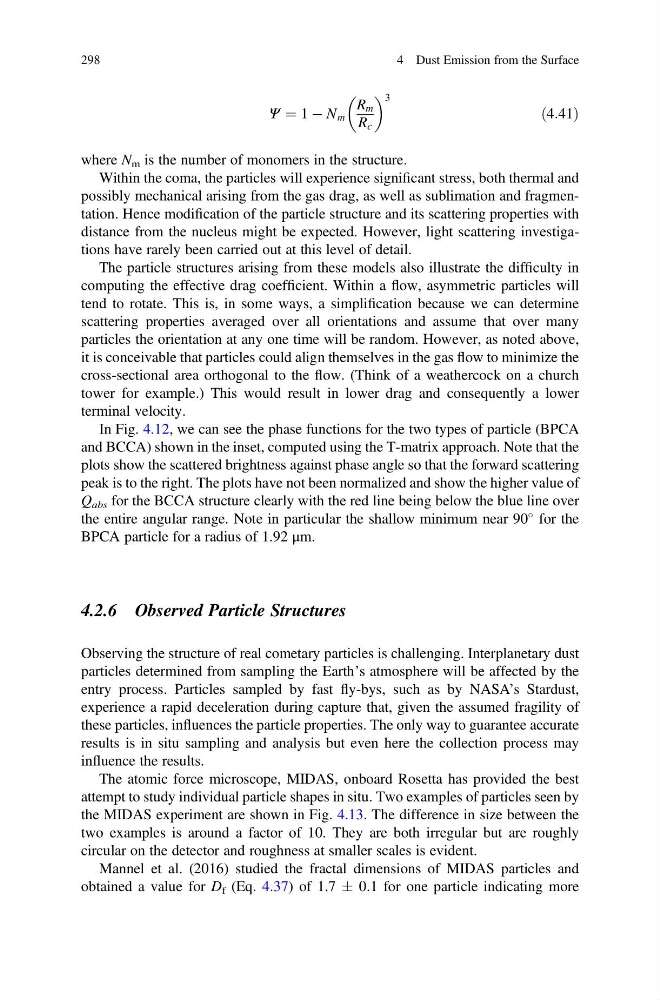
Ψ ¼ 1 À N m
R m
R c
3
ð4:41Þ
where N m is the number of monomers in the structure.
Within the coma, the particles will experience significant stress, both thermal and
possibly mechanical arising from the gas drag, as well as sublimation and fragmentation. Hence modification of the particle structure and its scattering properties with
distance from the nucleus might be expected. However, light scattering investigations have rarely been carried out at this level of detail.
The particle structures arising from these models also illustrate the difficulty in
computing the effective drag coefficient. Within a flow, asymmetric particles will
tend to rotate. This is, in some ways, a simplification because we can determine
scattering properties averaged over all orientations and assume that over many
particles the orientation at any one time will be random. However, as noted above,
it is conceivable that particles could align themselves in the gas flow to minimize the
cross-sectional area orthogonal to the flow. (Think of a weathercock on a church
tower for example.) This would result in lower drag and consequently a lower
terminal velocity.
In Fig. 4.12, we can see the phase functions for the two types of particle (BPCA
and BCCA) shown in the inset, computed using the T-matrix approach. Note that the
plots show the scattered brightness against phase angle so that the forward scattering
peak is to the right. The plots have not been normalized and show the higher value of
Q abs for the BCCA structure clearly with the red line being below the blue line over
the entire angular range. Note in particular the shallow minimum near 90
for the
BPCA particle for a radius of 1.92 μm.
4.2.6 Observed Particle Structures
Observing the structure of real cometary particles is challenging. Interplanetary dust
particles determined from sampling the Earth’s atmosphere will be affected by the
entry process. Particles sampled by fast fly-bys, such as by NASA’s Stardust,
experience a rapid deceleration during capture that, given the assumed fragility of
these particles, influences the particle properties. The only way to guarantee accurate
results is in situ sampling and analysis but even here the collection process may
influence the results.
The atomic force microscope, MIDAS, onboard Rosetta has provided the best
attempt to study individual particle shapes in situ. Two examples of particles seen by
the MIDAS experiment are shown in Fig. 4.13. The difference in size between the
two examples is around a factor of 10. They are both irregular but are roughly
circular on the detector and roughness at smaller scales is evident.
Mannel et al. (2016) studied the fractal dimensions of MIDAS particles and
obtained a value for D f (Eq. 4.37) of 1.7 Æ 0.1 for one particle indicating more
298
4 Dust Emission from the Surface
R m
R c
3
ð4:41Þ
where N m is the number of monomers in the structure.
Within the coma, the particles will experience significant stress, both thermal and
possibly mechanical arising from the gas drag, as well as sublimation and fragmentation. Hence modification of the particle structure and its scattering properties with
distance from the nucleus might be expected. However, light scattering investigations have rarely been carried out at this level of detail.
The particle structures arising from these models also illustrate the difficulty in
computing the effective drag coefficient. Within a flow, asymmetric particles will
tend to rotate. This is, in some ways, a simplification because we can determine
scattering properties averaged over all orientations and assume that over many
particles the orientation at any one time will be random. However, as noted above,
it is conceivable that particles could align themselves in the gas flow to minimize the
cross-sectional area orthogonal to the flow. (Think of a weathercock on a church
tower for example.) This would result in lower drag and consequently a lower
terminal velocity.
In Fig. 4.12, we can see the phase functions for the two types of particle (BPCA
and BCCA) shown in the inset, computed using the T-matrix approach. Note that the
plots show the scattered brightness against phase angle so that the forward scattering
peak is to the right. The plots have not been normalized and show the higher value of
Q abs for the BCCA structure clearly with the red line being below the blue line over
the entire angular range. Note in particular the shallow minimum near 90
for the
BPCA particle for a radius of 1.92 μm.
4.2.6 Observed Particle Structures
Observing the structure of real cometary particles is challenging. Interplanetary dust
particles determined from sampling the Earth’s atmosphere will be affected by the
entry process. Particles sampled by fast fly-bys, such as by NASA’s Stardust,
experience a rapid deceleration during capture that, given the assumed fragility of
these particles, influences the particle properties. The only way to guarantee accurate
results is in situ sampling and analysis but even here the collection process may
influence the results.
The atomic force microscope, MIDAS, onboard Rosetta has provided the best
attempt to study individual particle shapes in situ. Two examples of particles seen by
the MIDAS experiment are shown in Fig. 4.13. The difference in size between the
two examples is around a factor of 10. They are both irregular but are roughly
circular on the detector and roughness at smaller scales is evident.
Mannel et al. (2016) studied the fractal dimensions of MIDAS particles and
obtained a value for D f (Eq. 4.37) of 1.7 Æ 0.1 for one particle indicating more
298
4 Dust Emission from the Surface