

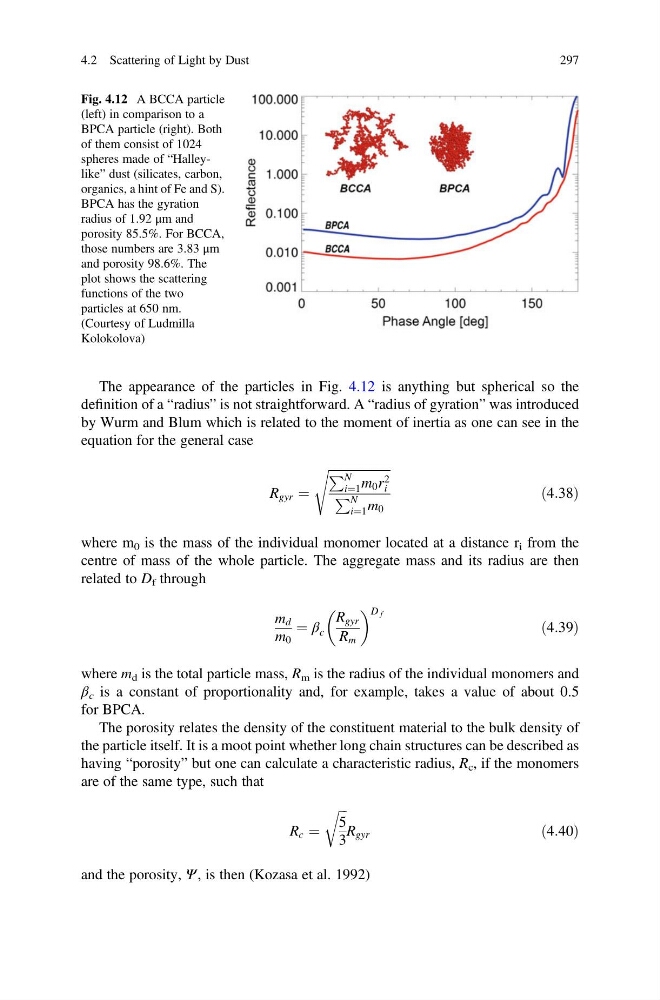
The appearance of the particles in Fig. 4.12 is anything but spherical so the
definition of a “radius” is not straightforward. A “radius of gyration” was introduced
by Wurm and Blum which is related to the moment of inertia as one can see in the
equation for the general case
R gyr ¼
ffiffiffiffiffiffiffiffiffiffiffiffiffiffiffiffiffiffiffiffi
P N
i¼1 m 0 r 2
i
P N
i¼1 m 0
s
ð4:38Þ
where m 0 is the mass of the individual monomer located at a distance r i from the
centre of mass of the whole particle. The aggregate mass and its radius are then
related to D f through
m d
m 0
¼ β c
R gyr
R m
D f
ð4:39Þ
where m d is the total particle mass, R m is the radius of the individual monomers and
β c is a constant of proportionality and, for example, takes a value of about 0.5
for BPCA.
The porosity relates the density of the constituent material to the bulk density of
the particle itself. It is a moot point whether long chain structures can be described as
having “porosity” but one can calculate a characteristic radius, R c , if the monomers
are of the same type, such that
R c ¼
ffiffi ffi
5
3
r
R gyr
ð4:40Þ
and the porosity, Ψ , is then (Kozasa et al. 1992)
Fig. 4.12 A BCCA particle
(left) in comparison to a
BPCA particle (right). Both
of them consist of 1024
spheres made of “Halleylike” dust (silicates, carbon,
organics, a hint of Fe and S).
BPCA has the gyration
radius of 1.92 μm and
porosity 85.5%. For BCCA,
those numbers are 3.83 μm
and porosity 98.6%. The
plot shows the scattering
functions of the two
particles at 650 nm.
(Courtesy of Ludmilla
Kolokolova)
4.2 Scattering of Light by Dust
297
definition of a “radius” is not straightforward. A “radius of gyration” was introduced
by Wurm and Blum which is related to the moment of inertia as one can see in the
equation for the general case
R gyr ¼
ffiffiffiffiffiffiffiffiffiffiffiffiffiffiffiffiffiffiffiffi
P N
i¼1 m 0 r 2
i
P N
i¼1 m 0
s
ð4:38Þ
where m 0 is the mass of the individual monomer located at a distance r i from the
centre of mass of the whole particle. The aggregate mass and its radius are then
related to D f through
m d
m 0
¼ β c
R gyr
R m
D f
ð4:39Þ
where m d is the total particle mass, R m is the radius of the individual monomers and
β c is a constant of proportionality and, for example, takes a value of about 0.5
for BPCA.
The porosity relates the density of the constituent material to the bulk density of
the particle itself. It is a moot point whether long chain structures can be described as
having “porosity” but one can calculate a characteristic radius, R c , if the monomers
are of the same type, such that
R c ¼
ffiffi ffi
5
3
r
R gyr
ð4:40Þ
and the porosity, Ψ , is then (Kozasa et al. 1992)
Fig. 4.12 A BCCA particle
(left) in comparison to a
BPCA particle (right). Both
of them consist of 1024
spheres made of “Halleylike” dust (silicates, carbon,
organics, a hint of Fe and S).
BPCA has the gyration
radius of 1.92 μm and
porosity 85.5%. For BCCA,
those numbers are 3.83 μm
and porosity 98.6%. The
plot shows the scattering
functions of the two
particles at 650 nm.
(Courtesy of Ludmilla
Kolokolova)
4.2 Scattering of Light by Dust
297